Winning construction bids in 2026 requires a smarter, more precise approach. With razor-thin profit margins (2–3%) and an average win rate of just 10–15%, contractors face tough competition. Here’s what you need to know:
- Focus on the right projects: Use construction estimating guides and a Bid/No-Bid framework to prioritize high-potential opportunities and avoid wasting time on low-value bids.
- Track performance: Monitor your bid-hit ratio to identify strengths and refine your strategy. A small improvement in your win rate can significantly boost profits.
- Leverage technology: Digital tools like ScopeTakeoff can reduce manual errors, speed up estimating by 60%, and improve bid accuracy by 23–35%.
- Tailor proposals: Personalize bids to address client needs, highlight solutions, and ensure clear, professional presentation.
Construction Bid Win Rate Statistics and Impact Analysis 2026
Construction Bidding Process 2026: Where to Find Projects, How to Qualify Opportunities, and…
sbb-itb-4ee4ad4
Build a Bid/No-Bid Decision Framework
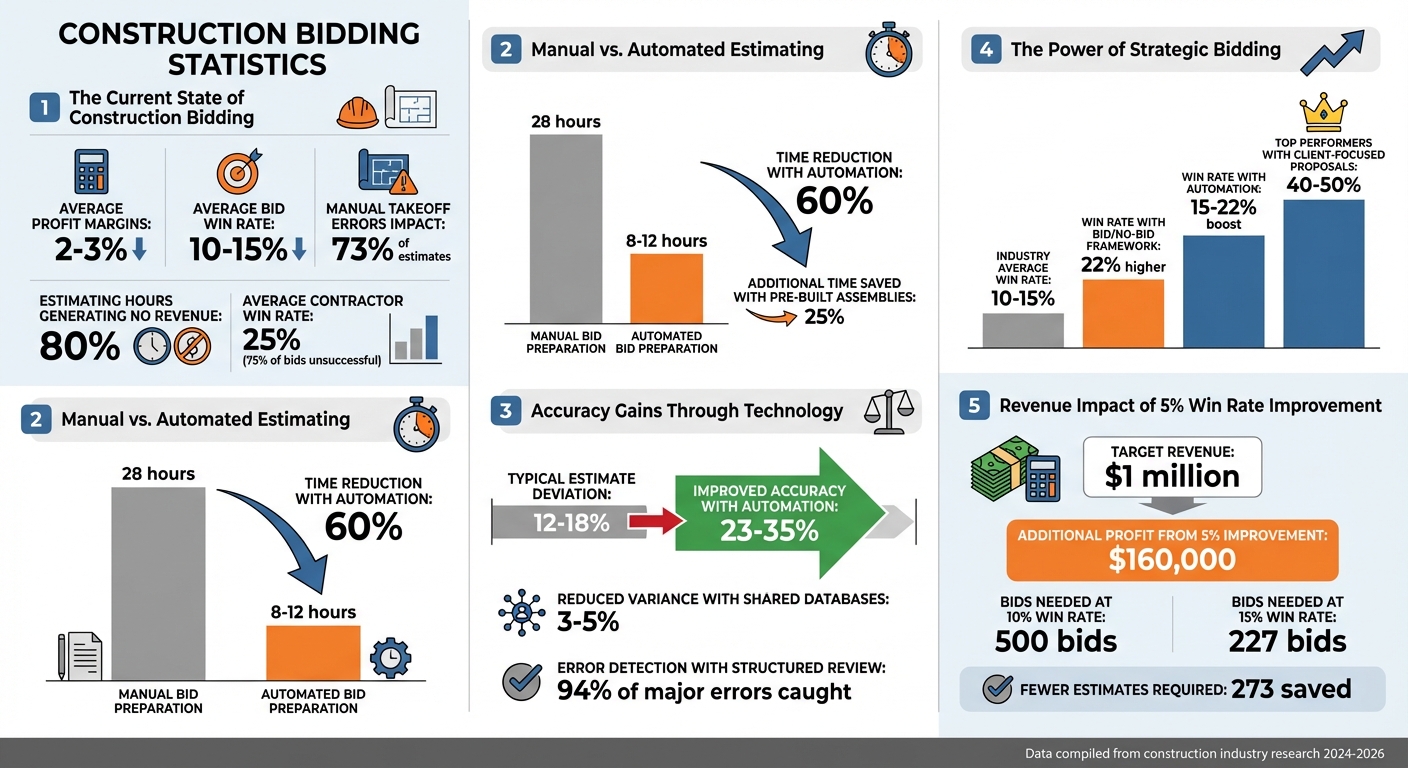
When it comes to bidding, focusing on projects that clearly show revenue potential is critical. Here’s why: 80% of estimating hours generate no revenue. For subcontractors, this means having a system in place to separate worthwhile opportunities from those that waste time. A structured Bid/No-Bid framework can help you avoid unnecessary effort and redirect resources to where they’ll have the most impact.
Contractors who use a scoring framework for bid decisions report a 22% higher win rate. Compare that to the industry average win rate of just 10–15%, and it’s clear that a structured approach can significantly boost profitability.
"Every hour you spend estimating a job you shouldn’t have bid is an hour you could have spent on a real opportunity."
The first step? Evaluate each project to ensure it aligns with your strategic goals.
Evaluate Project Fit
Before diving into any project details, ask the tough questions upfront. Is the client financially stable? How many competitors are bidding? Is the start date realistic? These quick checks can save you from wasting time on projects with little chance of success.
Site conditions can make or break a project. Things like restricted delivery hours, limited staging areas, or poor road access can increase labor costs by 10–25%. A mandatory site visit using a standardized checklist can help you identify these potential issues early. Missing a required pre-bid meeting? That often leads to automatic disqualification, so make sure your schedule aligns.
Some red flags should stop you in your tracks. If the project scope keeps shifting, the client is only interested in the lowest price, or payment terms stretch to Net-90 or beyond, it’s time to walk away. Watch out for unreasonable contract terms, like aggressive liquidated damages or ambiguous scope language. As ConstructConnect puts it: "If you notice [you would not get a profit], the best thing to do is dump the bid and look for another project".
Once you’ve filtered out unqualified projects, focus on those that align with your strengths.
Target Projects That Match Your Strengths
Your "sweet spot" lies where project size, trade skills, and location intersect. Track your bid-hit ratio by category – such as public versus private projects or specific general contractors – to figure out where you’re most successful. For instance, if you win one out of every four private project bids but only one out of seven public project bids, it’s a clear sign to prioritize private work.
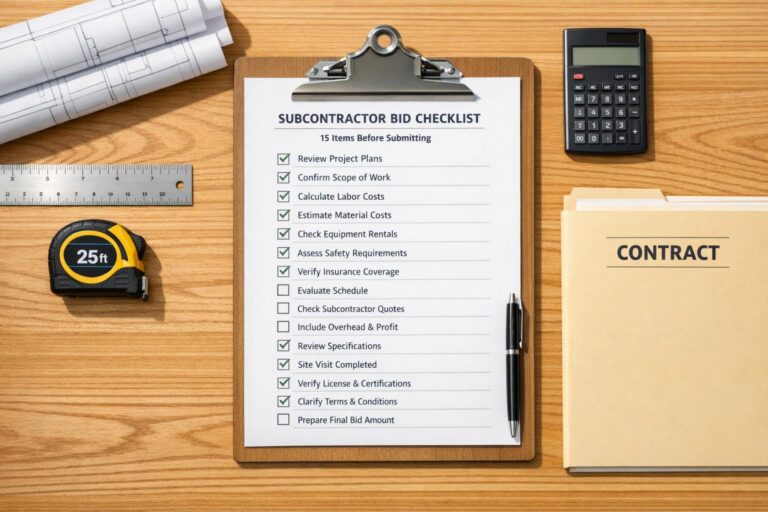
A weighted scoring system can add discipline to your decision-making process. Score criteria such as payment history, project fit, resource availability, and profit potential on a 1–5 scale. Then, set a minimum score threshold – say, 25 out of 35 points – that a project must meet before you commit to estimating. This approach avoids the "bid everything and hope" mentality that drains resources without delivering results.
There are times when a strategic project – like entering a new market, strengthening a client relationship, or keeping your crew busy – might justify lower margins. The key is to make that decision intentionally, not after you’ve already sunk resources into the bid.
Track and Improve Your Bid-Hit Ratio
Building on the Bid/No-Bid framework, tracking your bid-hit ratio can help you refine your estimating efforts and focus on what drives revenue. This single metric shows how effectively your team converts effort into income. On average, construction bid win rates hover around 10–15%. That means most contractors lose 85–90% of their bids. But here’s the kicker: increasing your hit ratio by just 5% can bring in approximately $160,000 in extra profit for a team aiming for $1 million in revenue.
"Hit ratio measures efficiency. If your hit-ratio is high, then you don’t need many bids or estimators to hit-revenue targets."
- Andy Lee
The difference between a 10% and 15% hit ratio is more than just winning a few extra bids. It’s about working smarter, not harder. For instance, a team with a 15% hit ratio only needs 227 bids to hit $1 million in revenue. In contrast, a team at 10% requires 500 bids to reach the same goal. That’s 273 fewer estimates to prepare, review, and submit – saving time and resources.
Set Up Bid Performance Tracking
Start by recording details for every bid, such as project name, contractor, sector, type, bid amount, and markup percentage. Don’t stop at a company-wide ratio – break it down by categories to identify where you’re most competitive.
Group your bids based on factors like public versus private projects, building types, specific general contractors, or geographic locations. Then calculate your bid-hit ratio for each category. For example, you might find that you win one out of every four private project bids (a 4:1 ratio) but only one out of every seven public project bids (a 7:1 ratio). This insight helps you decide where to focus your time and energy.
Also, track "qualified declined" bids – opportunities that were a good fit but couldn’t be pursued due to limited resources or tight deadlines. This data can reveal untapped opportunities and indicate when it’s time to grow your estimating team. Use these insights to spot trends and identify areas for improvement.
Analyze What Makes Winning Bids Successful
Once you’ve pinpointed your high-performing categories, dig deeper into what makes those bids successful. After each bid, request a debrief to understand whether factors like pricing, schedule, scope clarity, or alignment with the project’s needs played a role.
For winning projects, compare your estimated costs to actual job costs in detail. Typically, estimates deviate 12–18% from actual costs, but contractors who track this data closely can reduce future estimating errors by about 35%. If you notice recurring gaps between estimates and real costs, update your cost database to reflect more accurate pricing.
Take a close look at the markup percentages in your winning bids versus your losses. This can help you refine your pricing strategy and zero in on your competitive sweet spot.
"The common thread among most advanced contractors is that they are all very disciplined around tracking projects and analyzing bidding data."
- Andy Lee
Finally, follow up with every general contractor after submitting a proposal. Consistent follow-ups not only strengthen relationships but also help you catch any overlooked details that could make or break your bid. Aim for a 100% follow-up rate to ensure you’re always learning and improving.
Speed Up Estimating with ScopeTakeoff
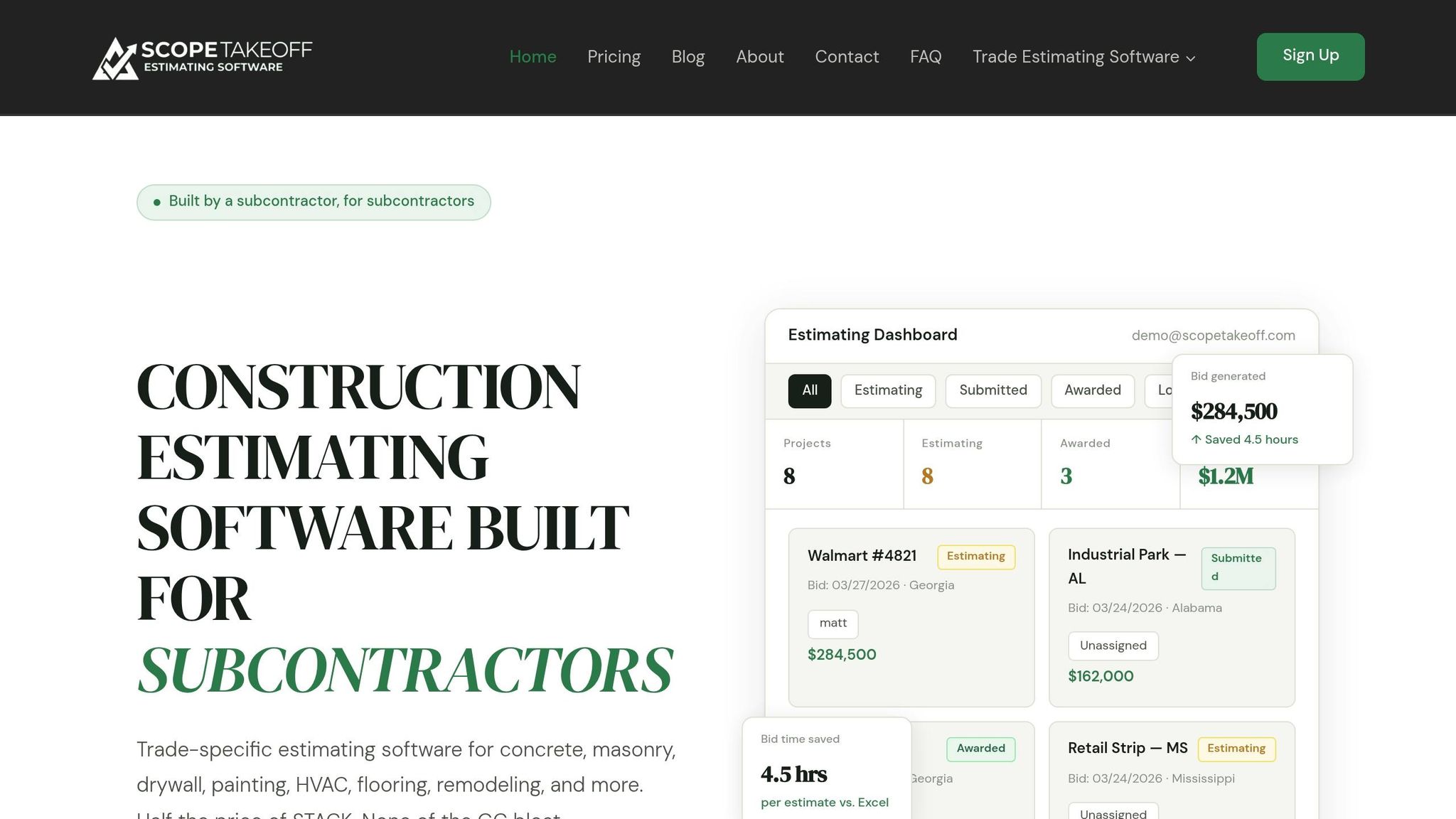
Refining bid-hit strategies is one thing, but speeding up the estimating process is where real gains happen. Did you know that 73% of construction estimates are impacted by manual takeoff errors?. These mistakes don’t just cost time – they cost money. On average, preparing a commercial construction bid manually takes 28 hours of labor, but with automation, you can cut that down to just 8–12 hours. That’s where ScopeTakeoff steps in. Designed specifically for subcontractors across more than 10 trades – like concrete, masonry, drywall, HVAC, and flooring – it streamlines the entire process. By combining digital takeoff tools, trade-specific assemblies, and team collaboration features, ScopeTakeoff helps you create bids that are faster and more precise.
"Many of the significant pain points experienced by estimators, including inaccuracies, frustrations, uncertainties, and a lack of profitability, have been greatly reduced by digitization."
- Dave Chapman, April 15, 2024
Automating takeoff and pricing can slash estimation time per bid by 60%. Even better, contractors who adopt automated workflows report a 15–22% boost in win rates, thanks to quicker response times and more accurate bids. When every second counts in competitive bidding, saving time while improving precision can make all the difference.
Use Pre-Built Assemblies and Auto Calculations
Automation is the key to speeding up workflows, and pre-built assemblies are a great example. Instead of manually listing materials for something like a standard exterior wall or an HVAC system, you can use ready-made templates. These templates automatically calculate everything you’ll need. For instance, if you measure lumber, the system can instantly calculate the required number of nails. This alone can reduce estimation time by an extra 25% per bid.
ScopeTakeoff’s trade-specific libraries ensure that no critical components are overlooked. This standardization eliminates the "missed scope items" that often occur with manual estimates. Plus, AI-enabled tools can scan blueprints – whether they’re PDFs or CAD files – and automatically identify walls, doors, fixtures, and more. The system then calculates lengths, areas, and counts without any manual input. These features boost estimate accuracy by 23–35% compared to manual methods.
Simplify Takeoff with PDF Tools
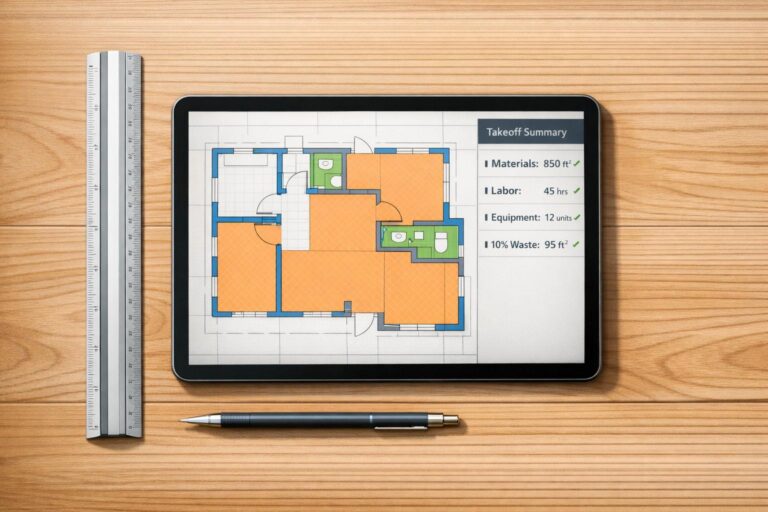
Digital takeoff tools make it easy to measure dimensions and quantities directly from architectural and engineering drawings. Forget about physical scale rulers – now you can measure pipe lengths, floor areas, or wall dimensions right on a digital blueprint. This approach eliminates scaling errors and reduces the risk of missing items.
Once your takeoff is complete, ScopeTakeoff’s SOV export feature lets you seamlessly transfer quantities into estimating formats or unit-cost databases. This eliminates the need for manual data entry, cutting down on errors and speeding up the final stages of your bid preparation. The platform even generates polished, client-facing proposals, saving you the hassle of additional formatting.
Coordinate Estimates with Your Team
Collaboration is easier than ever with cloud-based platforms. ScopeTakeoff allows your team to work on plans and estimates in real-time, whether they’re at the office, on the jobsite, or working remotely. Features like multi-entity profiles and team estimating make it simple to coordinate on large projects. Multiple team members can review, mark up, and collaborate on plans simultaneously, improving both speed and accuracy.
A structured review process – self-check, peer review, and management review – helps catch 94% of major errors before submitting a bid. ScopeTakeoff supports this workflow with tools like color-coded markups and a visual audit trail. By using a shared database for material and labor pricing, you ensure everyone is working with the same up-to-date costs. This reduces the typical industry variance of 12–18% to just 3–5%. The result? More consistent, competitive bids with fewer surprises. These efficiencies help you deliver proposals that stand out to clients.
Create Client-Focused Proposals
You’ve fine-tuned your estimating process and nailed down accurate numbers. But the real challenge lies in converting those bids into actual contracts. Commercial contractors, on average, win only 25% of the bids they submit, leaving a whopping 75% of estimates without results. The key to bridging this gap? A proposal that clearly shows why you’re the right choice.
"The gap between the bids you’re submitting and the contracts you’re winning rarely comes down to your credentials or your price. It comes down to how well your proposal gives the client a reason to choose you over everyone else in that pile."
- Taru Bhargava, Content Strategist, Qwilr
A winning proposal does more than just list prices. It proves you can deliver the project safely, on time, and within budget. It also makes it easy for the client – or their decision-making team – to justify selecting you. To stand out, your proposal must address the client’s specific needs and concerns.
Tailor Each Proposal to the Client
Generic, one-size-fits-all proposals don’t win contracts. Your executive summary should speak directly to the client’s unique challenges, using the language they used during your conversations or site visits. Instead of diving into your company’s history, focus on the client’s problem and explain how your approach solves it. This level of personalization can make all the difference in a crowded market.
Be clear about what’s included and excluded in your bid to avoid misunderstandings. Highlight the top 5–10 project-specific risks – like material lead times or site access issues – and explain how you’ll handle them. Construction disputes in North America are often caused by errors in contract documents, so clarity here is crucial. Avoid vague terms like "as needed" or "TBD." For instance, if you’re bidding on an HVAC project, specify whether your bid includes ductwork, electrical connections, or just equipment installation.
By addressing potential concerns upfront, you show that you’ve thought through the logistics and are prepared. Offering value engineering alternatives – like suggesting materials that lower costs without compromising quality – positions you as a problem-solver, not just a bidder.
Another way to stand out is by offering tiered pricing options (Base, Recommended, Enhanced). This gives clients flexibility while anchoring their perception around your recommended tier. Include a validity period, typically 30 days, to encourage timely decisions and protect yourself from material price fluctuations. After submission, follow up within 48 hours – not just to confirm receipt but to answer any questions about the scope.
Format Proposals for Clarity
Once you’ve tailored the content, the way you present your proposal matters just as much. A clean, professional layout builds trust and credibility. Align your proposal’s structure with the RFP or bid request, using the same order and terminology to make it easier for procurement teams to evaluate.
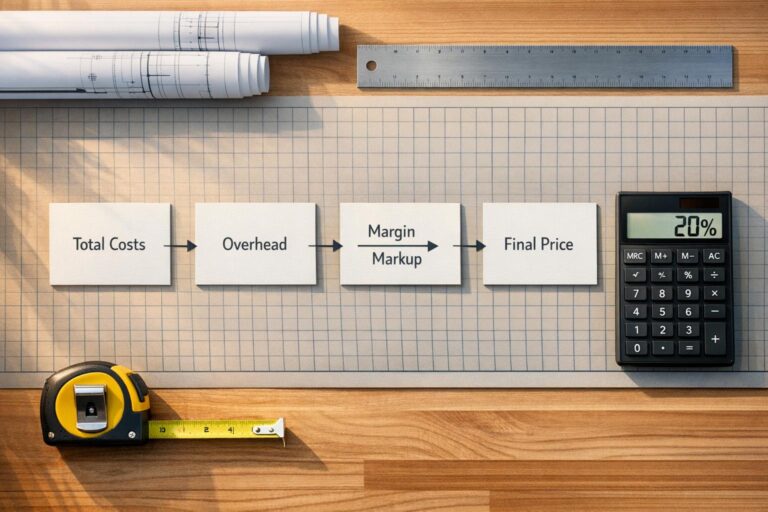
Use clear headings, bullet points, and professional templates to ensure everything is easy to read. Break down costs into categories like labor, materials, equipment, overhead, and profit. Include a detailed schedule with major milestones and note any external factors, such as permitting or site access, that could impact timelines. This level of transparency helps protect against delays outside your control.
Visuals can also make a big difference. High-quality images, 3D renderings, or drone footage of similar projects can showcase your capabilities and make your proposal more engaging. Tools like ScopeTakeoff’s proposal export feature can help you create polished, on-brand documents quickly, saving time while reinforcing a professional image.
Before sending your proposal, implement a three-step review process: self-check, peer review, and management review. This ensures your document is error-free and reflects the professionalism clients expect when choosing a subcontractor. A flawless proposal not only demonstrates competence but also increases your chances of winning the contract.
Conclusion
Every step of your bidding process plays a role in strengthening your competitive position. To win bids in 2026, you’ll need a strategic, data-driven approach.
Start by using a bid/no-bid decision framework. This allows you to focus your time and resources on projects that align with your strengths and profit goals, steering clear of bids with a low chance of success.
Keep a close eye on your bid-hit ratio and dig into the factors that set winning bids apart from unsuccessful ones. Precision matters, especially in competitive public project bids where margins often fall within just 2–3%.
Tools like ScopeTakeoff’s pre-built assemblies and PDF takeoff features can help you avoid manual errors and streamline your estimation process. By simplifying your workflow, you save time and reduce the risk of missing key details, which improves your chances of submitting competitive bids.
Remember, your proposal is more than a price quote – it’s your sales pitch. Most contractors don’t lose jobs because their price is too high; they lose because their process is flawed. Customize each proposal to address the client’s specific needs, present it clearly, and follow up quickly – within 48 hours if possible – to answer any questions. While the average contractor win rate hovers around 25%, those who create professional, client-focused proposals can achieve win rates as high as 40–50%.
Put these strategies into action to refine your bid submissions and improve your success rate today.
FAQs
What’s the simplest bid/no-bid scorecard I can start using?
A simple scoring matrix can be a great tool to evaluate bid opportunities. Start by rating each project based on important factors like profitability, how well it aligns with your team’s expertise, and potential risks. Use straightforward indicators – like green for "go" and red for "no-go" – to assess criteria such as project scope, the client’s reputation, and resource requirements. This method allows you to prioritize bids that are more likely to be profitable and low-risk while steering clear of less promising projects.
How do I track bid-hit ratio without extra admin work?
To efficiently track your bid-hit ratio, leverage your current bid management system to keep tabs on bids, project values, and client interactions. Make it a priority to follow up on every single bid you submit – aim for a 100% follow-up rate. Additionally, compare your historical win rates to industry standards: 10-20% for hard bids and 30-50% for negotiated jobs. This method fits naturally into your existing processes, helping you save time while gaining better insights.
What should I include in a proposal to win on value, not just price?
To stand out on value rather than price, focus on showcasing your expertise, dependability, and a deep understanding of what your client needs. Use clear examples of your quality work – like case studies or testimonials – to back up your claims. Explain how your approach solves their specific challenges and delivers results that go beyond just the basics.
Make your presentation polished and professional to build trust. Include visuals that highlight past successes and directly address the pain points your client is facing. The aim is to clearly demonstrate the value you bring to the table, so price becomes less of a priority in their decision.