Best Drywall Estimating Software for Contractors in 2026

landscaping project blueprints
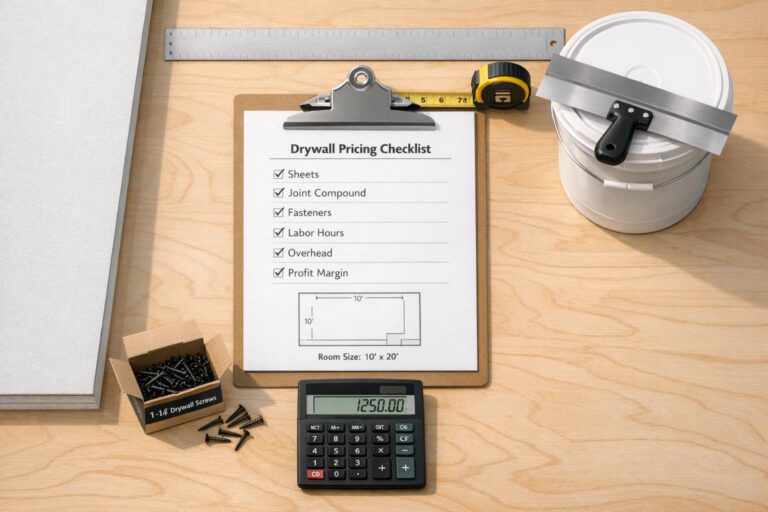
Drywall Estimating

Best Drywall Estimating Software for Contractors in 2026

Quick answer

For drywall contractors and subcontractors, ScopeTakeoff is the strongest drywall estimating software option on this list because it combines PDF takeoff, drywall-specific assemblies for hanging, framing, taping, finishing levels, texture, and fire-rated work, automatic board count and waste calculations, and SOV output formatted for GC submission in one workflow at $100/person/month. On-Center Software’s On-Screen Takeoff and PlanSwift are strong takeoff tools but require more manual setup for drywall-specific calculations, and STACK CT and Excel can work for general estimating with more configuration.

Why this comparison is different. This isn’t a generic software roundup written by a content team that hasn’t bid a drywall scope. From 2020 to 2024 I was the estimator and business development lead at Atlanta Concrete Company, where 100% of our roughly $20M in annual contracted revenue came from commercial remodel work for a national big-box retailer’s nationwide store remodel program. Drywall was on every single store bid — interior partition walls, fire-rated corridor and shaft assemblies, Level 3 and Level 4 finish work, occasional Level 5 in office areas, plus drywall repair across every TI scope. I stayed on through the 2024 acquisition, running estimating across the combined operation through 2026. ScopeTakeoff is the tool I built and used internally to turn out drywall SOVs alongside concrete, masonry, paint, and the rest of the trades on every store bid.

Drywall estimating has different requirements than general construction takeoff. A drywall contractor needs to calculate board count from SF (with the right waste factor for the board size), price hanging by SF, separate metal stud framing by LF, apply finish-level pricing correctly across Level 1 through Level 5, account for fire-rated assemblies with the correct number of board layers, price texture by SF and method, and produce a clean SOV the GC can submit without reformatting.

Most general construction estimating tools treat drywall as a generic line item. This comparison reflects what actually worked while estimating drywall alongside 14 other trades on hundreds of commercial remodel projects. Where ScopeTakeoff is the right answer I’ll say so. Where another tool genuinely fits better, I’ll say that too.

Quick comparison: best drywall estimating software 2026

Feature ScopeTakeoff OST PlanSwift STACK CT Excel
Best fit Drywall estimating + takeoff Measurement takeoff Plan-based takeoff General construction Simple manual estimates
Drywall-specific assemblies Hang, frame, tape, finish, texture Generic / custom Generic / custom Generic / custom Manual
Auto board count from SF Built into every assembly Custom setup needed Custom setup needed Custom setup needed Manual formula
Level 1–5 finish pricing Auto rate adjust by level Manual Manual Manual Manual lookup
Fire-rated assembly library Type X, Type C, shaft, UL refs Manual Manual Manual Manual
Opening deducts from board count Automatic Partial Partial Partial Manual
SOV output for GC submission One click, broken out by scope Limited Limited Partial Manual
PDF plan takeoff Included Core feature Core feature Included No
Pricing style $100/person/month Quote-based Varies by plan Quote-based Free / Microsoft 365

Best drywall estimating software by use case

  • Best for drywall estimating and takeoff: ScopeTakeoff
  • Best for measurement-only takeoff: On-Screen Takeoff (OST)
  • Best for plan-based takeoff: PlanSwift
  • Best for general construction takeoff: STACK CT
  • Best free option: Excel

1. ScopeTakeoff — Best Drywall Estimating Software for Subcontractors

Top Pick — Best for Drywall Estimating
1 ScopeTakeoff
$100/person/month

ScopeTakeoff is built for drywall contractors who need to move from takeoff to estimate to proposal without rebuilding board count formulas in spreadsheets every time.

For drywall contractors, ScopeTakeoff supports the major drywall scopes — hanging (1/2″, 5/8″, Type X, Type C, moisture-resistant, abuse-resistant), metal stud framing, taping and finishing at Level 1 through Level 5, texture (orange peel, knockdown, skip trowel, smooth), fire-rated assemblies (shaft walls, corridor walls, stairwell enclosures with UL references), and drywall repair for tenant improvement work. Each assembly automatically calculates board count from SF, applies the right waste factor by board size, deducts openings, and prices labor at the correct finish level.

Where drywall estimating tends to break down in generic estimating software is the finish-level pricing and fire-rated assemblies. A 30,000 SF wall hung at Level 3 versus Level 4 versus Level 5 has dramatically different finishing labor — but most generic tools either ignore this or require manual rate tables. ScopeTakeoff’s drywall assemblies adjust the labor rate automatically by finish level. Same for fire-rated assemblies — the board layer count, fastener pattern, and joint compound type are all built into the assembly rather than being remembered by the estimator on every bid.

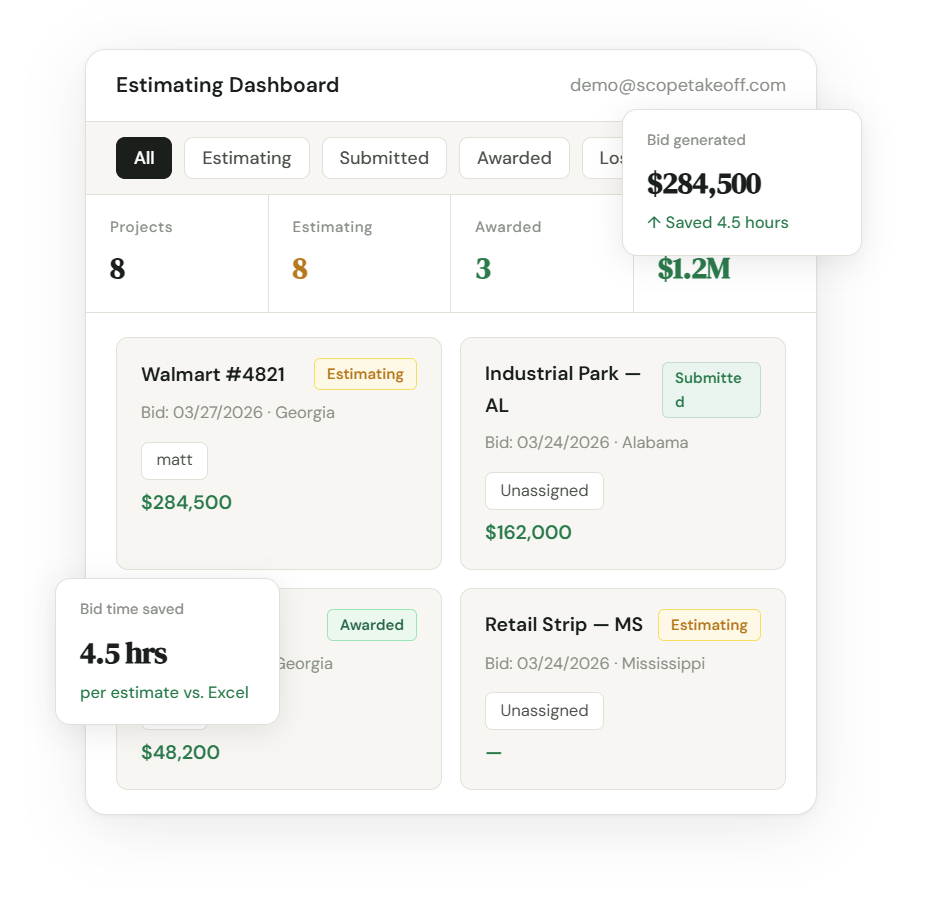
For commercial drywall subcontractors, the SOV output is broken out by scope — hang, frame, tape, finish, texture — which is exactly the format GCs typically request. When you’re submitting drywall as part of a multi-trade scope sheet that includes concrete, masonry, paint, and tile, having every trade’s SOV come out in matching format simplifies the bid package the GC sees.

At $100 per person per month with a 14-day free trial, ScopeTakeoff is priced for drywall subcontractors and small-to-mid commercial drywall companies — a fraction of the $400–$700/month enterprise drywall estimating tools charge.

Pros
  • Drywall-specific assemblies for hang, frame, tape, finish, texture, and repair
  • Automatic board count from SF with correct waste factor by board size
  • Level 1–5 finish pricing with auto rate adjustment
  • Fire-rated assembly library — Type X, Type C, shaft walls, UL references
  • Automatic opening deducts from board count
  • Drywall repair assemblies for TI and occupied-space work
  • PDF plan takeoff included
  • SOV output broken out by scope for GC submission
  • $100/person/month with no annual contract
  • 14-day free trial, self-serve onboarding
Cons
  • Newer publicly available product with less name recognition than OST or PlanSwift
  • No project scheduling, CRM, or client portal
  • Some teams may still need to customize labor production rates by region or crew
Bottom line: ScopeTakeoff is the best fit for drywall contractors who want drywall-specific assemblies, automatic board count, finish-level pricing, fire-rated assembly support, and SOV output without paying enterprise prices.
Start free trial → See drywall features

2. On-Screen Takeoff (OST) — Best for Measurement-Only Takeoff

2 On-Screen Takeoff (OST)
Quote-based

On-Screen Takeoff (OST) by ConstructConnect has been one of the most-used measurement tools in commercial drywall estimating for over two decades. Drywall estimators can use it to measure wall lengths, ceiling areas, opening deducts, and quantity types with strong layered measurement controls and condition-style takeoff.

For drywall estimators who already have their own pricing logic and just need accurate measurements from PDF drawings, OST is a solid fit. The tradeoff is that it’s a measurement tool first — drywall-specific calculations like automatic board count from SF, Level 1–5 finish rate adjustment, and fire-rated assembly logic typically require a separate estimating tool (often ConstructConnect’s QuickBid) or manual setup.

Pros
  • Industry-standard plan measurement tool in commercial drywall
  • Strong condition-based takeoff controls
  • Layered measurement workflow built for production estimating
  • Familiar to many experienced drywall estimators
Cons
  • Measurement only — pricing requires a separate tool or manual workflow
  • No native drywall assembly library
  • Pricing typically requires a sales call
  • Larger learning curve than newer web-based tools
  • Most valuable when paired with QuickBid, which adds cost
Bottom line: OST is a solid pick for experienced drywall estimators who already have pricing logic and want best-in-class plan measurement. Teams that want measurement and assembly-based pricing in one tool may want a more focused estimating platform.

3. PlanSwift — Best for Plan-Based Takeoff

3 PlanSwift
Varies by plan

PlanSwift is another long-standing on-screen takeoff tool used widely across multiple trades, drywall included. Drywall estimators can use it to measure wall and ceiling SF, opening deducts, and apply custom assemblies to those measurements.

For estimators willing to build and maintain their own drywall assemblies — board count formulas, finish-level rate tables, fire-rated assembly logic — PlanSwift is flexible. The tradeoff, like with OST, is that the drywall-specific intelligence comes from your custom setup rather than being native to the tool.

Pros
  • Strong on-screen plan measurement
  • Long history in trade estimating across multiple scopes
  • Flexible custom assemblies if you build them
  • Familiar workflow for many estimators
Cons
  • Drywall-specific assemblies must usually be built manually
  • Board count, finish-level pricing, and fire-rated logic are not native
  • SOV output for multi-trade GC submission may require extra steps
  • Less optimized for newer team members compared to web-based tools
Bottom line: PlanSwift is a solid option for drywall estimators who want strong plan measurement and are comfortable maintaining their own assemblies. Teams that want drywall-specific calculations out of the box may want a more focused tool.

4. STACK CT — Best for General Construction Takeoff

4 STACK CT
Quote-based / varies by plan

STACK CT is a cloud-based construction takeoff and estimating platform used across multiple trades. It’s strong for estimators who manage takeoffs across many scopes and want a centralized cloud workspace with team collaboration.

For drywall specifically, STACK can support measurement and quantity takeoff, but drywall-specific workflows like automatic board count, finish-level rate adjustment, and fire-rated assembly logic typically require manual assembly setup. It tends to fit GCs and multi-trade estimators better than drywall-only subcontractors.

Pros
  • Strong cloud-based plan takeoff
  • Useful for GCs and multi-trade contractors
  • Team collaboration on bid documents
  • Well-known construction software brand
Cons
  • Drywall-specific assemblies require setup
  • Pricing typically higher than focused subcontractor tools
  • Finish-level pricing logic is not native
  • Pricing typically requires a sales call
Bottom line: STACK CT is worth evaluating if you do takeoff across multiple trades and want a cloud-based platform. Drywall-only subcontractors may want a more drywall-focused tool.

5. Excel — Best Free Option

5 Microsoft Excel
Free / Microsoft 365

Excel is still common in drywall estimating because it’s flexible and familiar. A drywall estimator can build templates with board count formulas, framing LF, finish-level rate tables, texture pricing, and waste factors.

For low-volume estimating — a few small jobs per month — Excel can work. The challenge is consistency. Board count formulas, finish-level rate lookups, fire-rated layer counts, and opening deducts all depend on formulas that have to be maintained as your scopes change. We ran on Excel for the first stage of growth and outgrew it the moment drywall became one of 15 trades on every store bid — at that volume, the spreadsheet errors compound faster than you can catch them, and the wrong board count on a fire-rated corridor wall is the kind of mistake that costs real money.

Pros
  • Low cost and familiar
  • Fully customizable for your specific production rates
  • Useful for simple residential drywall estimates
  • Works as a backup estimating tool
Cons
  • No built-in PDF plan takeoff
  • No drywall assembly library
  • Board count formulas have to be maintained manually
  • Finish-level pricing requires manual rate lookups
  • Fire-rated assembly logic is fully manual
  • SOV output usually requires extra formatting per GC
  • More error-prone as bid volume increases
Bottom line: Excel can work for simple or low-volume drywall estimates. Once you’re bidding regularly — especially commercial multi-trade work with fire-rated assemblies and varying finish levels — drywall estimating software pays for itself in reduced errors and faster turnaround.

What drywall estimating software actually needs to do

Most “best of” software lists treat drywall as a generic takeoff scope. It isn’t. Here’s what drywall-specific software needs to handle that general construction tools usually don’t:

  • Automatic board count from SF: 4×8 sheets cover 32 SF, 4×12 sheets cover 48 SF, 4×16 sheets cover 64 SF. Add a 10–15% waste factor. The software should do this conversion automatically based on board size selection rather than requiring a manual formula.
  • Opening deducts: Doors and windows reduce hangable SF. Most estimators forget at least one opening on a busy bid. The software should pull opening counts from the takeoff and deduct the SF automatically rather than expecting the estimator to remember each one.
  • Finish-level rate adjustment (Level 1 through Level 5): A Level 3 finish in back-of-house space is dramatically less labor than a Level 5 finish in an executive office or hospital corridor. The labor rate per SF can vary by 2–3x between levels. The software should let you select the level on the assembly and adjust labor rate automatically.
  • Fire-rated assembly logic: A 1-hour rated wall is one layer of 5/8″ Type X each side. A 2-hour rated wall is two layers each side. Shaft walls and corridor walls have specific UL assembly requirements. The software should know these rather than expecting the estimator to remember board layer counts on every fire-rated assembly.
  • Metal framing by LF or SF: Stud framing is typically priced by LF of wall at standard spacing (16″ or 24″ on center). Ceiling grid is by SF. Track and headers add at openings. The software should calculate stud counts and accessories automatically from spacing selection.
  • Texture pricing by method: Spray-applied orange peel and knockdown have different labor than hand-applied skip trowel or smooth finish. The software should price texture by method with separate rates rather than treating it as a single line item.
  • Drywall repair for occupied space: TI and remodel work often includes patch and repair, sometimes in occupied space (after-hours premium, dust containment, protection). Repair labor is dramatically different from new construction hanging labor.
  • SOV output broken out by scope: Commercial drywall subs almost always submit through a GC. The SOV needs to be broken out by hang / frame / tape / finish / texture rather than rolled into a single drywall line item.

If a tool requires you to manually build all of the above, it isn’t really drywall estimating software — it’s a general takeoff tool that you’ve configured for drywall. There’s a meaningful difference in setup time and ongoing accuracy.

How to choose drywall estimating software

The best drywall estimating software depends on the type of work you bid and the volume you bid at. A residential drywall installer, commercial drywall subcontractor, tenant improvement specialist, and multi-trade subcontractor running drywall alongside other scopes may all need different workflows.

Before choosing a platform, look for these features specifically:

  • Drywall-specific assemblies out of the box: Hang, frame, tape, finish, texture, repair.
  • Automatic board count from SF: Should calculate from SF input with the right waste factor for the board size.
  • PDF plan takeoff: Measure wall and ceiling SF directly from drawings.
  • Level 1–5 finish pricing: Auto rate adjustment by finish level.
  • Fire-rated assembly support: Type X, Type C, shaft walls, UL references with correct board layer counts.
  • Opening deducts from board count: Automatic, not manual.
  • SOV output broken out by scope: Hang, frame, tape, finish, texture as separate line items for GC submission.
  • Multi-trade compatibility: If you bid drywall alongside concrete, masonry, or paint, the SOV output should match across trades.
  • Pricing fit: Avoid paying enterprise prices when you only need estimating and SOV output.

Recommendation for drywall contractors: Start with a tool that ships with drywall-specific assemblies and automation rather than one you have to configure. ScopeTakeoff is built around hang, frame, tape, finish, texture, fire-rated, and repair assemblies at $100/person/month — without forcing you to maintain custom formulas across every bid.

FAQ

What is the best drywall estimating software for contractors?+
For drywall contractors and subcontractors, ScopeTakeoff is a strong drywall estimating software option because it includes PDF takeoff, drywall-specific assemblies for hang, frame, tape, Level 1–5 finish, texture, fire-rated work, and repair, automatic board count and opening deducts, and SOV output for GC submission at $100 per person per month.
What is the best drywall takeoff software?+
The best drywall takeoff software should let contractors measure wall and ceiling SF directly from PDF plans, deduct openings automatically, and convert measurements into board count with the correct waste factor. ScopeTakeoff combines PDF takeoff with drywall assemblies so measurements flow directly into a priced bid. On-Screen Takeoff and PlanSwift offer strong measurement but require custom drywall assemblies.
How do you calculate drywall for a project?+
To calculate drywall for a project, measure total wall and ceiling area in SF, subtract openings (doors and windows), divide by the sheet size (32 SF for 4×8 or 48 SF for 4×12), and add a waste factor of 10–15%. ScopeTakeoff does all of this automatically — enter your wall dimensions or take off from a PDF plan and the board count, waste factor, fasteners, joint compound, and tape are calculated instantly.
How do you bid drywall jobs?+
To bid drywall jobs: take off wall and ceiling SF from plan drawings, calculate board count with waste factor, price hanging by SF, add metal framing by LF if in scope, price taping and finishing by level (Level 1–5), add texture by method, account for fire-rated assemblies, apply your overhead and margin, and produce an SOV broken out by scope for GC submission. Drywall estimating software automates these steps.
What’s the difference between drywall estimating software and drywall takeoff software?+
Drywall takeoff software measures wall and ceiling areas from plan drawings and calculates board count and material quantities. Drywall estimating software applies labor rates and material costs to those quantities to generate a priced bid. ScopeTakeoff does both — upload a PDF plan, measure areas, and quantities flow into priced drywall assemblies. On-Screen Takeoff and PlanSwift focus on the measurement side; pricing typically requires a separate tool or manual workflow.
Does ScopeTakeoff support fire-rated drywall assemblies?+
Yes. ScopeTakeoff includes fire-rated drywall assemblies with the correct board layer count, fastener pattern, and joint compound type for Type X, Type C, shaft wall, corridor wall, and stairwell enclosure assemblies. UL assembly references are included so estimators can verify the assembly matches the spec.
How much does drywall estimating software cost?+
Drywall estimating software pricing varies widely. Enterprise tools like STACK CT can run $500–$700+ per month per seat. ScopeTakeoff is $100 per person per month with no annual contract and a 14-day free trial. On-Screen Takeoff and PlanSwift pricing varies by plan and is typically lower than full enterprise tools but higher than focused subcontractor software.
Does ScopeTakeoff work for commercial drywall and tenant improvement work?+
Yes. ScopeTakeoff was originally built around multi-trade commercial work — including interior partition walls, fire-rated corridor and shaft assemblies, Level 3 and Level 4 finish work in office and retail TI, and drywall repair across occupied-space remodels. SOV output is formatted for direct GC submission on commercial projects.
Can Excel be used for drywall estimating?+
Yes. Excel can be used for drywall estimating, especially for simple jobs or low bid volume. The downside is that board count formulas, finish-level pricing, fire-rated assembly logic, opening deducts, and SOV output all require manual setup and ongoing maintenance.
Is ScopeTakeoff a good fit for multi-trade subcontractors who bid drywall alongside other scopes?+
Yes. ScopeTakeoff is built specifically for multi-trade subcontractors. Drywall assemblies live alongside concrete, masonry, paint, tile, and other trade assemblies, so a multi-trade SOV submission to a GC comes out of one tool with consistent formatting across every scope.
KK
Keaton Kumar
Founder of ScopeTakeoff. Spent 2020–2024 as estimator and business development lead at Atlanta Concrete Company, where the entire $20M+ in annual contracted revenue came from commercial remodel work for a national big-box retailer’s nationwide store remodel program. Bid concrete, masonry, paint, carpentry, demo, drywall, tile, millwork, polishing, landscaping, fencing, asphalt, striping and signage, plumbing, utilities, and grading as a multi-trade subcontractor under GCs running the program from the Southeast through the Northeast and Midwest. Stayed on through the 2024 acquisition, running estimating across the combined operation through 2026. Built ScopeTakeoff originally as the internal tool used to estimate roughly $25M per month in bid volume across all those trades — now offering it publicly to other subcontractors.

Try drywall estimating software built for subcontractors

14-day free trial. Hang, frame, tape, finish, texture, fire-rated, and repair assemblies, PDF takeoff, automatic board count, and SOV output for GC submission included.

Start free trial → Drywall · Concrete · Masonry · Painting · HVAC · Flooring · Landscape · Asphalt · Roofing · Remodeling

Similar Posts