

Best Flooring Estimating Software for Contractors in 2026

landscaping project blueprints
Flooring Estimating

Best Flooring Estimating Software for Contractors in 2026

Quick answer

For commercial flooring contractors and floor-covering subcontractors, ScopeTakeoff is the strongest flooring estimating software option on this list because it combines PDF takeoff, flooring-specific assemblies for VCT, LVT, LVP, hardwood, tile, polished concrete, and carpet, automatic waste-factor calculations by layout pattern, subfloor prep as a default line item, and SOV output formatted for GC submission at $100/person/month. Measure Square is the most credible alternative for commercial flooring, RFMS is the established option for retail flooring dealers, and Excel can work for low-volume estimating.

Why this comparison is different. This isn’t a generic software roundup written by a content team that hasn’t bid a flooring scope. From 2020 to 2024 I was the estimator and business development lead at Atlanta Concrete Company, where 100% of our roughly $20M in annual contracted revenue came from commercial remodel work for a national big-box retailer’s nationwide store remodel program. Flooring was a meaningful scope on every store — VCT and LVT across the sales floor and back-of-house, polished concrete in newer-prototype stores, ceramic and porcelain tile in restrooms and entries, plus subfloor prep and self-leveling on every project. I stayed on through the 2024 acquisition, running estimating across the combined operation through 2026. ScopeTakeoff is the tool I built and used internally to turn out flooring SOVs alongside concrete, drywall, paint, and the rest of the trades on every store bid.

Flooring estimating has different requirements than general construction takeoff. A flooring contractor needs to calculate room-by-room SF, apply the right waste factor by flooring type and layout pattern (5% for straight-lay LVT vs 15% for diagonal hardwood), separate subfloor prep from finished flooring, account for transitions and accessories, price commercial flooring differently than residential, and produce a clean SOV the GC can submit without reformatting.

Most general construction estimating tools treat flooring as a single line item per room. This comparison reflects what actually worked while estimating flooring alongside 14 other trades on hundreds of commercial remodel projects. Where ScopeTakeoff is the right answer I’ll say so. Where another tool genuinely fits better — including for retail flooring dealers selling to homeowners — I’ll say that too.

Quick comparison: best flooring estimating software 2026

Feature ScopeTakeoff Measure Square RFMS Excel
Best fit Commercial flooring + multi-trade subs Commercial flooring estimating Retail flooring dealers Simple manual estimates
Flooring-specific assemblies VCT, LVT, LVP, hardwood, tile, polished, carpet Included Retail-focused Manual
Auto waste factor by layout Per type + pattern Included Partial Manual formula
Subfloor prep as default line item Auto-included Partial Manual Easy to miss
Self-leveling & moisture mitigation Native assemblies Included Limited Manual
Polished concrete assemblies Included Limited Not native Manual
SOV output for GC submission By room and type Included Retail invoice format Manual
Multi-trade compatibility Unified with other trades Flooring-only Flooring-only No
PDF plan takeoff Included Core feature Limited No
Pricing style $100/person/month Quote-based / varies Quote-based / varies Free / Microsoft 365

Best flooring estimating software by use case

  • Best for commercial flooring (multi-trade subs, GC submission): ScopeTakeoff
  • Best dedicated commercial flooring estimator: Measure Square
  • Best for retail flooring dealers: RFMS
  • Best free option: Excel

1. ScopeTakeoff — Best for Commercial Flooring and Multi-Trade Subs

Top Pick — Commercial Flooring
1 ScopeTakeoff
$100/person/month

ScopeTakeoff is built for flooring contractors who bid from plans — commercial floor-covering subcontractors submitting to GCs, and multi-trade subs running flooring alongside concrete, drywall, paint, or tile on the same project.

For flooring estimators, ScopeTakeoff supports the major commercial flooring scopes — VCT (vinyl composition tile), LVT and LVP (luxury vinyl tile and plank), hardwood, ceramic and porcelain tile, polished concrete, carpet and carpet tile, epoxy and resinous coatings, plus all the prep work that goes underneath them. Each assembly automatically calculates SF, applies the right waste factor by layout pattern, and includes subfloor prep, self-leveling, moisture mitigation, transitions, and adhesive as default line items rather than as forgotten add-ons.

Where flooring estimating tends to break down in generic estimating software is the prep work and the layout-driven waste factor. A 30,000 SF VCT scope on a remodel often needs grinding, patching, self-leveling underlayment, and existing flooring removal before a single tile gets laid down. The prep work is frequently 30–50% of the labor cost on the scope. Most generic tools treat prep as a single optional line item; ScopeTakeoff bakes it into every flooring assembly so it can’t be forgotten on the bid. Same for waste — straight-lay LVT runs about 5%, diagonal LVT runs 10%, herringbone hardwood runs 15%, and large-format tile in a complex room can run 12–15%. The assembly knows the right waste factor by layout pattern instead of relying on the estimator to remember it.

For commercial flooring subcontractors, the SOV output is broken out by room and flooring type — exactly the format GCs request. When you’re submitting flooring as part of a multi-trade scope sheet that includes drywall, paint, concrete, and tile, having every trade’s SOV come out in matching format simplifies the bid package the GC sees.

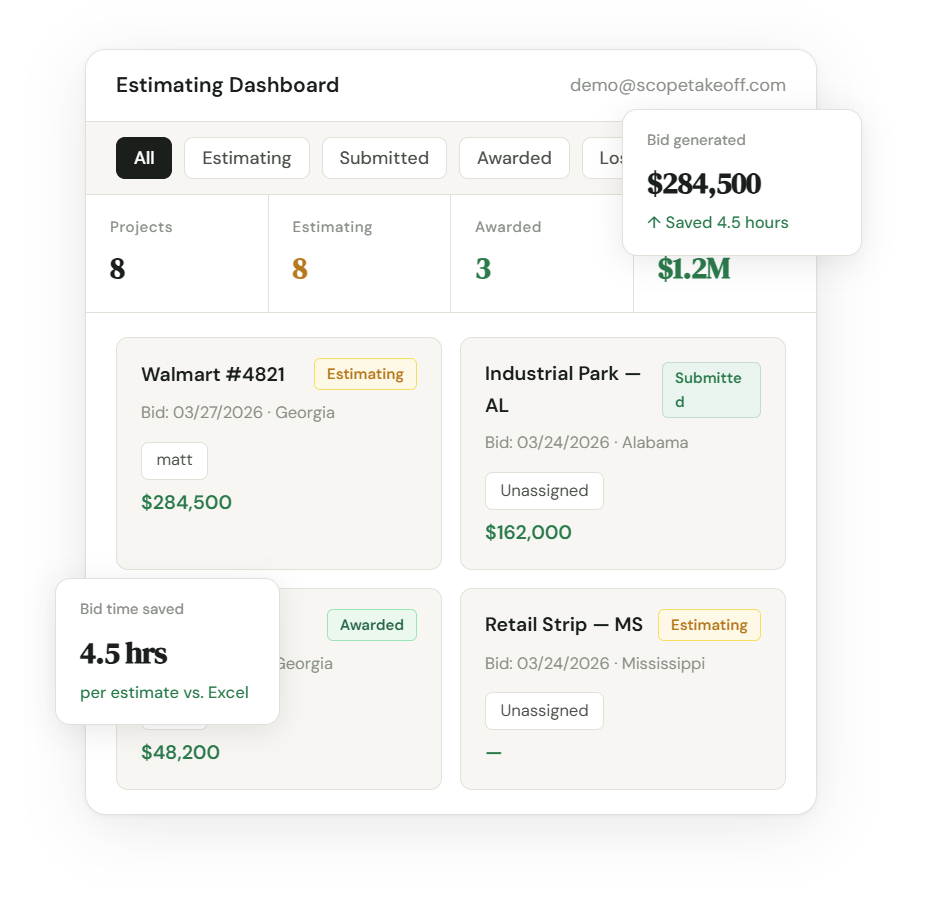
At $100 per person per month with a 14-day free trial, ScopeTakeoff is priced for flooring subcontractors and small-to-mid commercial flooring companies — a fraction of what enterprise flooring estimating tools or retail flooring suites charge.

Pros
  • Flooring-specific assemblies for VCT, LVT, LVP, hardwood, tile, polished concrete, carpet
  • Automatic waste factor by layout pattern
  • Subfloor prep, self-leveling, moisture mitigation as default line items
  • Polished concrete and epoxy assemblies native
  • PDF plan takeoff included
  • SOV output broken out by room and flooring type for GC submission
  • Multi-trade compatibility — flooring sits alongside other trades in one tool
  • $100/person/month with no annual contract
  • 14-day free trial, self-serve onboarding
Cons
  • Not designed for retail flooring dealer workflows (showroom invoicing, customer financing, store inventory)
  • Newer publicly available product with less name recognition than Measure Square or RFMS
  • No CRM, scheduling, or customer portal
  • Some teams may still need to customize labor production rates by region or crew
Bottom line: ScopeTakeoff is the best fit for commercial flooring contractors and multi-trade subcontractors who bid from plans and submit SOVs to GCs. Retail flooring dealers selling to homeowners through a showroom should look at RFMS instead.
Start free trial → See flooring features

2. Measure Square — Best Dedicated Commercial Flooring Estimator

2 Measure Square
Quote-based / varies by plan

Measure Square is one of the most established commercial flooring estimating platforms and has been the default choice for many flooring-only commercial subcontractors for over a decade. It’s strong specifically in flooring-trade depth — pattern recognition, seam diagrams, room layouts with rolled goods minimization for carpet, and detailed flooring-specific waste calculations.

For flooring-only commercial subcontractors who want maximum flooring-trade depth and don’t bid other trades alongside flooring, Measure Square is a credible alternative to ScopeTakeoff. The tradeoff is that Measure Square only covers flooring, so multi-trade subcontractors who also bid drywall, concrete, paint, or other scopes will need additional tools alongside it — and the SOV format won’t match across trades when submitting multi-trade bids.

Pros
  • Long-running dedicated commercial flooring platform
  • Deep flooring-trade workflow including seam diagrams and rolled goods optimization
  • Strong pattern and layout recognition
  • Familiar to many commercial flooring estimators
  • Cloud-based version available
Cons
  • Flooring only — multi-trade subs need additional tools alongside
  • Pricing typically requires a sales call
  • SOV format may not match other trade tools when submitting multi-trade bids
  • Less optimized for new users compared to focused subcontractor tools
Bottom line: Measure Square is a credible pick for flooring-only commercial subcontractors who want maximum flooring-trade depth. Multi-trade subs may prefer a tool that covers flooring alongside the rest of their scopes.

3. RFMS — Best for Retail Flooring Dealers

3 RFMS
Quote-based / varies by plan

RFMS is built for retail flooring dealers — flooring stores selling to homeowners through a showroom with measure-and-quote workflows, customer financing, store inventory, and product catalogs from manufacturers. It’s a fundamentally different business model from commercial flooring subcontracting.

If your business is a retail flooring dealer — a storefront where customers walk in, pick out flooring from samples, get an in-home measure, and you sell with installation — RFMS is the established option for that workflow. Customer management, financing options, manufacturer product catalogs, and store inventory are RFMS’s strengths, not commercial bid submission.

If your business is commercial flooring subcontracting — bidding from plans for a GC on retail rollouts, office TI, or multifamily — RFMS isn’t built for that workflow. The two products solve different problems.

Pros
  • Built specifically for retail flooring dealers
  • Customer management and financing tools
  • Store inventory and product catalog management
  • Manufacturer integrations for retail product data
  • Strong fit for showroom-based businesses
Cons
  • Not built for plan-based commercial flooring estimating
  • SOV output for GC submission is not the focus
  • Multi-trade bid workflows are not supported
  • Less useful for commercial subs bidding TI work
Bottom line: RFMS is the right tool for retail flooring dealers running a storefront. Commercial flooring subcontractors will be better served by a plan-based estimating tool.

4. Excel — Best Free Option

4 Microsoft Excel
Free / Microsoft 365

Excel is still common in flooring estimating because it’s flexible and familiar. A flooring estimator can build templates with room-by-room SF, waste factor lookups, material pricing per SF, labor production rates, and subfloor prep line items.

For low-volume estimating — a few small jobs per month — Excel can work. The challenge is consistency. Waste factor lookups by layout pattern, subfloor prep that has to be remembered manually, self-leveling and moisture mitigation that vary by substrate condition, and SOV formatting all depend on formulas that have to be maintained as your scopes change. We ran on Excel for the first stage of growth and outgrew it the moment flooring became one of 15 trades on every store bid — at that volume, the spreadsheet errors compound faster than you can catch them, and forgetting subfloor prep on a 30,000 SF VCT scope is the kind of mistake that costs five figures.

Pros
  • Low cost and familiar
  • Fully customizable for your specific production rates
  • Useful for simple low-volume estimates
  • Works as a backup estimating tool
Cons
  • No built-in PDF plan takeoff
  • No flooring assembly library
  • Waste factor lookups by layout pattern have to be maintained manually
  • Subfloor prep is one of the most-forgotten line items in flooring estimating
  • SOV output usually requires extra formatting per GC
  • More error-prone as bid volume increases
Bottom line: Excel can work for simple or low-volume flooring estimates. Once you’re bidding regularly — especially commercial work with significant prep scope — flooring estimating software pays for itself in reduced errors and faster turnaround.

Commercial flooring vs retail flooring: how the estimating differs

The biggest mistake flooring contractors make when shopping for software is treating “flooring estimating” as one workflow. It isn’t. Two distinct businesses live under that label and they need different tools:

Commercial flooring subcontracting typically involves:

  • Submitting to a GC who is running the project for the end client
  • Bidding from PDF plans rather than walking the space
  • Multi-room takeoffs across large square footage (10,000–100,000 SF projects)
  • Heavy subfloor prep — grinding, patching, self-leveling, moisture mitigation, existing flooring removal
  • SOV output formatted to the GC’s submission template, broken out by room and flooring type
  • Tight bid windows from drawings to submitted bid (often 5–10 business days)
  • Often part of a multi-trade scope sheet alongside drywall, concrete, paint, tile

Retail flooring dealing typically involves:

  • Selling directly to a homeowner who walks into a storefront
  • In-home measure and quote, often with the homeowner present
  • Customer financing and credit application workflows
  • Manufacturer product catalogs and showroom samples
  • Store inventory and stocking decisions
  • Customer-facing invoicing rather than GC submission
  • Single-room or whole-house projects rather than 50,000 SF jobs

The first workflow — commercial flooring subcontracting — is plan-based and is what ScopeTakeoff is built for. The second workflow — retail flooring dealing — is what RFMS is built for. There is no single tool that does both well, and any post that pretends one tool fits both is selling you something.

What flooring estimating software actually needs to do

Most “best of” software lists treat flooring as a generic takeoff scope. It isn’t. Here’s what flooring-specific software needs to handle that general construction tools usually don’t:

  • Waste factor by flooring type AND layout pattern: Straight-lay LVT runs about 5%. Diagonal LVT runs 10%. Herringbone hardwood runs 15%. Large-format tile in a complex room with lots of cuts can run 12–15%. The software should know the right factor by type and pattern, not require manual override every time.
  • Subfloor prep as a default line item, not an add-on: Subfloor prep — grinding, patching, self-leveling, moisture mitigation, existing flooring removal — is one of the most-forgotten line items in flooring estimating. On a remodel it’s frequently 30–50% of the labor on the scope. The software should bake prep into every flooring assembly so it can’t be left off.
  • Self-leveling and moisture mitigation by SF: Both are commonly required on commercial slab work, both have specific material costs (self-leveling underlayment is $1.50–$3+ per SF in materials alone), and both are easy to miss if the assembly doesn’t include them.
  • VCT and LVT separation: They look similar but estimate differently — VCT is by the carton with simpler waste, LVT is by the box with layout-driven waste. The software should handle them as distinct assemblies, not one combined line item.
  • Polished concrete as its own assembly: Polished concrete isn’t really “flooring” in the floor-covering sense — it’s grinding, densifying, and polishing the existing slab. Different labor, different equipment, different production rates. Most generic flooring tools don’t handle it. Commercial estimators bidding retail rollouts, big-box, and warehouse work need it.
  • Carpet by SY for broadloom, SF for carpet tile: Broadloom carpet is sold by the square yard with seam-placement waste. Carpet tile is sold by the SF with much lower waste. Mixing units is a common error source.
  • Tile mortar, grout, and setting bed: Tile assemblies need to include the right mortar coverage by tile size, grout joint width, and setting bed where structural slab is uneven. These are easy to miss.
  • Transitions, reducers, and accessories: The accessories between flooring types (transition strips, reducers, T-moldings, stair nosings) are easy to forget but show up on the takeoff and the labor.
  • Removal and disposal of existing flooring: Tear-out is its own line item with its own labor rate and disposal cost. On a remodel, the demo scope is often as much labor as the install.
  • SOV output by room and flooring type: Commercial flooring subs almost always submit through a GC. The SOV needs to break out the work by room and flooring type, not roll into one flooring line item.

If a tool requires you to manually build all of the above, it isn’t really flooring estimating software — it’s a general takeoff tool that you’ve configured for flooring. There’s a meaningful difference in setup time and ongoing accuracy.

How to choose flooring estimating software

Start by identifying which business you run: commercial flooring subcontracting (bidding from plans for a GC) or retail flooring dealing (selling to homeowners from a showroom). That single decision narrows the field faster than any feature comparison.

  • Commercial flooring subcontracting: ScopeTakeoff or Measure Square. Pick ScopeTakeoff if you also bid other trades; Measure Square if you’re flooring-only and want maximum flooring-trade depth.
  • Retail flooring dealer: RFMS. Storefront-based selling to homeowners is a different problem than plan-based commercial bidding.
  • Low volume across either workflow: Excel still works.

Beyond that, look for features that match flooring estimating specifically:

  • Flooring-specific assemblies out of the box: VCT, LVT, LVP, hardwood, tile, polished concrete, carpet, epoxy.
  • Auto waste factor by type AND layout pattern.
  • Subfloor prep as a default line item: Not optional, not an add-on, baked into every assembly.
  • Self-leveling and moisture mitigation: Native assemblies for commercial slab work.
  • Transitions and accessories: Auto-included where applicable.
  • Removal and disposal: Separate line item with its own labor rate.
  • SOV output by room and flooring type: For GC submission.
  • Multi-trade compatibility: If you bid flooring alongside drywall, concrete, paint, or tile, the SOV output should match across trades.
  • Pricing fit: Avoid paying enterprise prices when you only need estimating and SOV output.

Recommendation: If you bid commercial flooring from plans — retail rollouts, office TI, multifamily, big-box — start with ScopeTakeoff at $100/person/month. If you run a retail flooring storefront selling to homeowners, start with RFMS. The two tools solve different problems and there’s no shame in using the right one for your workflow rather than forcing a fit.

FAQ

What is the best flooring estimating software for contractors?+
For commercial flooring contractors and multi-trade subcontractors, ScopeTakeoff is a strong flooring estimating software option because it includes PDF takeoff, flooring-specific assemblies for VCT, LVT, LVP, hardwood, tile, polished concrete, and carpet, automatic waste-factor calculations by layout pattern, subfloor prep as a default line item, and SOV output for GC submission at $100 per person per month. For retail flooring dealers selling to homeowners through a showroom, RFMS is the better fit.
What is the best flooring takeoff software?+
The best flooring takeoff software should let contractors measure room SF directly from PDF plans, apply the right waste factor by flooring type and layout pattern, and convert measurements into priced assemblies that include subfloor prep, transitions, and accessories. ScopeTakeoff combines PDF takeoff with flooring assemblies so measurements flow directly into a priced bid. Measure Square offers strong measurement specifically for flooring-only commercial subs.
How do you calculate flooring for a project?+
To calculate flooring for a project, measure each room’s floor area in SF, apply a waste factor based on flooring type and layout pattern (5% for straight-lay LVT, 10% for diagonal, 15% for herringbone hardwood, 10–12% for large-format tile), then add material needed including underlayment, transitions, adhesive, and accessories. Don’t forget subfloor prep — grinding, patching, self-leveling, moisture mitigation, and existing flooring removal — which is often 30–50% of the labor on a remodel. ScopeTakeoff automates all of this from a PDF takeoff.
How do you bid commercial flooring jobs?+
To bid commercial flooring jobs: take off room SF from plan drawings, apply waste factor by flooring type and layout, price material and installation labor for each room, include subfloor prep (grinding, patching, self-leveling, moisture mitigation, removal), add transitions and accessories, account for tear-out and disposal, apply your overhead and margin, and produce an SOV broken out by room and flooring type for GC submission. Commercial flooring estimating software automates these steps.
What’s the difference between commercial flooring and retail flooring estimating?+
Commercial flooring estimating is plan-based — measuring SF from drawings, applying multi-room takeoffs, and submitting an SOV to a GC. Retail flooring estimating is showroom-based — homeowner walks in, picks flooring from samples, you do an in-home measure, and you sell with installation through a customer-facing invoice. The two workflows need fundamentally different tools. Plan-based tools (ScopeTakeoff, Measure Square) handle commercial. Retail-focused tools (RFMS) handle showroom dealers.
Does ScopeTakeoff support polished concrete estimating?+
Yes. ScopeTakeoff includes polished concrete assemblies for grinding, densifying, polishing, and sealing, with separate labor rates for different polish levels (salt-and-pepper exposure, medium aggregate, full aggregate) and refinish vs new construction. This is especially useful for commercial estimators bidding retail rollouts, big-box stores, and warehouse polished concrete scopes.
Does ScopeTakeoff support VCT and LVT estimating?+
Yes. ScopeTakeoff includes separate VCT and LVT assemblies with the right waste factors, adhesive types, and labor production rates for each. VCT is priced by the carton with straight-lay or quarter-turn waste factors. LVT is priced by the box with layout-driven waste factors for straight-lay, diagonal, and herringbone patterns. Subfloor prep is included as a default line item on both.
How much does flooring estimating software cost?+
Flooring estimating software pricing varies by tool. ScopeTakeoff is $100 per person per month with no annual contract and a 14-day free trial. Measure Square and RFMS pricing varies by plan and typically requires a sales call. Excel is free if you already have Microsoft 365.
Can Excel be used for flooring estimating?+
Yes. Excel can be used for flooring estimates, especially for simple jobs or low bid volume. The downside is that waste factors, subfloor prep, self-leveling, transitions, and SOV output all require manual setup and ongoing maintenance — and subfloor prep specifically is one of the most-forgotten line items when estimators rely on a spreadsheet.
Is ScopeTakeoff a good fit for multi-trade subcontractors who bid flooring alongside other scopes?+
Yes. ScopeTakeoff is built specifically for multi-trade subcontractors. Flooring assemblies live alongside concrete, masonry, drywall, paint, and tile assemblies, so a multi-trade SOV submission to a GC comes out of one tool with consistent formatting across every scope. This is unusual — most flooring estimating tools (Measure Square, RFMS) are flooring-only.
KK
Keaton Kumar
Founder of ScopeTakeoff. Spent 2020–2024 as estimator and business development lead at Atlanta Concrete Company, where the entire $20M+ in annual contracted revenue came from commercial remodel work for a national big-box retailer’s nationwide store remodel program. Bid concrete, masonry, paint, carpentry, demo, drywall, tile, millwork, polishing, landscaping, fencing, asphalt, striping and signage, plumbing, utilities, and grading as a multi-trade subcontractor under GCs running the program from the Southeast through the Northeast and Midwest. Flooring scopes specifically included VCT and LVT across sales-floor and back-of-house areas, polished concrete in newer-prototype stores, ceramic and porcelain tile in restrooms and entries, plus subfloor prep and self-leveling on every project. Stayed on through the 2024 acquisition, running estimating across the combined operation through 2026. Built ScopeTakeoff originally as the internal tool used to estimate roughly $25M per month in bid volume across all those trades — now offering it publicly to other subcontractors.

Try flooring estimating software built for commercial subs

14-day free trial. VCT, LVT, LVP, hardwood, tile, polished concrete, and carpet assemblies, PDF takeoff, automatic waste calculations, subfloor prep, and SOV output for GC submission included.

Start free trial → Flooring · Concrete · Masonry · Drywall · Painting · HVAC · Landscape · Asphalt · Roofing · Remodeling