Subcontractor Bid Checklist: 15 Items Before Submitting
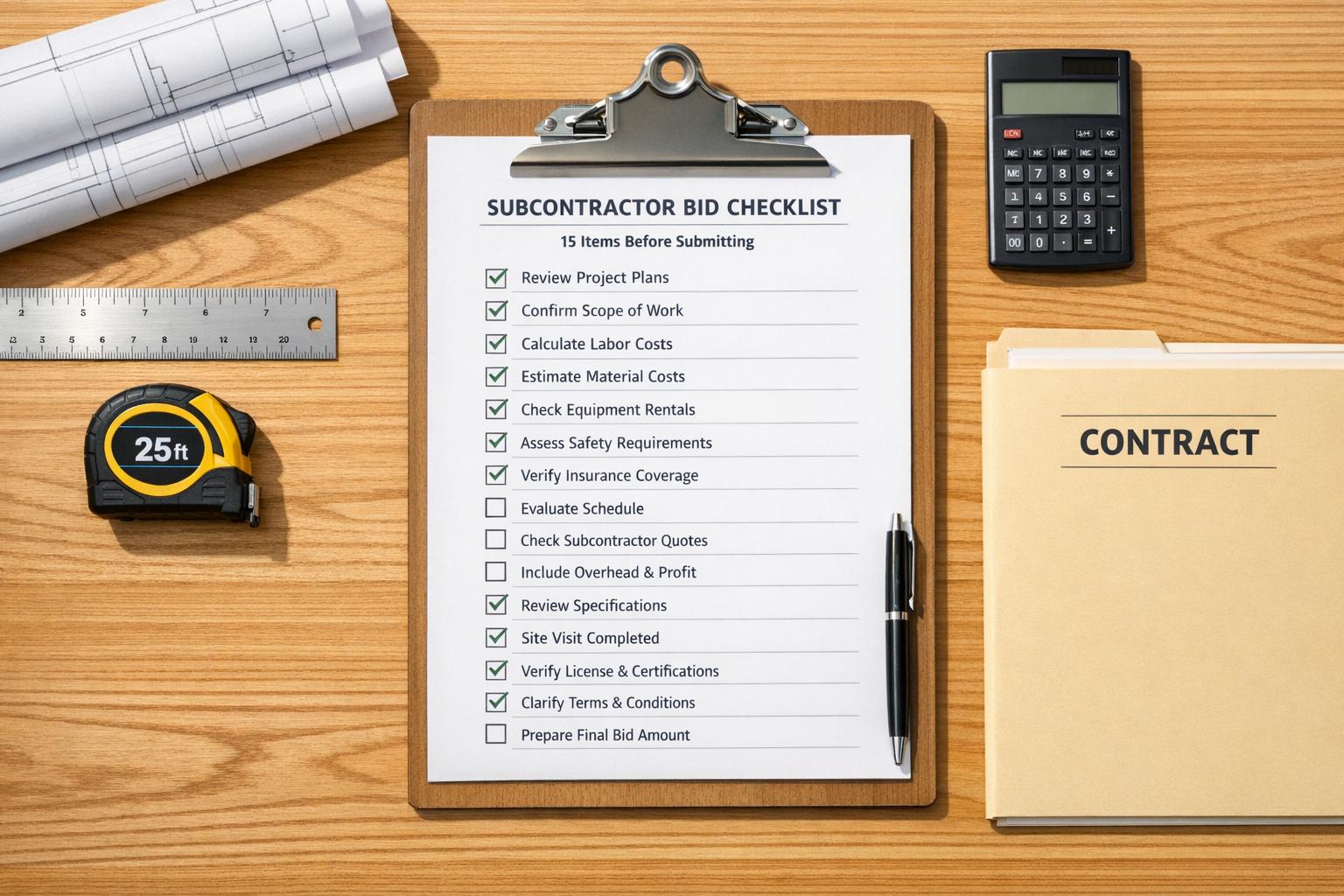
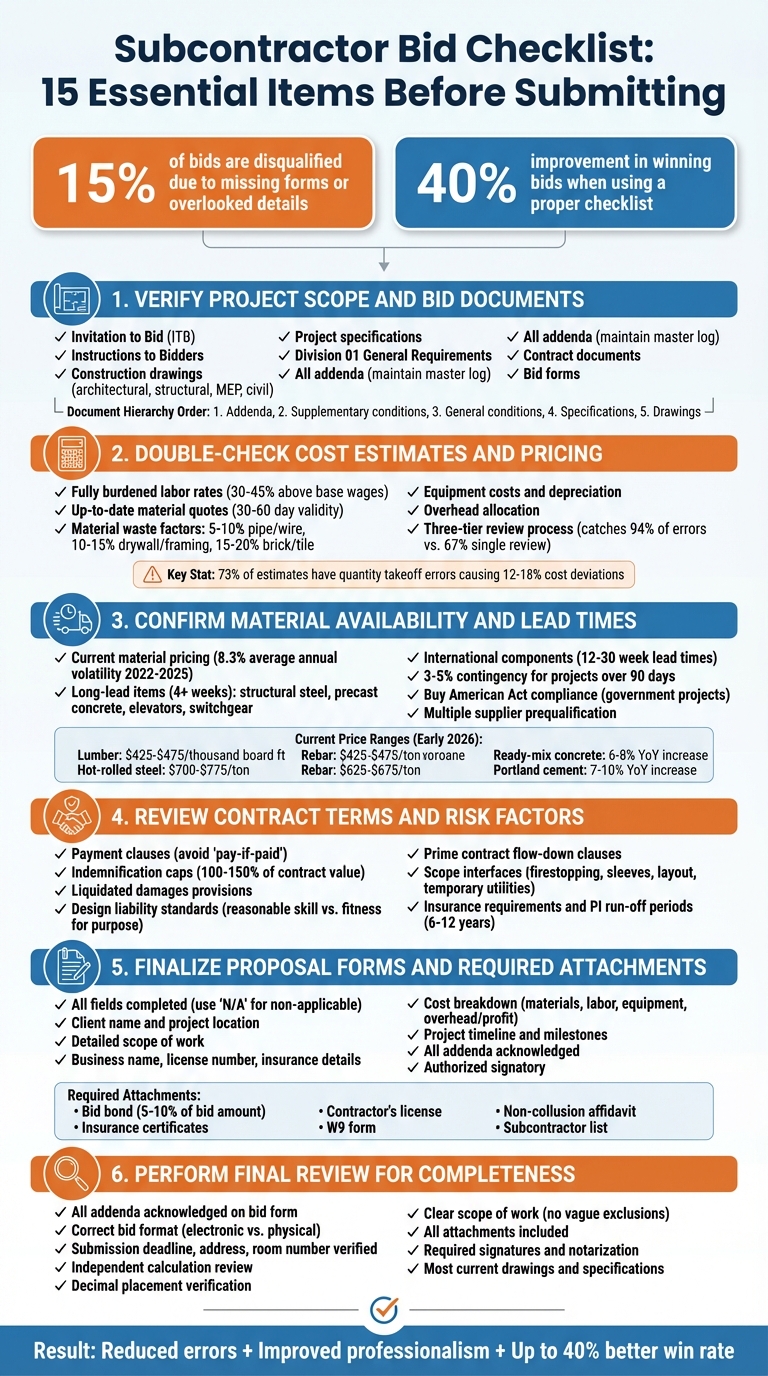
Submitting a bid without proper preparation can lead to costly mistakes, like missing forms or overlooked details, which disqualify around 15% of bids. To avoid this, use a 15-item checklist to ensure your proposal is accurate, complete, and competitive. This process not only reduces errors but also improves your chances of winning bids by up to 40%. Here’s what to focus on:
- Verify Documents: Ensure all bid materials, including addenda, are complete and accurate.
- Review Costs: Double-check labor rates, material prices, and overhead for accuracy.
- Check Material Availability: Confirm lead times and include contingencies for price changes.
- Examine Contract Terms: Look out for risky clauses like "pay-if-paid" or excessive liability terms.
- Complete Forms: Ensure all fields are filled, signatures are correct, and attachments are included.
- Final Review: Double-check everything – missing details or errors can disqualify your bid.
This checklist saves time, prevents errors, and demonstrates professionalism, helping you submit bids that stand out for their thoroughness and reliability.
15-Item Subcontractor Bid Checklist Before Submission
How To Make a Subcontractor Proposal
sbb-itb-4ee4ad4
1. Verify Project Scope and Bid Documents
Before diving into pricing, take a moment to ensure you have every required document in hand. This step is critical in avoiding costly mistakes down the line. Your bid package should include the Invitation to Bid (ITB), Instructions to Bidders, construction drawings (covering architectural, structural, MEP, and civil aspects), project specifications, Division 01 General Requirements, all addenda, contract documents, and bid forms. Missing even one sheet of drawings or a section of the specifications can lead to underpricing or scope gaps that could hurt your bid.
Pay particular attention to Division 01 and the Instructions to Bidders. These sections outline essential details like temporary facilities, submittal requirements, quality control measures, closeout procedures, submission formats, pre-bid meeting information, and bid security requirements. These details can directly impact your bid preparation and pricing.
Addenda deserve your utmost attention. These updates override the original documents and must be acknowledged on your bid form. To stay organized, maintain a master addenda log that tracks the addendum number, issue date, and the changes made. Regularly check the procurement portal for updates – especially on submission day – or set up email alerts to ensure nothing slips through the cracks.
"Failure to acknowledge addenda can make your bid non-responsive and disqualify you from award." – CBConstructionBids.ai Team
When you encounter conflicting information – like a drawing showing a 6-inch base while the specs call for 4 inches – use the document hierarchy to resolve it. Follow this order: addenda, supplementary conditions, general conditions, specifications, and then drawings. If the conflict remains unclear, submit an RFI immediately to clarify. Also, verify drawing scales to avoid guessing dimensions, as assumptions can lead to errors.
Once you’ve confirmed that all documents are accurate and accounted for, you’ll be ready to move forward with refining cost estimates and pricing details. This thorough review at the outset will save time and prevent headaches later.
2. Double-Check Cost Estimates and Pricing
Carefully reviewing cost estimates is essential – mistakes in quantity takeoffs impact 73% of estimates and can lead to deviations of 12–18% from actual costs. Even a small error in labor rates or material quantities can snowball, turning a seemingly profitable project into a financial loss.
Start by verifying fully burdened labor rates, which should include FICA, workers’ compensation, health benefits, and PTO. These can increase base wages by 30–45%. For materials, ensure quotes are up-to-date since they often expire within 30–60 days. Given the average annual material price volatility of 8.3% from 2022–2025, relying on outdated quotes can lead to costly miscalculations. Don’t forget to factor in waste: 5–10% for pipe and wire, 10–15% for drywall and framing, and 15–20% for brick and tile.
Equipment costs also need attention. Use an internal rental rate for owned equipment to account for depreciation and maintenance. Allocate overhead consistently, whether as a percentage of direct costs or based on labor hours. Perform a sanity check by calculating costs per square foot or per unit and comparing these figures to historical data. If the numbers seem off, investigate further to pinpoint the issue.
"Quantity errors are the most damaging because they cascade through the entire estimate. Wrong quantities multiplied by correct unit costs produce wrong totals." – David Martinez, CBDavid Martinez
To minimize errors, adopt a three-tier review process: self-check, peer review, and management sign-off. This method catches 94% of significant errors, compared to just 67% when only one person reviews the estimate. Make sure your base bid aligns perfectly with your detailed estimate, and price alternates or unit changes fairly to avoid financial losses during change orders.
Lastly, be cautious about the markup versus margin difference. For example, applying a 20% markup on $100,000 in costs results in a $120,000 sell price, which equates to only a 16.7% margin. To achieve a true 20% margin, you’d need to use a 25% markup. Getting this right is critical to protecting your profit margins.
Once your cost estimates are locked in, the next step is to confirm material availability and lead times.
3. Confirm Material Availability and Lead Times
When estimating project costs, understanding current material availability is essential. Using outdated data – like bidding for 2026 projects with mid-2025 pricing – can lead to serious margin losses. Key materials such as steel, copper, lumber, and concrete often see price fluctuations of 10–20% between the bid submission and the project start. On top of that, extended lead times can disrupt schedules and escalate costs.
For materials with lead times exceeding four weeks, categorize them as long-lead items. Items like structural steel, precast concrete, curtain wall systems, elevators, electrical switchgear, and mechanical chillers often require anywhere from 14 to over 52 weeks for fabrication after design approval. When sourcing components internationally, lead times can range between 12 and 30 weeks. To avoid surprises, ask suppliers for their latest procurement data, including current lead times, a list of long-lead items, and deadlines for approvals and releases to meet the project schedule.
Ensure supplier quotes are up to date. For example, as of early 2026, lumber prices have stabilized between $425 and $475 per thousand board feet, hot-rolled steel coil ranges from $700 to $775 per ton, and rebar costs around $625 to $675 per ton. Ready-mix concrete prices increased 6–8% year-over-year in late 2025, while Portland cement rose by 7–10%. For projects spanning over 90 days, consider adding a material escalation clause or a 3–5% contingency to mitigate price volatility risks.
Pay close attention to project specifications. Proprietary requirements that mandate specific brands can lead to "monopoly pricing" or supply chain bottlenecks if substitutions aren’t permitted. Look for "or approved equal" clauses that allow flexibility to suggest alternatives with better availability. On government projects, ensure compliance with regulations like the Buy American Act, which requires proof of domestic manufacturing for materials such as steel. During bid leveling, double-check for any assumptions about cheaper substitutions that might not align with project requirements.
"Lead times can swing, labor availability can change week to week, and scope packages are increasingly interdependent." – ContractorBusinessGuide
Document all verbal clarifications from suppliers regarding material availability and pricing in a written log to attach to your final subcontract. This step safeguards against shifting delivery dates or unforeseen bottlenecks. To further reduce risks, prequalify multiple suppliers for critical items and explore nearshoring or regional sourcing for materials on the critical path. Once material availability is confirmed, the next step is to evaluate contract terms and potential risk factors.
4. Review Contract Terms and Risk Factors
Once you’ve confirmed material availability, the next step is to carefully examine the contract terms. This is crucial for protecting your payment rights and minimizing financial risks, ensuring your bid remains both competitive and secure.
Payment clauses are particularly important to scrutinize. For instance, a "pay-if-paid" clause ties your payment to the general contractor receiving funds from the owner. If the owner doesn’t pay, you might not get paid either. On the other hand, a "pay-when-paid" clause only delays your payment but ensures you’ll eventually receive it. To safeguard your rights, work to remove any "pay-if-paid" language from the contract.
Indemnification clauses are another area to review closely. It’s wise to cap liability between 100% and 150% of the subcontract value. Be cautious of terms like "unlimited liability" or "broad indemnification", which could expose you to excessive risk. Similarly, review liquidated damages (LDs) provisions to ensure they only apply if your work directly causes delays. LDs tied to issues you can’t control, such as upstream delays, should be avoided.
"A £50,000 subcontract carrying £10,000-per-week LDs should raise immediate questions".
Pay close attention to design liability standards as well. Most Professional Indemnity (PI) insurance policies only cover "reasonable skill and care", which means acting as a competent professional would. However, some contracts may require a "fitness for purpose" guarantee, which holds you responsible for achieving a specific result regardless of your competence. If the contract demands this higher standard, negotiate it down or confirm your insurer can cover the gap. Accepting an uninsured obligation can pose a significant risk.
Before signing, request a copy of the prime contract to check flow-down clauses. Look for "no damage for delay" provisions, which could leave you covering labor and equipment costs during delays caused by the general contractor or owner. Also, ensure that termination for convenience clauses allow for reimbursement of pre-purchased materials.
Clearly define scope interfaces to avoid disputes over responsibilities. Specify who is responsible for items like firestopping, sleeves, layout, and temporary utilities. Replace vague phrases like "standard exclusions apply" with detailed exclusions and assign them to the appropriate party (e.g., "Owner to provide temporary power"). If anything in the contract is unclear, submit a Request for Information (RFI) to get an official addendum.
Lastly, have your insurance broker review the contract’s insurance schedule. Confirm that required coverages, such as PI run-off periods of 6–12 years, are both available and affordable before committing.
5. Finalize Proposal Forms and Required Attachments
Once you’ve reviewed the contract terms, it’s time to finalize your proposal documents. This step is crucial because even the most competitive bid can be disqualified if forms are incomplete or attachments are missing. Attention to detail here can make or break your submission.
Make sure every field on the bid form is filled out. If a section doesn’t apply, write "N/A" instead of leaving it blank, as empty fields can cause confusion and might lead to rejection. Double-check that your proposal includes the client’s name, project location, and a detailed scope of work. Add your business name, license number, insurance details, and contact information. Break down costs clearly, separating materials, labor, equipment, and overhead or profit. Don’t forget to outline your project timeline, including start and completion dates, major milestones, and payment terms.
"Incomplete project information is the most frequent disqualifying mistake, where contractors fail to cover all project requirements or specifications outlined in the invitation to bid." – Bridget Cooper
Acknowledge all addenda provided during the bidding process. Missing even one can disqualify your bid instantly. Verify that the signatory on your forms is authorized to legally bind your company – some projects may even require notarized signatures from specific corporate officers. Before submitting, confirm that all supporting documents and certifications are included.
Prepare all required attachments ahead of the submission deadline. These typically include a bid bond (usually 5–10% of your bid amount), insurance certificates, contractor’s license, a completed W9, a non-collusion affidavit, and a list of subcontractors. For projects that require qualification statements (like AIA A305), include your company history, resumes of key personnel, and examples of relevant project experience. Organize everything according to the RFP checklist, and name your files exactly as listed in the request. This makes it easier for the procurement team to evaluate your submission. Proper documentation ensures your bid stands out and meets all requirements.
6. Perform a Final Review for Completeness
Once you’ve checked the project scope, pricing, material availability, contract terms, and proposal forms, it’s time for a thorough final review. This step ensures nothing critical slips through the cracks. Mistakes at this stage – like missing details or errors in calculations – can lead to disqualification or unexpected costs. A methodical review helps safeguard your bid and keeps it competitive. Having a fresh set of eyes, such as a colleague, examine the bid can also help catch anything missed in the rush to meet deadlines.
Start by confirming that every addendum is acknowledged on your bid form. Forgetting even one can result in immediate disqualification, no matter how attractive your pricing is. Double-check that all bid prices follow the requested format. Review the submission requirements carefully: does the client want an electronic file or a physical copy? If it’s a hard copy, how many are needed? Verify the delivery details, including the exact deadline, street address, and room number. Missing the deadline – even by minutes – can render your bid useless.
"A perfectly priced bid submitted five minutes late is worthless. Deadline management is just as important as accurate estimating." – Bridget Cooper
Have someone independently review all calculations and pricing. Even a small error, like a misplaced decimal or a transposed digit, can turn a profitable project into a costly mistake. Pay close attention to decimal placement in both quantity and pricing figures. Make sure your scope of work clearly outlines all major tasks and materials. Avoid vague terms like "standard exclusions apply" and instead provide a detailed, itemized list of exclusions.
Finally, confirm that all required attachments listed in the Instructions to Bidders are included. Check that all necessary forms are signed by an authorized corporate officer and notarized if required. Ensure your estimate incorporates the most up-to-date drawings and specifications. This final review ties together all earlier checks, ensuring your bid is accurate, professional, and ready for submission. It’s the last step to show clients you’re serious about the project and your work.
Conclusion
Using this 15-item checklist transforms your bidding process into a well-organized and strategic approach. By systematically reviewing each bid, you can avoid preventable mistakes and present yourself as a reliable, detail-oriented professional to general contractors.
This shift in approach helps reduce risks while improving the competitiveness of your bids. A structured review process ensures you catch issues like arithmetic errors, incorrect units, or scope gaps before they derail your bid’s profitability. Providing clear scope narratives, exclusions, and accurate pricing breakdowns simplifies bid leveling and gives you an edge over competitors.
"Making even the smallest mistake can mean the difference between submitting a winning bid and missing out on a coveted and profitable project".
Thorough pre-submission reviews foster trust with general contractors, who value subcontractors with organized and consistent processes. This not only minimizes their risks but also strengthens your professional relationships. By following this checklist, you protect your profit margins, build credibility, and enhance client trust.
Ultimately, this checklist is more than a tool – it’s a way to reinforce your reputation and ensure success in every project bid. Each item plays a critical role in achieving clarity, accuracy, and financial security. Every bid is your chance to showcase professionalism, mitigate risks, and prove your ability to deliver on promises. Winning isn’t just about offering the lowest price – it’s about understanding the project, managing risks effectively, and standing out as a dependable partner.
FAQs
What’s the fastest way to catch scope gaps before pricing a bid?
To spot scope gaps quickly, make it a priority to thoroughly review all bid documents – this includes specifications, drawings, and any addenda. A clear understanding of the project scope starts here. Keeping these documents organized digitally can also help you stay on top of updates. Finally, cross-check your scope with the bid requirements to confirm every detail is accounted for, avoiding mistakes before you submit your bid.
How do I protect my bid from material price increases and long lead times?
To safeguard your bid, consider adding an escalation clause to your contract. This allows for price adjustments if material costs increase substantially. Additionally, make sure to secure up-to-date quotes from suppliers and include contingency allowances to account for potential price hikes. These measures can help you manage risks associated with fluctuating prices and long lead times, ensuring your profitability stays intact.
Which contract clauses are the biggest red flags for subcontractors?
Key warning signs in contract clauses for subcontractors include unlimited liability, auto-renewal provisions, and unfair payment terms like delayed payments or overly strict conditions. These clauses can lead to major financial risks and operational headaches. Always review the terms thoroughly to steer clear of unexpected obligations.