
Low Bid Win Rate? 5 Ways to Improve Estimate Accuracy
Struggling to win bids or maintain profit margins? The solution lies in improving your estimating accuracy. Construction estimates often miss final costs by 12–18%, and 86% of projects exceed their budgets. Small errors – like a 5% mistake – can cost hundreds of thousands of dollars on larger projects.
Here are 5 proven strategies to tighten your estimates, reduce errors, and secure more profitable bids:
- Use Advanced Estimating Software: Automate measurements and calculations to cut errors by up to 70%.
- Leverage Digital Takeoff Tools: Eliminate manual mistakes and speed up takeoff processes by 40–70%.
- Analyze Historical Data: Track past project costs to reduce future estimating errors by 35%.
- Create Standardized Templates: Build reusable frameworks to ensure consistency and save time.
- Implement Structured Bid Reviews: A three-tier review process can catch 94% of errors before submission.
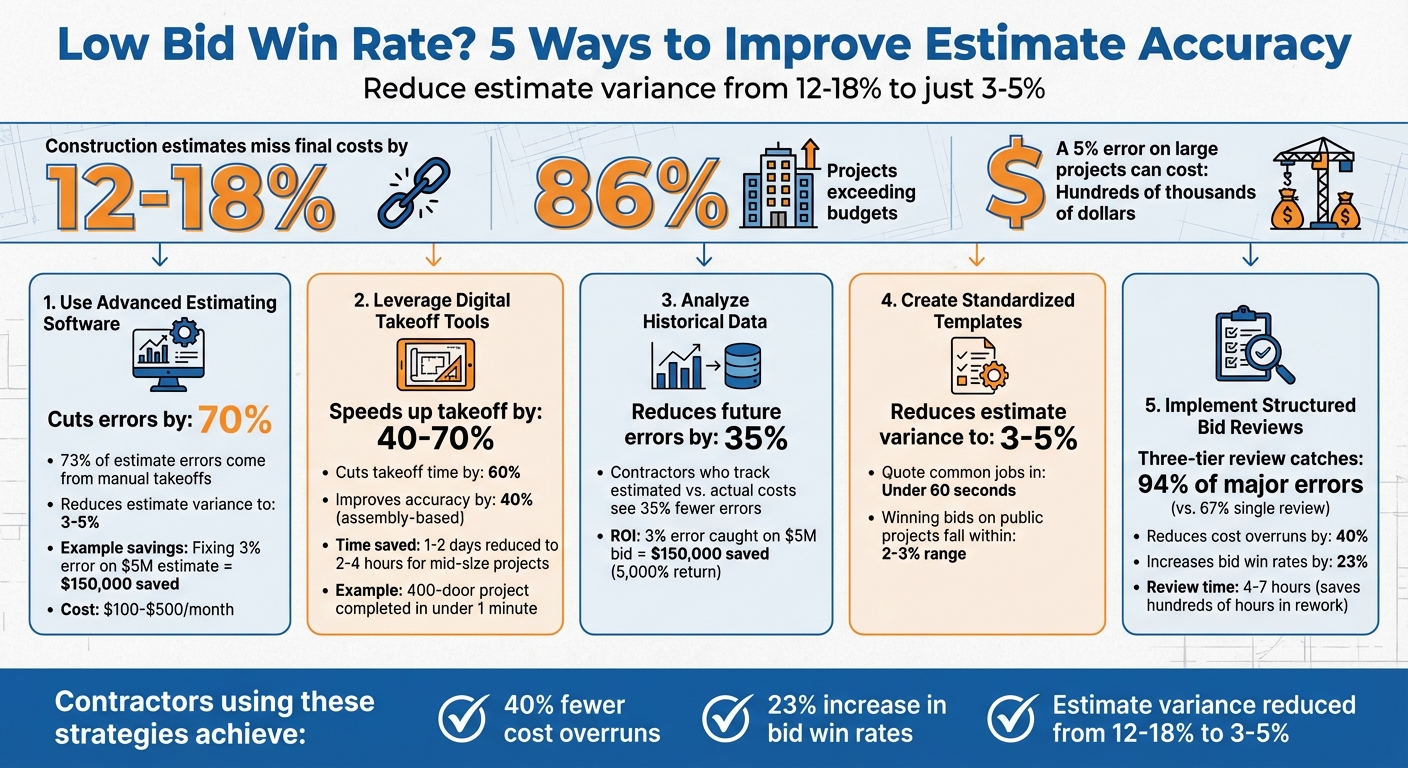
5 Strategies to Improve Construction Estimate Accuracy: Key Statistics and Benefits
5 Easy Ways To Avoid Estimating Errors
sbb-itb-4ee4ad4
1. Use Advanced Estimating Software like ScopeTakeoff
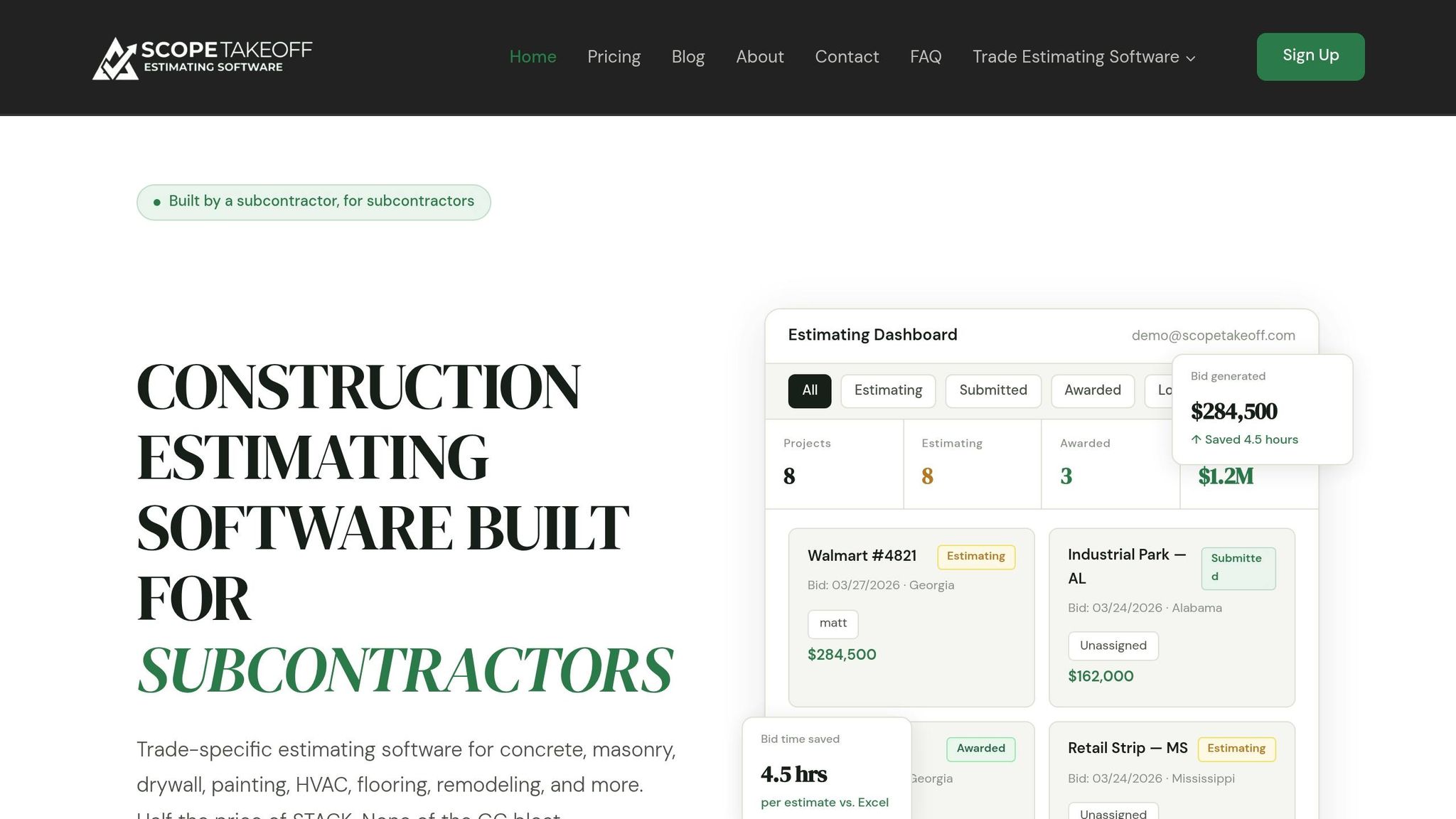
Did you know that 73% of estimate errors come from manual takeoffs? Relying on manual tools for measurements often leads to compounded mistakes. Advanced estimating software like ScopeTakeoff takes the guesswork out of the equation by automating measurements, calculations, and pricing updates throughout your bid process.
How It Improves Accuracy
Digital takeoff tools use computer vision to analyze building components directly from PDF plans. These tools can flag anomalies – like items that don’t align with historical data – before they’re incorporated into your bid. With this approach, estimate variance drops dramatically from 12–18% to just 3–5%.
Let’s put that into perspective: fixing a 3% error on a $5 million estimate saves $150,000. That’s a massive return on the time invested in a digital review – over 5,000%.
"Digital takeoff software eliminates scale errors and measurement inconsistencies. Cross-referencing quantities against square-foot benchmarks catches outliers before they embed in the estimate." – David Martinez, CBDavid Martinez
ScopeTakeoff’s assembly-based system ensures that all related components – like screws, adhesive, and labor – are automatically included when you measure a primary item. Plus, its regional pricing models adjust for real-time material costs, labor rates, and local market conditions. This means your bids stay current and reflect the realities of your market, not outdated data.
Speeding Up Your Workflow
Precision is one thing, but speed matters too. Digital tools powered by AI can extract quantities in just minutes, cutting takeoff time by 60%. Instead of tediously tracing walls, doors, and outlets across multiple pages, you simply review and confirm the software’s findings. Cloud-based platforms take it a step further by centralizing drawings, scope notes, and historical data. This ensures that any cost updates automatically sync across your takeoff-to-estimate workflow.
Affordable and Cost-Effective
Professional digital tools typically cost between $100 and $500 per month. ScopeTakeoff, priced at $100 per person per month, offers a lot for its price: access to 10+ trade assembly libraries, unlimited projects, PDF plan takeoff, and even client-ready proposal exports. There’s no annual contract either, so you’re not locked in. The savings from avoiding costly errors and the time you’ll gain make it a smart investment for improving bid accuracy and efficiency.
2. Improve Quantity Takeoffs with Digital Tools
Quantity takeoff errors impact 73% of construction estimates, and even a small mistake – like a 10% error on a $500,000 project – can lead to a $50,000 discrepancy before pricing is even factored in. Digital tools simplify this process, eliminating errors from manual scale readings. Let’s dive into how these tools enhance both accuracy and efficiency.
Boosting Accuracy
Traditional takeoffs, relying on scale rulers, printed plans, and manual calculations, are prone to mistakes at every step. In contrast, digital tools automate the process, calculating areas, lengths, volumes, and counts with precision. Features like color-coded markups on PDF plans ensure no detail – like doors, outlets, or square footage – is overlooked.
Assembly-based takeoffs take this even further. For example, when measuring a wall, these tools automatically include related components such as studs, drywall, fasteners, and adhesive. This ensures that every associated item is accounted for, improving estimating accuracy by 40%.
"Quantity errors are the most damaging because they cascade through the entire estimate. Wrong quantities multiplied by correct unit costs produce wrong totals." – David Martinez, ConstructionBids.ai
Saving Time
Digital takeoff software can slash the time needed for takeoffs and estimates by 40–70%. For mid-size commercial projects, this means what used to take 1–2 days can now be completed in just 2–4 hours. A great example? Carroll Estimating used automated counting tools to complete a 400-door project in under a minute.
These tools also make revisions easier. Overlay features highlight changes between drawing versions in different colors, allowing you to update quantities instantly instead of starting over. For projects with repetitive layouts, like hotels or apartment complexes, you can perform a takeoff once and replicate it across similar spaces. Plus, cloud-based platforms enable multiple estimators to collaborate on the same file, cutting down communication delays and speeding up turnaround times. All these efficiencies integrate seamlessly with your existing estimating workflow.
Seamless Integration into Current Processes
Digital tools aren’t just faster – they’re easy to incorporate into your current workflow. Since most modern projects already provide digital PDF plans, integration is straightforward. The learning curve is manageable, with most estimators becoming proficient in just 2–4 weeks. Once mastered, the data from takeoffs can flow directly into estimating sheets, automatically updating the final bid price.
These tools also help catch errors early. By cross-referencing quantities against square-foot benchmarks, you can identify and correct outliers before they affect your estimate. Additionally, a three-tier review process – combining self-checks, peer reviews, and management reviews – can catch 94% of major errors before bid submission, compared to just 67% with a single review.
Digital tools are transforming takeoffs, making them faster, more accurate, and easier to manage – saving both time and money while reducing stress.
3. Use Historical Cost Data for Better Pricing
Looking at past projects can be a game-changer when it comes to accurate estimates. Analyzing historical data is one of the most effective ways subcontractors can improve their estimating accuracy. The stats don’t lie: contractors who track estimated versus actual costs on every project see a 35% reduction in future estimating errors.
Accuracy Improvement Potential
To get started, set up a simple tracking system. A spreadsheet works just fine – record your estimates and actual costs by CSI division for your last 10 projects. Then, calculate the variance to spot any consistent patterns. It’s a straightforward process: during construction, assign actual costs to the same categories. Once the project wraps up, compare the estimated and actual costs line by line to calculate variance percentages for each division.
This process uncovers trends you might miss otherwise. For instance, you may find you’re underestimating electrical work by 12% or that concrete costs consistently run 7% over budget. Once you identify these patterns, you can adjust future bids accordingly. For example, if your data shows a consistent 7% underestimation in concrete costs, you can apply a 1.07 adjustment factor to your future bids. Similarly, monitor material waste based on actual job site data rather than relying on generic allowances like 5–15%.
"Five years of data across 50+ projects creates a powerful predictive tool that no published cost guide can match. Your database reflects your crews, your markets, your management approach, and your actual cost structure." – ConstructionBids.ai
With this tracking system in place, you can use these insights to fine-tune your future estimates.
Cost-Effectiveness
The financial benefits are hard to ignore. Catching a 3% error on a $5 million bid through data-backed reviews can save $150,000 – a return of over 5,000% on the time spent reviewing. Historical data also lets you identify areas to save money, like renegotiating subcontractor rates or switching materials based on past performance. By tracking the difference between a subcontractor’s initial quote and their final cost, you can pinpoint which partners consistently provide reliable pricing.
Time-Saving Benefits
Digital estimating tools make this process even faster. These platforms centralize your historical data, allowing you to create quick preliminary estimates using parametric modeling. Instead of starting from scratch with every bid, you can rely on standardized cost libraries and templates built from your actual project history. Use square-foot cost benchmarks tailored to project type, size, and location to validate new estimates against your historical averages. If a new bid deviates significantly from your past data, investigate the reasons before submitting. And by updating your adjustment factors quarterly with new project data, you can keep your estimates aligned with current market trends.
Leveraging historical data not only sharpens your estimates but also streamlines your entire bidding process, setting you up for more accurate and efficient future projects.
4. Create Standard Estimates with Templates and Assemblies
Using top construction estimating software and data insights becomes even more effective when paired with standardized templates and assemblies. These tools ensure consistency and thoroughness in every bid while saving time and reducing errors.
Starting estimates from scratch often leads to missed items or inconsistent pricing. Templates and assemblies address this by providing reusable frameworks that improve accuracy and cut down repetitive work. The idea is simple: create a detailed "Master Template" for each core service you offer – whether it’s a bathroom remodel or recessed lighting installation. This template includes every potential line item. For a new job, you simply duplicate the template and remove any irrelevant items instead of starting from zero.
Accuracy Improvement Potential
Templates act as built-in checklists, ensuring you don’t forget essential items like debris removal, permit fees, insurance, or admin costs. Assemblies take it further by bundling related components – materials, labor, and equipment – into a single package. For instance, an electrical assembly for a light fixture might automatically include the fixture, wiring, labor hours, and necessary controls. This ensures no critical component gets overlooked.
The impact is clear. While traditional estimates often vary by 12–18%, structured templates can reduce this variance to just 3–5%. On public projects, where winning bids often fall within a narrow 2–3% range, this level of precision can be the deciding factor between securing the job or losing out. Templates and assemblies also work seamlessly with digital takeoff processes and historical data, ensuring every cost component is consistently included.
Time-Saving Benefits
The time savings are impressive. Templates allow contractors to quote common jobs in under 60 seconds. Assemblies streamline the process further by adding multiple related items to your takeoff with a single click, eliminating repetitive data entry. Setting up a basic bid template takes just a few hours, and the time saved on future estimates quickly adds up.
Templates also make client communication more efficient. You can duplicate your master template to create tiered pricing options, showcasing flexibility and professionalism while increasing your average job value. For larger projects exceeding $100,000, breaking quotes into phases like Demo, Framing, and Finishing makes proposals easier for clients to understand while maintaining accuracy.
Ease of Integration into Existing Workflows
Incorporating templates into your workflow is straightforward and doesn’t require a complete process overhaul. Start with master templates for common job types. Include standard terms, payment schedules, and warranty details in the template notes to ensure consistent legal protections across all bids. You can also create smaller "mini-templates" for frequent add-ons or change orders – like those last-minute "while you’re here" requests – so you can quickly provide professional quotes for extra work.
Templates also double as training tools. New estimators can quickly learn your company’s pricing and scope standards by working from these frameworks rather than starting from scratch. To keep your templates relevant, update unit costs monthly for fluctuating material prices and review which templates are most used and profitable on a quarterly basis.
5. Add Bid Review Workflows and Math Checks
Even with standardized templates ensuring a solid foundation, a thorough bid review process is your final defense against costly mistakes. While digital tools and templates provide a great starting point, they can’t catch everything. That’s where a structured review comes in – it acts as a safety net, spotting issues that could either lose you the job or lead to unprofitable contracts.
Accuracy Improvement Potential
A well-designed three-tier review system can identify 94% of major errors before submission, compared to just 67% with a single reviewer. Think about it: catching a 3% error on a $5 million estimate could save $150,000. That’s a return of over 5,000% on the time spent reviewing.
Here’s how the three tiers work:
- Tier 1: Self-Review
The estimator spends 30–60 minutes using a checklist to catch math errors, missing items, and unit mismatches. - Tier 2: Peer Review
A second estimator reviews the five highest-value line items and challenges pricing assumptions for items over $50,000. This step typically takes 2–4 hours. - Tier 3: Management Review
Senior leadership spends 1–2 hours assessing strategic alignment, risk allocation, and whether contingencies are adequate.
This method significantly reduces estimate variances – bringing the industry average of 12–18% down to just 3–5%. It also leads to 40% fewer cost overruns and boosts bid win rates by 23%.
Time-Saving Benefits
Although a full review adds 4–7 hours to the pre-bid process, it can save hundreds of hours later by avoiding the headaches of damage control and rework caused by errors. The key is focusing your efforts where they matter most. During peer reviews, for example, spend 80% of your time on the 20% of line items that drive the bulk of costs. Cross-referencing quantities and costs against square-foot benchmarks can quickly flag any outliers needing attention.
Tools like ScopeTakeoff’s bid review workflow feature make this process more efficient by keeping the entire team on the same page and ensuring nothing is overlooked. After the project wraps up, comparing estimated costs with actual expenses on a line-by-line basis can reveal patterns that help contractors cut future estimating errors by 35%.
Conclusion
Winning bids in today’s competitive market comes down to one thing: accurate estimating. Precision in your estimates can mean the difference between growing your bottom line or losing money. By applying the five methods outlined here, you can shrink estimate variance from the industry average of 12–18% to just 3–5%.
Each of these strategies – leveraging advanced digital tools, refining takeoffs, analyzing historical data, using standard templates, and conducting thorough bid reviews – tackles key weaknesses in traditional estimating practices. For example, tools like ScopeTakeoff can cut quantity takeoff time by 60% through automation. Digital solutions also eliminate scale reading errors, which account for up to 73% of quantity mistakes. Historical cost data counters the optimism bias that often leads to underpricing, while standard templates ensure no cost category is overlooked. Finally, structured review processes catch 94% of major errors before submission. Contractors who adopt these practices see 40% fewer cost overruns and a 23% increase in bid win rates. On public projects, where winning bids often fall within a narrow 2–3% margin, even small improvements in accuracy can significantly enhance your chances of success – without cutting into profits.
Focus on the method that addresses your biggest pain point. If takeoffs are eating up too much time, start with digital tools. If you’re consistently underpricing certain trades, dig into your historical cost data. The goal is to create a repeatable, data-driven process that minimizes guesswork and safeguards your margins. By implementing these strategies, you’ll not only improve bid accuracy but also secure profitable projects in a highly competitive market. Success in 2026 isn’t about being the cheapest bidder – it’s about being strategic, precise, and delivering real value.
FAQs
Which estimate mistakes most often kill my win rate?
When it comes to estimating, certain mistakes can seriously affect your chances of winning bids. Some of the most frequent issues include:
- Quantity Takeoff Errors: Miscalculating materials or labor needs can throw off your entire estimate.
- Outdated Unit Costs: Using old cost data means your bid may not reflect current market conditions.
- Scope Interpretation Issues: Misunderstanding the project scope can lead to over- or underestimating.
- Overlooking Site Conditions: Missing critical details about the site can result in unexpected costs.
- Optimism Bias: Being overly optimistic about timelines or costs can lead to underbidding.
These errors can cause your bids to stray 12-18% from actual costs, making them less competitive. To avoid this, focus on accurate quantity takeoffs, keep cost data up to date, and use tools and processes designed to reduce mistakes and improve precision. Small adjustments can make a big difference in your win rate.
How do I start using historical job costs if I don’t track them today?
Start by collecting data from completed projects to create a database of actual expenses. Include details like labor, materials, equipment, and subcontractor costs. You can use a straightforward spreadsheet or a digital tool to keep everything organized. Over time, reviewing these records will reveal cost patterns, helping you fine-tune future estimates. This way, your projections will rely on real-world data instead of guesswork.
What should a quick pre-bid review checklist include?
Before submitting a bid, running through a quick review checklist can make all the difference. Here are the key steps to cover:
- Double-check the scope: Make sure the project requirements are fully understood and correctly interpreted.
- Spot scope gaps: Look for any ambiguities or missing details in the scope and address them upfront.
- Review quantity takeoffs: Ensure all calculations are accurate to avoid costly mistakes later.
- Use historical cost data: Compare estimates against past projects to validate your numbers.
- Assess site conditions: Factor in any unique site-specific considerations that could impact the project.
- Perform a three-tier review: Start with a self-check, then have a peer review it, and finally get management’s approval.
By following these steps, you can minimize errors and increase your chances of submitting a winning bid.