
Ultimate Guide to Trade-Specific Estimating Accuracy
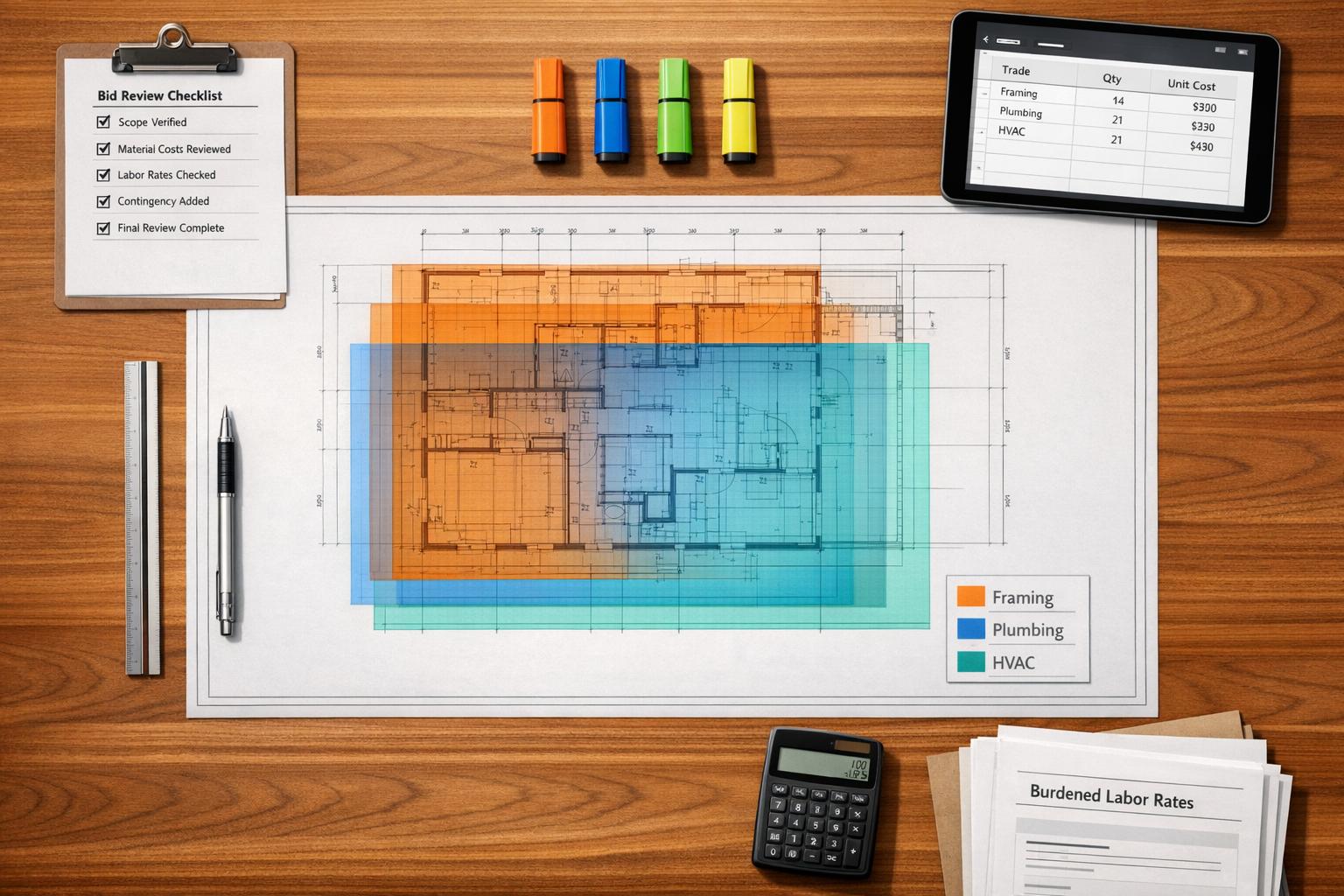
Construction estimates can make or break your business. Even a 5% error on a $2 million project could cost $100,000 or more. With increasing competition and AI-driven bid validations, precision has become non-negotiable. By 2026, government agencies may reject bids deviating too far from independent estimates.
Here’s what you need to know:
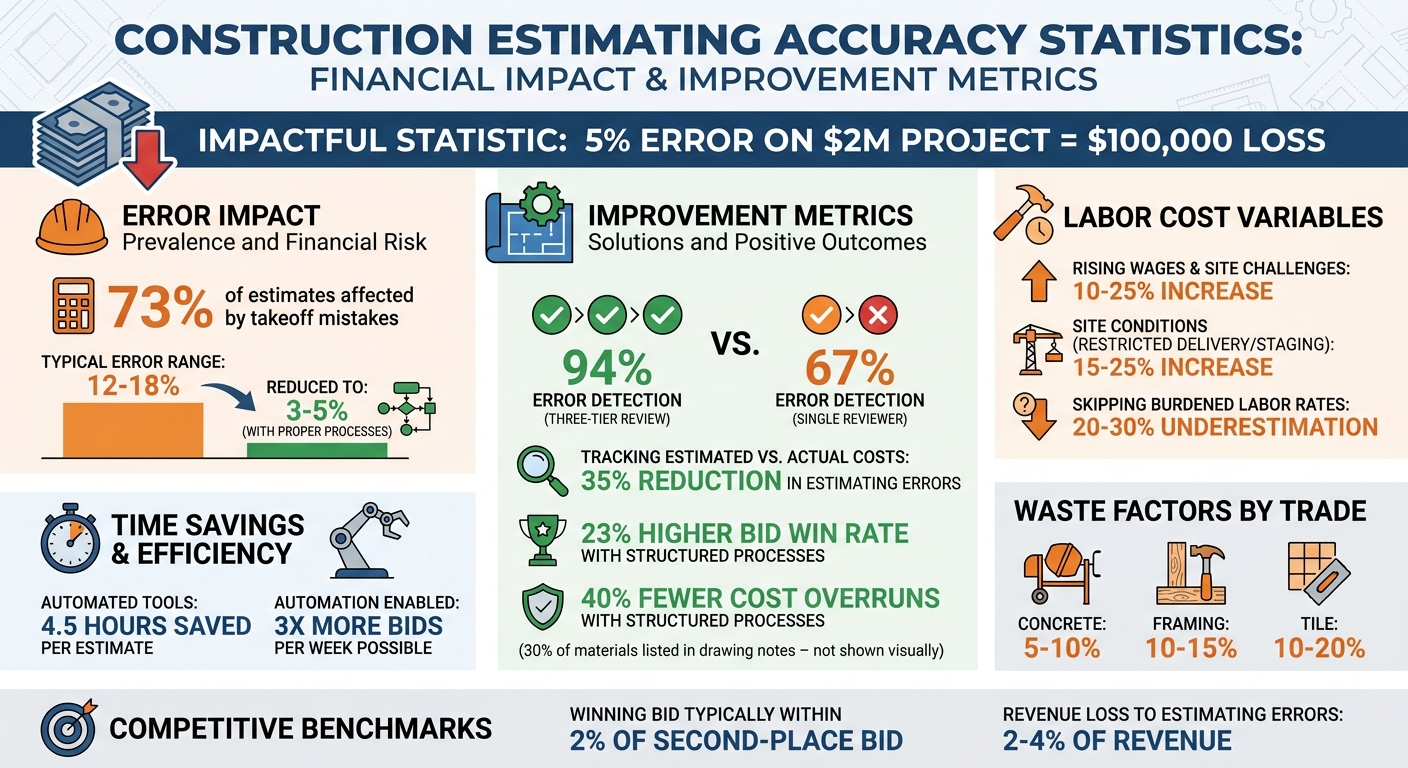
- Common errors: Quantity takeoffs, outdated pricing, and labor miscalculations are frequent culprits, with takeoff mistakes affecting 73% of estimates.
- Trade-specific factors: Each trade has unique variables – like PSI ratings in concrete or slope factors in roofing – that significantly impact costs.
- Labor costs: Rising wages and site-specific challenges can increase labor costs by 10–25%.
- Solutions: Use accurate takeoff tools, historical data, and structured review processes to reduce errors from 12–18% to as low as 3–5%.
The key is combining precise workflows, team collaboration, and software like ScopeTakeoff to streamline calculations and improve accuracy. This guide breaks down strategies to refine your estimates and protect your bottom line.
Construction Estimating Accuracy: Key Statistics and Cost Impact
Core Principles of Accurate Trade Estimating
Accounting for Trade-Specific Variables
Every trade comes with its own set of cost and labor factors that need to be carefully considered. For example, concrete work involves specifics like PSI ratings, application depth (e.g., 4 inches for sidewalks versus 6 inches for driveways), sub-base preparation, and reinforcement materials like rebar or wire mesh. In framing, you need to factor in stud spacing (16 inches versus 12 inches on center), headers for openings, and joist spans that depend on wood species and grade. Roofing estimates require attention to slope factors, the number of shingle bundles per square, underlayment rolls, and ridge caps. When estimating drywall, you’ll need to account for board thickness, type (fire-rated or moisture-resistant), and ceiling height, all of which affect material needs and labor efficiency. Even flooring layouts – like straight versus diagonal patterns – can significantly impact waste calculations.
Labor costs go beyond hourly wages and should include taxes, benefits, union contributions, and tools. Additionally, site conditions – such as restricted delivery times or limited staging areas – can increase labor costs by as much as 15–25%. These trade-specific details underscore the importance of precise quantity takeoffs to ensure accuracy.
Performing Precise Quantity Takeoffs
One of the most common mistakes in estimating is failing to perform accurate quantity takeoffs. Errors like misreading scales, overlooking items on drawings, or neglecting waste factors can derail an estimate. It’s important to remember that 100% material utilization is unrealistic – concrete typically requires 5–10% waste, framing 10–15%, and tile installations may need 10–20% waste, depending on the pattern.
Best construction estimating software and digital takeoff tools can help avoid scale-reading errors and automatically calculate areas, lengths, and counts. Breaking measurements down by floor or area makes tracking easier and avoids redoing the process if more detail is needed later. Another key detail: about 30% of materials are listed in drawing notes rather than shown visually, so skipping these notes can lead to major omissions. A multi-tier review process is also critical – having multiple people check takeoffs significantly reduces errors compared to relying on a single reviewer. Once the takeoff is accurate, past project data can further fine-tune the estimate.
Using Past Project Data
After accounting for trade-specific factors and refining takeoffs, leveraging historical project data is the next step in improving accuracy. Analyzing past data is one of the best ways to enhance estimating because it reflects actual crew performance, local market conditions, and management strategies rather than relying on generic industry averages. Contractors who track estimated versus actual costs on every project can reduce future estimating errors by up to 35%. This process also highlights recurring issues, like consistently underestimating tasks such as electrical rough-ins or drywall finishing.
Post-project reviews are invaluable. Comparing estimated costs to actual costs line-by-line can reveal consistent variances for each trade. For instance, if a specific trade consistently exceeds the budget by 7%, applying a 1.07 multiplier to that category in future bids can account for the discrepancy. Tracking real-world crew productivity – such as how many square feet of drywall are installed per day – provides a more reliable basis for labor calculations than subjective estimates. Maintaining a library of benchmarks, like cost-per-square-foot or cost-per-unit for various project types, also helps identify outliers in new estimates. By building on this foundation of historical data, contractors can continually refine their processes, leading to more accurate and reliable estimates over time.
sbb-itb-4ee4ad4
Proven Methods for Better Trade Estimates
Creating Standard Estimating Workflows
A consistent process can significantly reduce errors in trade-specific estimating. Start by defining the project scope, then move methodically through steps like takeoffs, labor calculations, gathering subcontractor quotes, applying overhead, adding profit, and finishing with a sanity check. This sequence ensures no cost categories are missed. To avoid scope creep or disputes, maintain a "bible" that clearly outlines inclusions and exclusions.
Using standardized templates and CSI MasterFormat divisions helps cover all cost categories systematically. When calculating labor costs, account for fully burdened rates. This includes base pay plus payroll taxes (7.65% FICA), workers’ compensation (around 15%), general liability (3%), benefits, and PTO. Skipping these details can lead to underestimating labor costs by 20–30%. These structured workflows also create a foundation for collaborative input, further improving accuracy.
Getting Team Input on Estimates
Team involvement is critical for catching errors. Field crews, project managers, and other estimators each bring a unique perspective. A three-tier review system works well: the lead estimator checks calculations and units, a peer verifies quantities for high-value items (e.g., items over $50,000), and management evaluates the overall strategy and markup approach.
"A structured three-tier review process catches 94% of significant estimating errors before bid submission, compared to 67% with single-reviewer processes." – David Martinez, ConstructionBids.ai
Field supervisors should validate productivity rates to ensure labor estimates match actual crew performance, not just theoretical averages. Post-project reviews comparing estimated and actual costs can reveal patterns and improve future estimates. Cloud-based platforms also help by giving all team members access to the latest drawings and updates.
Checking Estimates Against Industry Standards
After collaborating on estimates, compare them to industry benchmarks. Resources like RS Means, the ENR Cost Index, and Craftsman provide baseline material and labor costs. Adjust these figures for your region using local market factors. A quick parametric check – such as comparing your cost-per-square-foot to data from 20+ similar projects – can identify major inconsistencies.
In competitive public bids, the winning contractor’s price is typically within 2% of the second-place bid. Update commodity prices monthly to account for market changes. For high-value materials, fresh supplier quotes are more reliable than historical data. Organizing estimates by CSI MasterFormat divisions ensures your line items align with industry norms and client expectations.
Software Tools for Trade-Specific Estimating
What to Look for in Estimating Software
When choosing estimating software, it’s crucial to ensure it handles trade-specific calculations effectively. Tools with pre-built assembly libraries allow users to input a single dimension and automatically generate detailed, priced estimates. These estimates include labor and material breakdowns tailored for trades like concrete, masonry, and drywall. For example, automated trade calculations can convert square footage and depth into cubic yards for concrete, calculate board counts (accounting for openings) for drywall, apply slope factors for roofing, or determine tonnage for asphalt.
Another essential feature is digital plan takeoff, which enables direct measurements from uploaded PDFs – eliminating the risk of manual errors. Additionally, professional output capabilities are important. Look for software that can create a Schedule of Values (SOV) for general contractor submissions or branded client proposals with just one click. Collaboration features, like individual logins for team members and bid review workflows for managers, are also helpful for improving accuracy. Subcontractors juggling multiple licenses will benefit from multi-entity management, which auto-populates license numbers and addresses for different projects. Avoid software overloaded with unnecessary features, as even small pricing or quantity mistakes on a $500,000 project can severely impact profitability.
How ScopeTakeoff Improves Trade Estimating
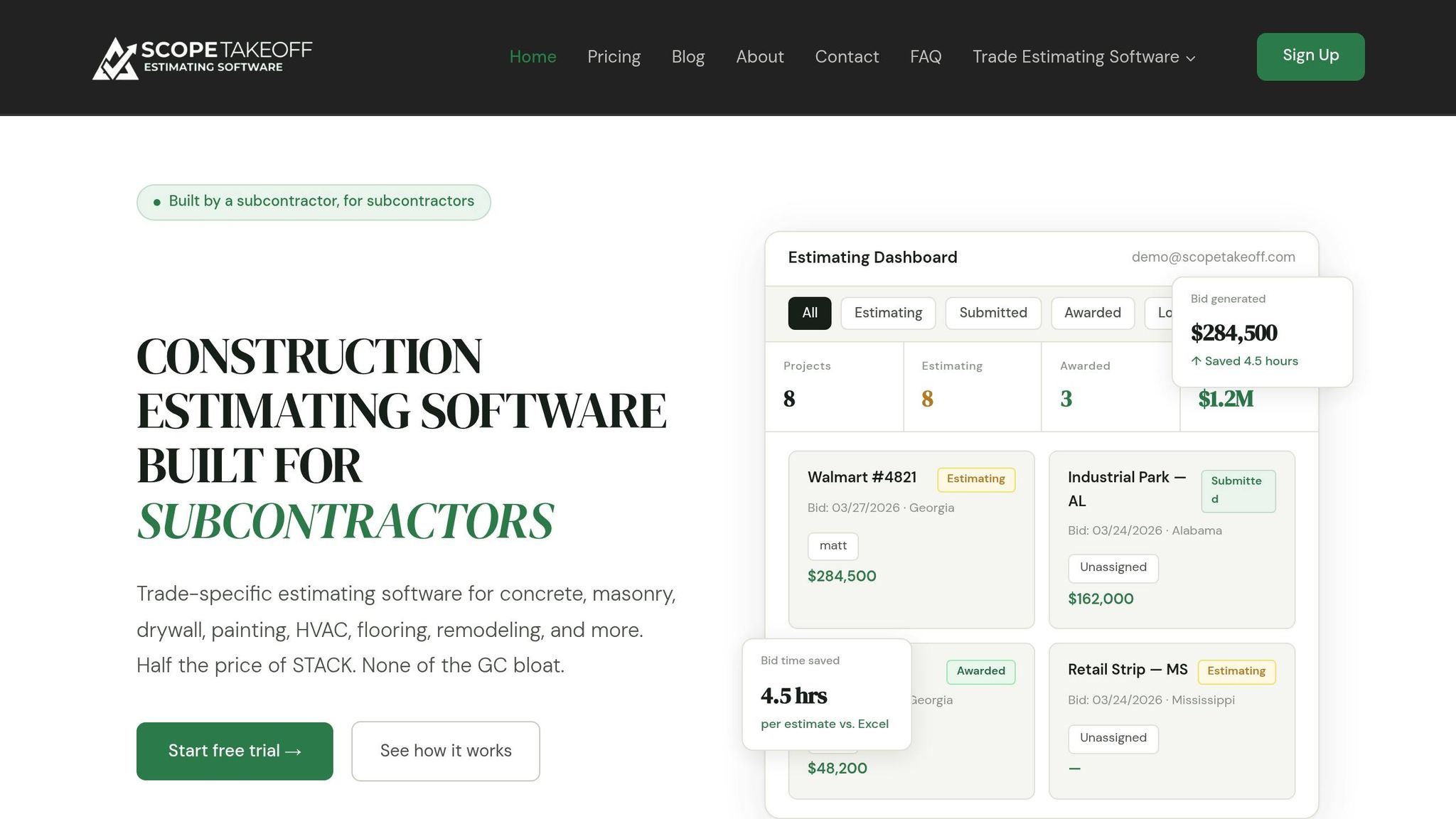
ScopeTakeoff is a great example of how specialized tools can make trade-specific estimating more efficient. This software offers libraries tailored to over 10 trades, including concrete, masonry, drywall, painting, HVAC, flooring, roofing, and more. Each library is designed to match the workflows of its respective trade. For instance, concrete estimates automatically calculate cubic yards based on square footage and depth, while drywall estimates account for board counts with deductions for openings. Similarly, masonry assemblies compute quantities for blocks, mortar, and grout, and roofing calculations factor in slope adjustments.
"The masonry assembly library alone is worth it. I used to count every block by hand off the plans. Now I enter the dimensions and it spits out quantities, mortar, everything." – Mike C., Masonry Contractor
ScopeTakeoff also integrates seamlessly with PDF takeoff tools, allowing users to measure plans directly and link those measurements to automated assemblies. The software generates professional SOVs and branded proposals effortlessly. A roofing subcontractor shared their experience: "Our estimators turn around 3x as many bids per week now. The SOV export goes straight to the GC – no reformatting, no copying into Word". Additional features, such as bid status dashboards, review workflows, and multi-entity profiles for quick license switching, further simplify the estimating process. Priced at $100 per person per month with no annual contracts or setup fees, ScopeTakeoff saves an average of 4.5 hours per estimate compared to Excel.
ScopeTakeoff vs. Manual Estimating
It’s clear that automated estimating tools like ScopeTakeoff outperform manual methods in both speed and precision. Manual approaches often lead to broken formulas or missed items, which can drive up costs and reduce profitability.
| Feature | ScopeTakeoff | Excel / Manual |
|---|---|---|
| Speed | Saves ~4.5 hours per bid | Starts afresh for each bid |
| Accuracy | Auto-calculations and detailed assemblies | Prone to errors and omissions |
| Takeoff | Integrated PDF plan takeoff | Manual counting off plans |
| Output | One-click SOV and proposal export | Requires manual reformatting |
| Trade Logic | Built-in calculations (e.g., cubic yards, tonnage) | Manual math and spreadsheets |
With ScopeTakeoff, estimators can handle three times as many bids per week while minimizing calculation errors that could cut into profit margins. The next section will explore how rigorous review processes can further enhance the reliability of these automated tools.
Improve the Accuracy of your Construction Estimates
How to Review and Validate Trade Estimates
Carefully reviewing trade estimates is essential to reducing estimating errors from a range of 12–18% down to 3–5%. Building on detailed workflows, final validation ensures accuracy and reliability. A structured three-tier review process – self-check, peer review, and management review – can greatly improve the precision of estimates before submitting a bid.
Verifying Material and Labor Costs
Material and labor costs fluctuate frequently, and relying on outdated information can derail an otherwise accurate estimate. Always confirm current material prices directly with suppliers rather than depending on databases or older quotes, as most supplier quotes are only valid for 30–60 days. Don’t forget to account for delivery fees, sales tax, and additional consumables.
When it comes to labor, use fully burdened rates. These rates include not just base wages but also payroll taxes (7.65% for FICA), workers’ compensation (often 15% or more), and benefits. For example, a carpenter with a $35/hour base wage actually costs $51.98/hour when these factors are included. Task durations should be estimated using historical data or industry standards, and site conditions should be considered. Challenges like limited access, occupied spaces, work at height, or extreme weather can increase labor costs by 10–30%.
Having Others Review Your Estimates
Collaboration during the review process adds another layer of reliability. Assign a peer reviewer to independently verify quantities for the five highest-value line items and challenge any pricing assumptions exceeding $50,000. The peer reviewer’s role isn’t to re-estimate the entire project but to stress-test key components and validate methodologies.
Following the peer review, a management review should focus on strategic aspects. Questions to address include: Is the markup appropriate for the project’s risk level? Does the contingency allocation align with potential uncertainties? Are the terms and conditions acceptable?. This step requires time – plan for 2–4 hours for bids under $500,000, 4–8 hours for bids between $500,000 and $2 million, and 1–2 days for bids up to $10 million. Catching even a 3% error on a $5 million estimate could save $150,000.
Using Checklists Before Finalizing Bids
Checklists are a vital safeguard against common estimating mistakes like math errors, scope gaps, missed specifications, and pricing inaccuracies. Your checklist should address five key areas:
- Document completeness: Ensure all addenda are acknowledged, and bid bonds are included.
- Scope verification: Confirm all specification sections are covered, and alternates are priced.
- Quantity verification: Apply waste factors and verify drawing scales.
- Pricing verification: Confirm labor rates are current and material quotes are still valid.
- Risk assessment: Address site conditions and confirm appropriate contingency allocations.
Pay special attention to drawing scales and unit conversions – mixing up linear feet and square feet can lead to cascading errors. If using spreadsheets, check for broken links, hidden rows, and incorrect cell references. Clearly document all exclusions to avoid scope creep later. Incorporating checklists into your workflow should be a standard, non-negotiable practice.
"A single oversight can cost you a project – or worse, win you a job at a loss." – CBConstructionBids.ai Team
Conclusion
Getting your estimates right isn’t just about avoiding mistakes – it’s about protecting your business and setting it up for growth. Accurate estimating shields you from taking on unprofitable projects and gives you the edge over competitors who may rely on luck or guesswork instead of disciplined processes. Reducing variability in your estimates doesn’t just improve your bids; it transforms them into a reliable pathway for predictable, profitable growth.
The strategies we’ve discussed – precise quantity takeoffs, burdened labor rates, historical data tracking, and structured review processes – work together to eliminate common errors and improve accuracy. These aren’t just "nice-to-haves"; they’re essential practices that differentiate successful subcontractors from those barely scraping by. By sticking to these principles, you’ll not only avoid costly mistakes but also build a reputation for professionalism and reliability.
General Contractors want subcontractors they can trust. Accurate estimates are a major part of earning that trust. When your bids are based on real data and well-documented assumptions, they’re easier to defend during reviews and show that you’re serious about your work. This professionalism leads to stronger relationships and more repeat business. In fact, contractors who use structured estimating processes report a 23% higher bid win rate and 40% fewer cost overruns. Those numbers speak for themselves.
Technology can take your estimating game to the next level. Tools like ScopeTakeoff eliminate manual errors, handle trade-specific calculations, and generate polished proposals in minutes. At $100 per person per month with no annual commitment, it’s a small investment compared to the 2–4% of revenue that estimating errors can cost contractors. With its trade-specific libraries for concrete, masonry, drywall, HVAC, and more, you can be confident that every material and labor component is accounted for – no missed line items, no broken spreadsheet formulas.
For remodelers aiming for a 10–20% net profit, the difference between markup and margin can be significant. For example, a 20% markup only delivers a 16.7% margin. Accurate estimating bridges that gap, turning your markup into real profit. By applying the workflows, verification steps, and tools outlined here, you’ll move from guessing to knowing. And that confidence will shine through in every bid you submit.
FAQs
What’s the fastest way to find takeoff mistakes before I bid?
The fastest way to catch takeoff mistakes before submitting a bid is by using a structured review process paired with digital tools. Incorporate self-checks, peer reviews, and management reviews to identify errors early on. Additionally, using software that automates calculations and highlights discrepancies in PDF plans can help minimize mistakes, save time, and improve the accuracy of your bids.
How do I calculate a fully burdened labor rate for my crews?
To figure out a fully burdened labor rate, begin with the employee’s hourly wage. Then, include all associated costs, such as payroll taxes (Social Security, Medicare, FUTA, SUTA), workers’ compensation insurance, health benefits, paid time off, uniforms, tools, and non-billable hours like travel or training. Adding these expenses gives you a complete hourly rate that represents the actual cost of employing that worker.
How can I use my past jobs to make my next estimate more accurate?
To make your estimates more precise, take a close look at historical data from past projects. By tracking actual costs and productivity and comparing them to your original estimates, you can fine-tune your future bids. This method aligns your estimates with your specific work processes, labor rates, and current market conditions, which helps minimize mistakes and ensures your numbers are grounded in real-world experience. Plus, leveraging past data can help you better predict costs, handle change order negotiations, and improve your chances of winning bids.