
How Digital Tools Improve Subcontractor Estimating
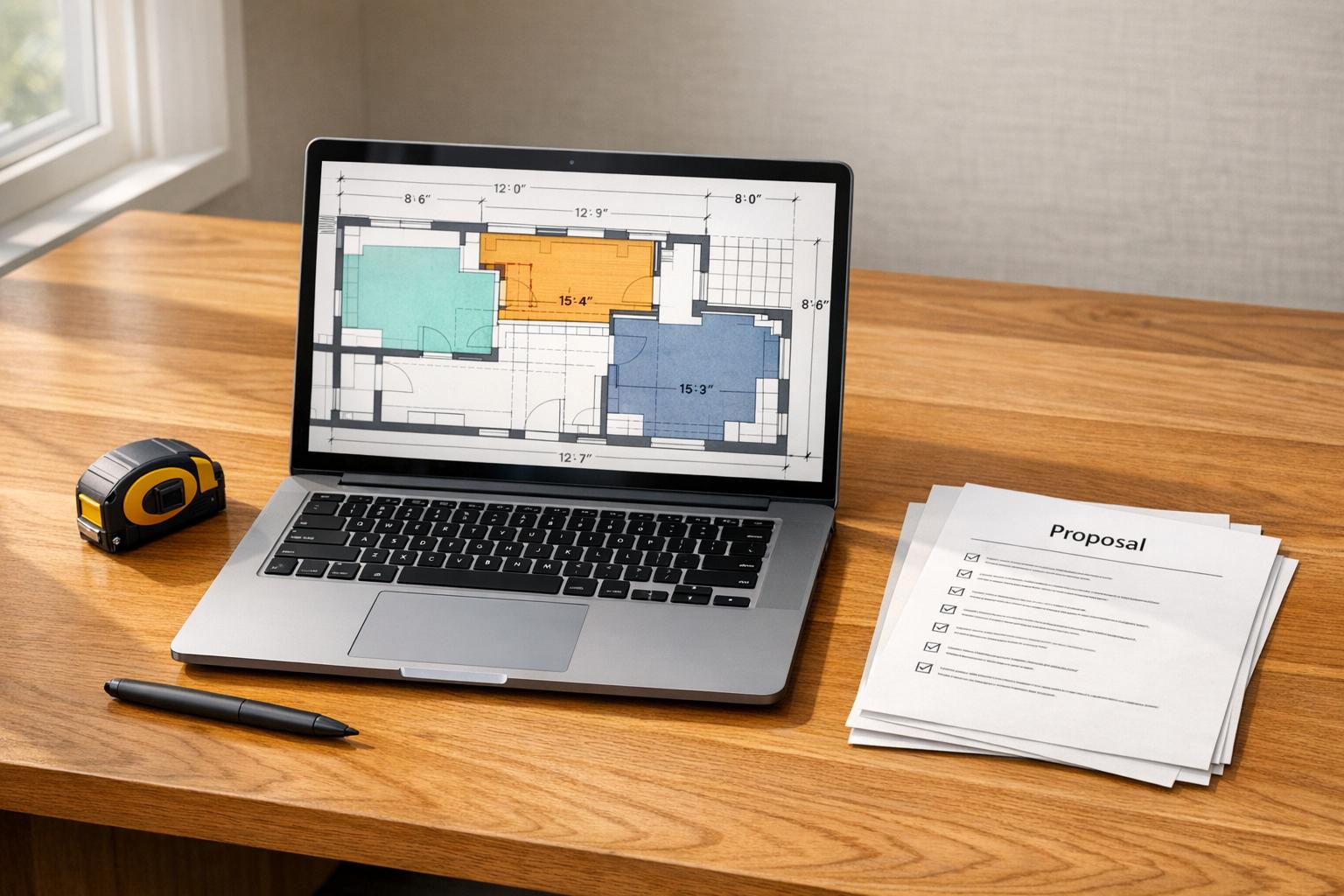
Accurate estimating is critical for subcontractors to avoid profit losses. Manual methods like printed plans and spreadsheets are slow, error-prone, and limit the number of bids you can submit. This leads to missed opportunities, costly mistakes, and strained client relationships.
Digital estimating tools solve these problems by automating tedious tasks, improving accuracy, and saving time. Key benefits include:
- Faster estimates: Cut estimating time by 60–90%, allowing more bids per week.
- Improved accuracy: Reduce errors and achieve up to 98% precision.
- Streamlined workflows: Automate takeoffs, cost calculations, and bid formatting.
- Professional proposals: Generate polished, client-ready documents instantly.
Platforms like ScopeTakeoff make these tools accessible with trade-specific features, unlimited projects, and affordable pricing at $100 per month per user. Subcontractors using digital tools report saving 4.5 hours per estimate and completing three times as many bids weekly.
Switching to digital tools can help subcontractors save time, reduce errors, and win more projects while protecting profit margins.
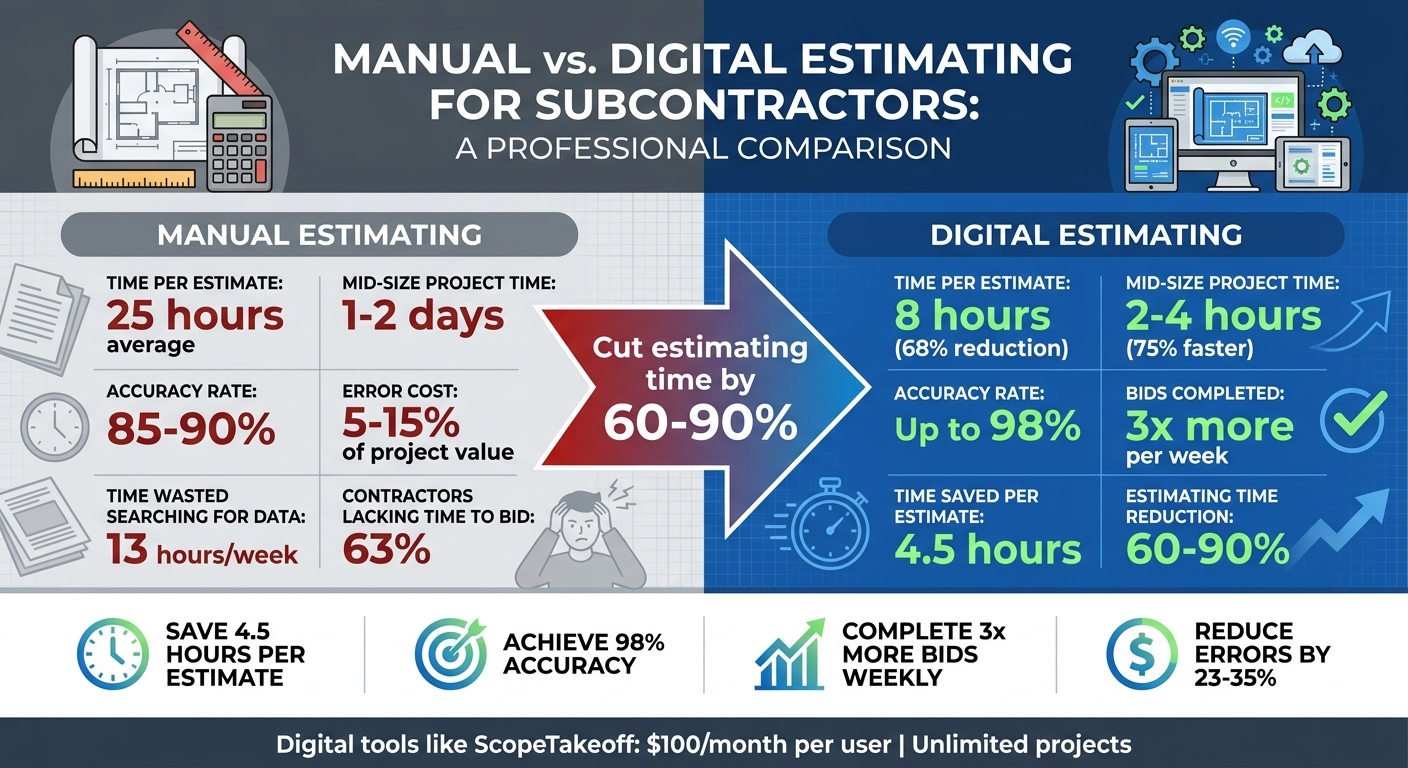
Manual vs Digital Estimating: Time Savings and Accuracy Comparison for Subcontractors
Construction Estimating Software – What you need, and what you don’t
sbb-itb-4ee4ad4
Problems with Manual Estimating
Manual estimating locks subcontractors into a time-consuming and outdated process. It often requires physically measuring printed blueprints and logging every detail by hand. For mid-size projects, this can take 1–2 days, compared to just 2–4 hours with digital tools. On average, estimators spend 25 hours per project using manual methods, while digital solutions reduce that time to around 8 hours. These inefficiencies ripple through the workflow, causing delays and wasting valuable time.
Slow Workflows and Wasted Time
Without digital templates, estimators must create bids line by line. If blueprints change, they’re forced to start over from scratch. On top of that, construction professionals spend an average of 13 hours per week just searching for project data scattered across disconnected systems. Add in the time spent double-checking calculations, and it’s no wonder 63% of contractors say they don’t have enough time to bid as often as they’d like.
"If you are still printing plans and using a scale ruler, you are losing hours on every bid." – Projul
This inefficiency, often called "bid lag", puts firms at a disadvantage. While manual estimators are stuck working on a single bid, competitors using digital tools can submit multiple proposals, seizing opportunities faster.
Common Errors and Expensive Mistakes
Manual methods are prone to errors – misreading scales, missing dimensions, or transposing numbers can result in costly mistakes that eat up 5–15% of a project’s value. Accuracy with manual estimating typically ranges from 85–90%, while digital tools push that number up to 98%. This difference can make or break profit margins.
"One tiny mistake can cost you thousands. Miscalculate the materials? You’re either overordering and wasting money, or underordering and delaying the project." – Chris Bates
Tight deadlines only compound the problem. In a rush, estimators often skip over details, rely on assumptions to fill gaps, or fail to catch inconsistencies between drawing sheets. Even a single overlooked item can wipe out all potential profit on a job.
Missing Standards and Disconnected Data
Manual processes also lead to inconsistency and fragmented data. Errors aside, the lack of standardized construction estimating guides means estimators can produce wildly different results for the same project. This inconsistency damages trust with general contractors. Furthermore, manual files are hard to share across teams, often leading to version control issues and communication delays. To make matters worse, data often needs to be re-entered into other software, increasing the chance of errors.
"The bigger your company gets, the more you need a system that works fast and delivers accurate results every single time. Manual takeoffs? They just don’t cut it." – Chris Bates
In the U.S., construction workers spend over 14 hours each week dealing with avoidable problems like rework caused by poor data and miscommunication. This disconnected approach limits a company’s ability to grow. When every estimate has to be built from scratch, it’s nearly impossible to handle a higher volume of bids as the business expands.
How Digital Tools Speed Up Subcontractor Estimating
Digital estimating software has revolutionized what used to be a slow, manual process, turning it into an efficient, streamlined workflow. Tasks that once took hours – like manual takeoffs – can now be completed in minutes, significantly increasing both speed and accuracy. In fact, moving from manual to digital tools can cut total project estimation time by up to 70%. This time-saving advantage enables firms to bid on more projects and secure more work, setting the stage for the advanced features outlined below.
PDF Plan Takeoff and Automatic Quantity Extraction
One of the standout features of digital tools is their ability to eliminate manual measurement. Estimators can work directly from PDF plans, where the software, after a quick calibration, converts pixel distances into real-world measurements. With just a few clicks, they can trace areas for materials like flooring or roofing, draw lines for pipes, or count fixtures such as outlets. The software instantly accumulates totals, saving hours of tedious work.
AI-powered systems take this to the next level. Using computer vision, they can identify construction elements – like walls or fixtures – across multiple sheets of plans. What used to take 6–8 hours manually can now be completed in just 20–30 minutes. These tools also make handling plan revisions painless; instead of re-measuring everything from scratch, digital traces can be updated instantly.
Pre-Built Libraries and Trade-Specific Assemblies
Digital platforms also simplify complex calculations with pre-built libraries. These libraries allow estimators to group related materials and labor into one-click calculations. For example, marking "linear feet of exterior wall" prompts the software to automatically calculate studs, plates, nails, and headers. This feature prevents costly oversights, like forgetting brackets or anchors, which can eat into profit margins.
Trade-specific assemblies further streamline the process. For instance:
- Concrete work: The software converts square footage and depth into cubic yards (CY) and calculates rebar and forming requirements.
- Drywall: It determines board counts, deducts openings, and includes framing and finishing materials.
- Masonry: It computes block counts, mortar, and grout needs based on simple dimensional inputs.
These assemblies even apply waste factors – such as 5% to 10% for drywall or 10% to 15% for trim carpentry – ensuring bids account for material waste in real-world conditions.
"The masonry assembly library alone is worth it. I used to count every block by hand off the plans. Now I enter the dimensions and it spits out quantities, mortar, everything." – Mike C., Masonry Contractor
Subcontractors using these automated libraries report being able to generate three times as many bids per week compared to manual methods. On average, they save 4.5 hours per estimate compared to using Excel.
Automated Cost Calculations and Regional Pricing
Digital tools also excel at automating cost estimates by integrating labor, material, and pricing data. This eliminates the need for complex manual formulas, which are prone to errors if spreadsheet cells are accidentally altered. Assembly-based pricing ensures that nothing is overlooked, from major materials to small fasteners, reducing the risk of underbidding and protecting profit margins.
Better Bid Management with Digital Tools
Once you’ve calculated quantities and costs, the next hurdle is turning that data into professional, competitive bids. Digital tools make this process fast and accurate, transforming what used to be a tedious reformatting task into a streamlined, one-click operation. This approach not only reduces errors but also builds on the time saved during digital estimating.
SOV and Client-Facing Proposal Outputs
Traditionally, preparing bids meant copying numbers from spreadsheets into Word documents and reformatting everything manually. trade estimating software eliminate this hassle by automatically generating Schedule of Values (SOV) documents and client-facing proposals. These are formatted with your company branding, ensuring every submission to a General Contractor looks polished and professional.
"The SOV export goes straight to the GC – no reformatting, no copying into Word. It looks professional every time." – Travis W., Roofing Sub
By automating these repetitive tasks, estimators can dedicate more energy to tackling new projects instead of being stuck in formatting limbo.
Team Collaboration and Multi-Entity Profiles
Managing bids across multiple entities and licenses can get messy fast. Digital tools simplify this by offering multi-entity profiles that automatically populate key details like license numbers, addresses, and signatories for each proposal. On top of that, team collaboration becomes much easier with individual logins and a centralized dashboard. This dashboard provides real-time updates on bid statuses – whether they’re in progress, submitted, awarded, or lost.
Bid Review Workflows and Submission Tracking
A thorough review is critical to ensure bids are accurate before submission. Digital platforms come equipped with built-in review workflows that allow senior estimators or managers to inspect and approve bids. This ensures mistakes like misplaced decimals or missing line items are caught early. Additionally, submission tracking provides a clear audit trail and insights into bidding performance, helping teams deliver error-free bids with full transparency.
ScopeTakeoff: A Complete Solution for Subcontractors
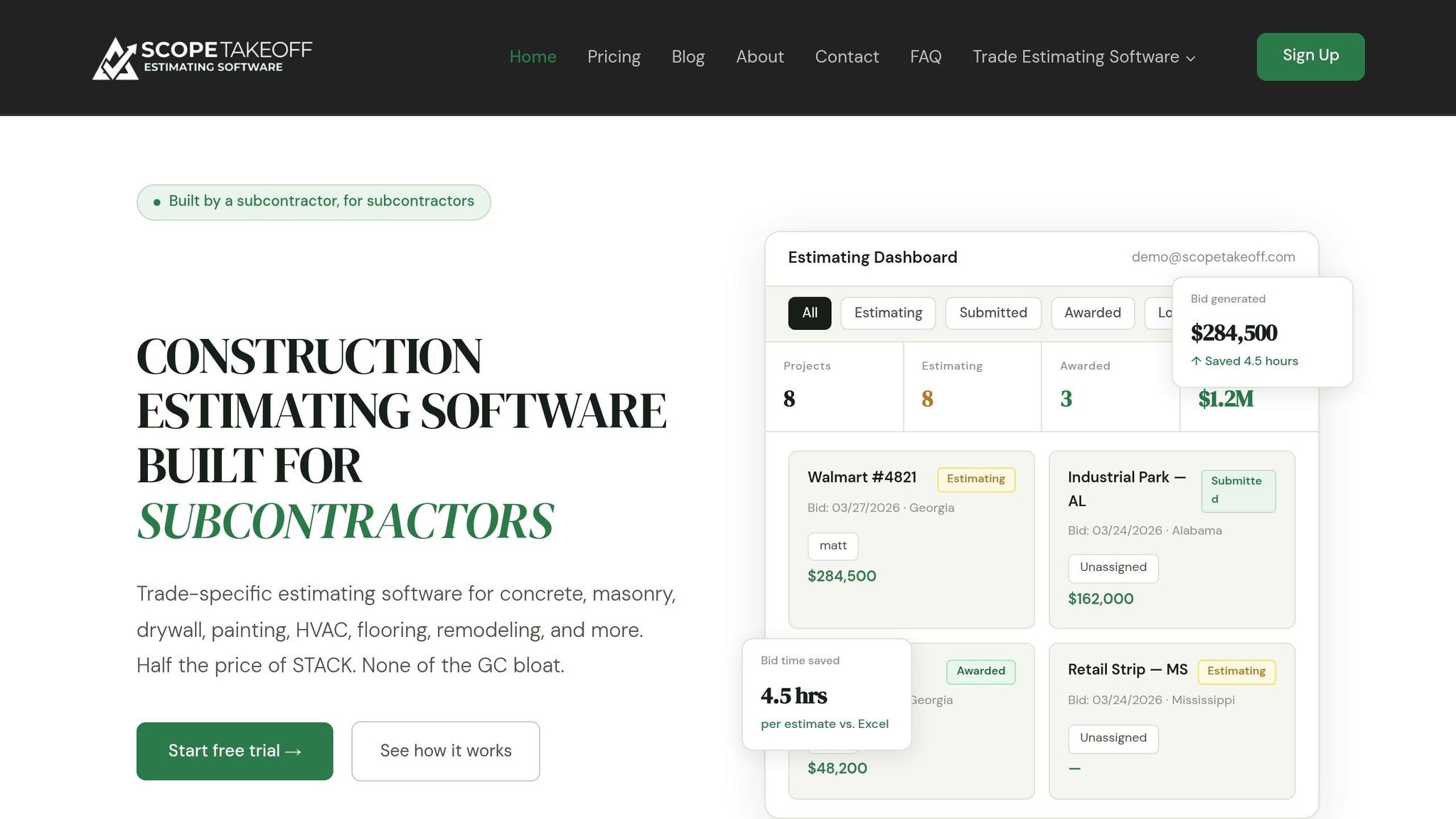
When it comes to estimating software tailored for subcontractors, ScopeTakeoff is built to meet the unique needs of businesses with annual revenues ranging from $500,000 to $10 million. It combines automation, precision, and scalability to streamline the estimating process and improve bid management.
Trade-Specific Features and Unlimited Projects
ScopeTakeoff comes equipped with pre-built assembly libraries for over 10 trades, including concrete, masonry, drywall, painting, HVAC, flooring, remodeling, landscaping, roofing, and asphalt. These libraries handle trade-specific calculations automatically, breaking down labor and material costs once quantities are entered.
The platform also features an integrated PDF plan takeoff tool, allowing users to upload plan sheets, measure quantities directly on the drawings, and instantly transfer data into their estimates. With support for unlimited projects and estimates, ScopeTakeoff is designed to grow alongside your business, whether you’re working solo or managing a team.
Affordable Pricing and Scalability
ScopeTakeoff keeps pricing straightforward at $100 per person per month. There are no setup fees, extra charges for specific trades, or annual contract requirements. The subscription includes all trade assembly libraries, the PDF plan takeoff tool, and unlimited projects. Plus, you can try it for free for 14 days – no credit card required.
The platform is built to scale effortlessly. Features like individual logins, multi-entity profiles with unique license numbers, and centralized bid tracking make it easy to expand from a single estimator to a larger team. This flexibility ensures that ScopeTakeoff can adapt as your operation grows, helping you maintain accuracy and improve bid outcomes.
Improved Accuracy and Bid Success Rates
ScopeTakeoff’s digital tools are designed to save time and reduce errors. On average, subcontractors using the platform save 4.5 hours per estimate compared to Excel and can complete three times as many bids per week. This added efficiency not only increases the number of opportunities to bid but also improves profit margins on the jobs you win.
Benefits of Using Digital Estimating Tools
Digital estimating tools offer more than just smoother workflows and improved precision – they bring measurable advantages in time management, accuracy, and competitiveness.
Time Savings and Productivity Gains
These tools can drastically cut the time spent on each bid. For example, the average bid time can drop from 28 hours to just 5 hours – an impressive 82% reduction. For subcontractors handling 10 bids a month, that’s a recovery of 160 hours every month.
A significant portion of this time savings comes from automating quantity takeoffs, which often make up half of the estimating process. By replacing manual measurements with automation, residential projects that previously took 3–4 hours can now be completed in just 45–60 minutes. Similarly, mid-size commercial jobs that once required 1–2 days can now be finished in 2–4 hours.
"Our estimators turn around 3x as many bids per week now. The SOV export goes straight to the GC – no reformatting, no copying into Word."
- Travis W., Roofing Sub
Better Accuracy and Fewer Errors
Digital tools can improve estimate accuracy by 23–35% compared to traditional manual methods. With AI-powered detection, misreads and omissions are significantly reduced, addressing common issues like scale misinterpretations, overlooked scope items, and outdated pricing.
Built-in trade-specific assemblies ensure thorough coverage, while automated formulas convert measurements into precise trade-specific units, such as cubic yards for concrete or board counts for drywall. This level of precision minimizes calculation errors, leading to faster bid preparation and more reliable project outcomes.
Higher Bid Win Rates and Growth Potential
The combination of speed and accuracy enhances bid performance, allowing subcontractors to secure more projects. With digital tools, estimators can handle 3–4 times as many projects without increasing staff. This efficiency enables subcontractors to focus on high-margin opportunities and improve success rates. Additionally, these tools allow contractors to bid up to four times faster, providing a critical edge in competitive markets.
Professional, branded proposals and Schedules of Values also build trust during the review process, reducing friction and improving win rates.
"We were on STACK at $600/month and honestly using maybe 20% of it. ScopeTakeoff has everything we actually need for our concrete work. Cut our bid time in half."
- Jason R., Concrete Sub
Wrapping Up
Relying on outdated methods like broken Excel formulas and manual measurements can eat away at your profit margins and make it harder to stay competitive. Digital tools are a game-changer, simplifying essential estimating tasks and boosting efficiency.
Take platforms like ScopeTakeoff as an example. They tackle subcontractors’ biggest challenges with features like trade-specific assembly libraries that cut down on repetitive data entry, integrated PDF plan takeoff tools that significantly speed up measurements, and automated calculations tailored to your trade. Plus, professional SOV exports and branded proposals show general contractors that you prioritize accuracy and quality.
The advantages speak for themselves – subcontractors save time and can turn around bids much faster. And with a price of just $100 per person per month, ScopeTakeoff provides a cost-effective way to modernize your estimating process.
Sticking with spreadsheets and manual takeoffs puts you at a disadvantage, especially as general contractors increasingly expect digital documentation. Delivering fast, precise, and professional bids helps you stand out from the competition.
FAQs
What do I need to switch from Excel to digital estimating?
Switching from Excel to specialized digital estimating software can make a world of difference for subcontractors. These programs are tailored to meet the unique needs of specific trades, offering features like pre-built assembly libraries, PDF plan takeoff tools, and automatic trade calculations. These capabilities help cut down on errors and save valuable time.
Unlike Excel, which often requires manual input and repetitive tasks, digital estimating software simplifies workflows. It ensures more accurate bids and eliminates the hassle of manual pricing or building estimates from scratch.
How does PDF takeoff stay accurate when plans change?
Digital tools for PDF takeoff make it easy to update measurements directly on imported plans. This ensures that quantities are always aligned with the latest revisions, allowing subcontractors to stay precise even when project details shift.
How fast can ScopeTakeoff pay for itself?
ScopeTakeoff usually recoups its cost in just about 2.1 months. It achieves this by helping subcontractors save time, enhance bid accuracy, and cut down on cost overruns. Over time, these improvements can translate into considerable yearly savings.