
Ultimate Guide to Risk Management in Bidding
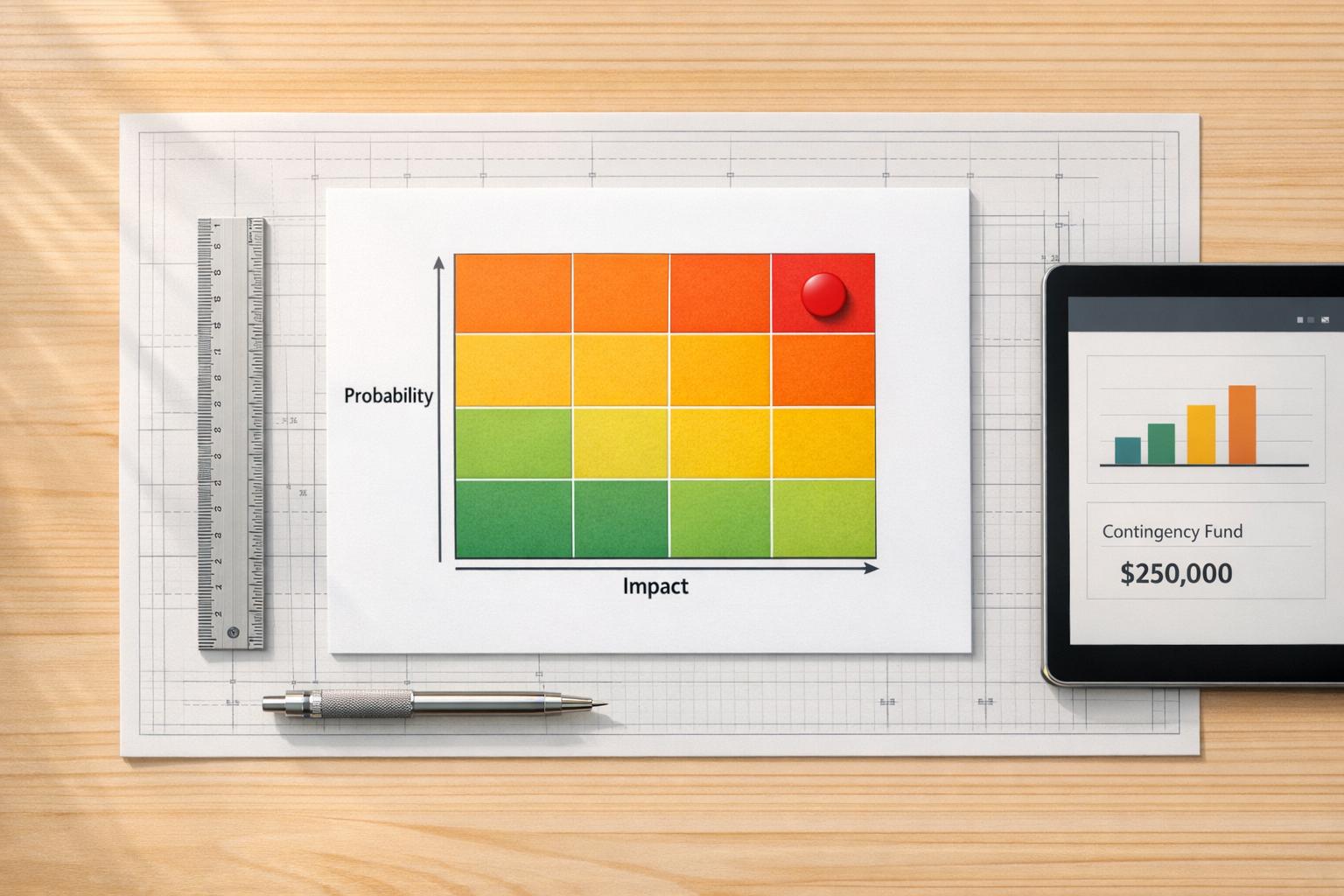
Risk management in construction bidding is critical for safeguarding profits and avoiding costly mistakes. With 70% of contractors reporting losses on at least one project annually and industry profit margins averaging 5–7%, managing risks during the bidding phase can make or break your business.
Here’s what you need to know:
- Key Risks: Material price volatility, labor shortages, supply chain disruptions, incomplete designs, unfair contract terms, and site challenges.
- Risk Management Tools: Use a Probability-Impact Matrix (1–5 scale) to prioritize risks and create a detailed risk register to track and address them.
- Mitigation Strategies: Allocate 3–10% contingencies for general risks, negotiate escalation clauses, and use advanced tools like Monte Carlo simulations for precise cost projections.
- Practical Steps: Conduct site visits, review contract terms carefully, vet subcontractors, and leverage software like ScopeTakeoff to improve accuracy and efficiency.
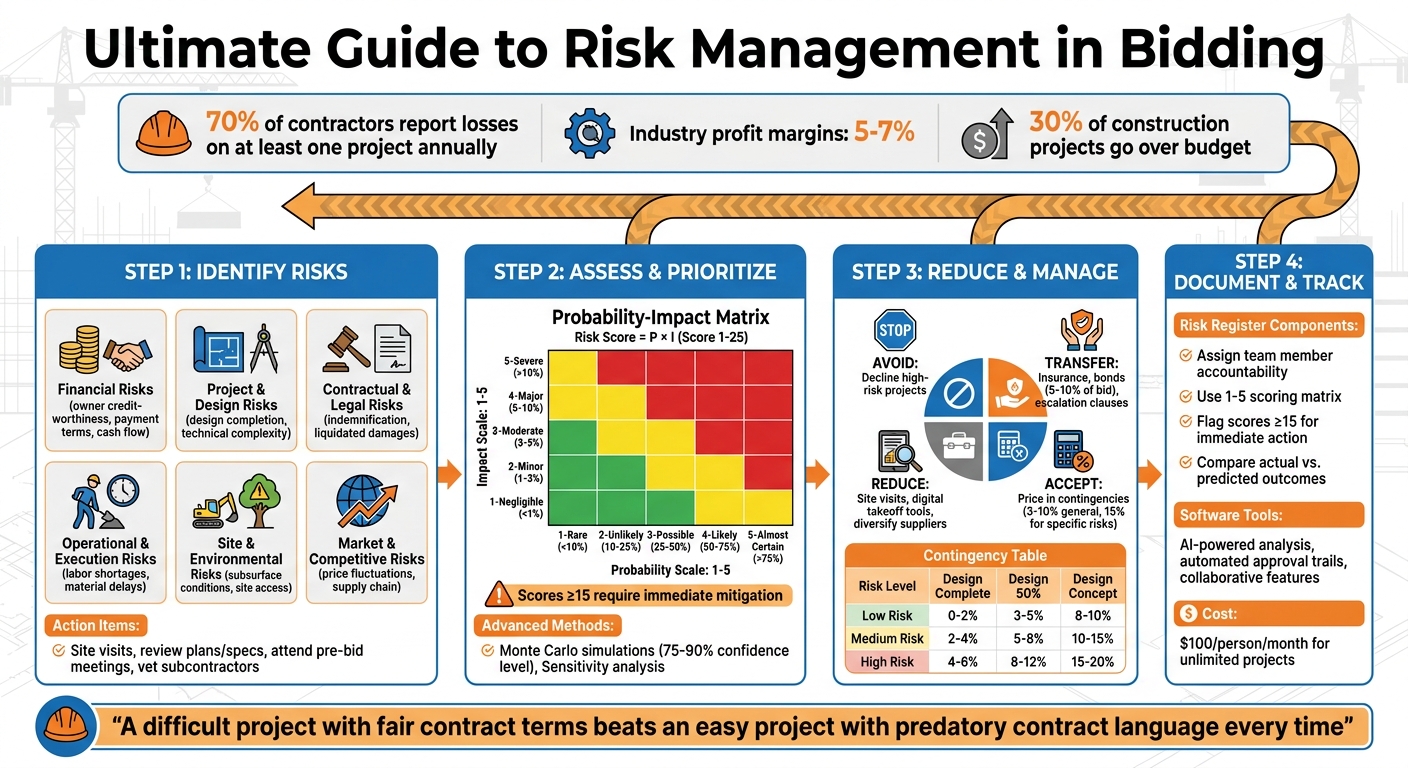
Construction Bidding Risk Management Framework: 4-Step Process
Identifying Risks in Bid Preparation
Common Risk Categories in Construction Bidding
Understanding where problems often arise is key to identifying risks in construction bidding. Financial risks include concerns like the owner’s creditworthiness, payment terms such as "pay-when-paid" clauses, and the cash flow challenges that come with retainage. To mitigate these risks, check the owner’s payment capacity through tools like credit reports, bank references, and lien searches.
Project and design risks revolve around how complete and clear the design and scope are, as well as the technical complexity of the project. For example, projects with less than 90% design completion may require a 15% contingency to account for potential design-related uncertainties.
Contractual and legal risks often stem from one-sided clauses, such as unfair indemnification terms, liquidated damages, and excessive insurance requirements. These can unfairly shift liability to your company. In fact, fair contract terms can sometimes be more critical than the complexity of the project itself.
Operational and execution risks include challenges like labor shortages, equipment availability, subcontractor capacity, material delays, and tight schedules. Meanwhile, site and environmental risks may involve unexpected subsurface conditions, limited site access, or environmental contamination that isn’t fully detailed in the project drawings. Lastly, market and competitive risks cover issues like material price fluctuations, supply chain disruptions, and aggressive bidding from competitors.
By categorizing risks this way, you can approach bid preparation with a clearer understanding of the challenges ahead.
How to Identify Risks
Once you’ve outlined the risk categories, the next step is to systematically uncover potential issues. Start by carefully reviewing the plans, specifications, and addenda to spot scope gaps or technical challenges. Conduct site visits to identify potential logistical constraints, utility problems, or hidden conditions that could impact your budget or timeline. For instance, these visits can highlight access difficulties or staging limitations that may not be apparent from the documents.
Leverage historical data from similar projects to analyze cost variances, scheduling patterns, and productivity rates. This can provide valuable insights into potential risks and opportunities. Pre-bid risk reviews with your project managers and estimators are another critical step. These reviews can help identify probable risks and ensure you’re prepared for any challenges.
Attending pre-bid meetings is also vital. These meetings offer a chance to clarify ambiguous specifications and understand the expectations of the project team. Additionally, carefully review the legal terms of the contract to spot problematic clauses, such as those related to indemnification, liquidated damages, or unfavorable payment terms. Finally, evaluate subcontractors’ financial stability, capacity, and safety records before relying on their estimates.
Taking these steps can help you make informed decisions during the bidding process, ensuring your margins are protected and your projects remain profitable.
sbb-itb-4ee4ad4
Assessing and Prioritizing Risks
Using a Probability-Impact Matrix
Once risks are identified, the next step is ranking them with a probability-impact matrix. This tool helps evaluate each risk based on its likelihood and potential impact. Both factors are rated on a 1–5 scale. For probability, a score of 1 means "Rare" (less than 10% chance), while 5 signifies "Almost Certain" (more than 75% chance). For impact, 1 reflects "Negligible" (affecting less than 1% of the contract value), and 5 represents "Severe" (impacting over 10% of the contract value).
To determine a Risk Score, multiply the probability and impact ratings (P × I). Scores range from 1 to 25, providing a clear way to prioritize risks. For example, a risk rated 4 for probability and 3 for impact would score 12. Establish clear thresholds to decide when action is needed – such as requiring mitigation for risks scoring 15 or higher. To ensure consistency, standardize the scale across all estimators and define specific criteria for each score. For instance, "Impact 4" might mean a 5–10% effect on the contract value. Regularly recalibrate the scoring system – quarterly reviews comparing predicted scores to actual outcomes can refine accuracy over time. This structured method lays the groundwork for more advanced risk assessment techniques.
Advanced Risk Assessment Methods
While the matrix provides a straightforward overview, some projects require more detailed analysis. Building on the matrix, Monte Carlo simulations can model thousands of scenarios to predict a range of possible outcomes. By assigning probability distributions to factors like material costs or labor efficiency, you can simulate final cost estimates. Many contractors use this method to set contingencies at a 75–90% confidence level.
Another useful tool is sensitivity analysis, which examines how changes in specific variables – like a 10% increase in steel prices or a two-week project delay – affect the overall bid. This is particularly valuable when dealing with fluctuating material costs or tight deadlines.
Some contractors also apply weighted scoring matrices to align risk evaluation with company priorities. For instance, Financial Risks and Contract Terms might each carry a 25% weight, while Project Complexity is weighted at 20%, Schedule at 15%, and Competition at 10%. This method generates a composite risk score, typically normalized on a 1.0 to 5.0 scale, reflecting the company’s unique risk tolerance. Considering that 70% of contractors report losing money on at least one project annually – and with profit margins averaging just 5–7% – these advanced techniques can be crucial for turning a risky bid into a profitable one.
Reducing and Managing Risks
Core Risk Reduction Strategies
Managing risks effectively starts with a four-part framework: avoidance, transfer, reduction, and acceptance. Each strategy helps you handle risks based on their severity and specifics.
Risk avoidance involves steering clear of projects where the potential downsides outweigh the benefits. For example, you might decide not to bid on projects if the owner has a track record of payment defaults or if the contract includes clauses like unlimited indemnification.
"A difficult project with fair contract terms beats an easy project with predatory contract language every time".
Focus on projects where the potential rewards justify the risks involved.
Risk transfer shifts liability to others using tools like insurance, surety bonds, or specific contract clauses. Bid bonds, which typically range from 5% to 10% of your bid, ensure you honor your bid if accepted. For long-term projects that might face material price fluctuations, consider negotiating escalation clauses. Adding "Changed Conditions" clauses can also protect you from unexpected site challenges.
Risk reduction is about lowering the chances of an issue occurring or lessening its impact. For instance, mandatory site visits can help identify potential problems like hard-to-access areas, uneven ground, or hidden utility conflicts. Using digital takeoff tools improves accuracy in estimating quantities, while diversifying suppliers ensures that a single vendor’s failure won’t disrupt the entire project.
Risk acceptance means accounting for unavoidable risks in your bid pricing. For smaller risks – such as minor weather delays or slight design uncertainties – a general contingency of 3% to 10% of the contract value is typically sufficient. For more specific risks, like excavation in unpredictable soil, a higher contingency of around 15% may be appropriate. By incorporating these strategies, you can build a solid foundation for managing risks during bid preparation.
Practical Implementation Steps
Once you’ve outlined your risk management strategies, it’s time to put them into action. These steps will help you strengthen your bid preparation process.
Start with a Bid/No-Bid Matrix that uses a scoring system (such as 1.0 to 5.0) to assess factors like financial stability, project complexity, schedule feasibility, and contract terms. Projects scoring 4.1 or higher – considered the "Red Zone" – should generally be avoided unless there’s a compelling strategic reason to proceed.
Verify the owner’s creditworthiness by reviewing commercial credit reports and bank references. To minimize supply chain risks, standardize your vendor onboarding process by thoroughly evaluating suppliers’ financial stability, safety records, and overall reliability.
Secure your bonding capacity early. Bid bonds and performance/payment bonds, which typically cost 5% to 10% of the bid value, are often required for larger public and private projects. These bonds protect both your bid and the execution of the project.
Leverage advanced construction estimating tools like ScopeTakeoff to streamline your process. These tools offer features like pre-built assembly libraries, automatic trade calculations, and team reviews, all of which help reduce errors and improve consistency. For example, PDF plan takeoff features minimize quantity miscalculations, while collaborative estimating tools enable multiple team members to review complex projects.
Lastly, plan your cash flow requirements early. Calculate the "peak capital requirement" to ensure your line of credit can handle the project’s spending curve, especially for contracts with high retainage. Proper financial planning prevents cash flow shortages and keeps your project running smoothly.
Contingency Planning for High-Impact Risks
How to Develop a Contingency Plan
Creating a solid contingency plan begins with identifying the risks that need focused attention. Use your risk scoring system to pinpoint high-impact risks – those scoring 15 or higher should have a dedicated contingency plan.
After identifying these risks, the next step is to evaluate their potential financial impact. For instance, if you’re bidding on a project where the design is less than 90% complete, you’re dealing with a significant risk. In such cases, it’s common to allocate a 15% contingency. Divide your contingency into two categories: line item contingency, which addresses specific risks (like uncertain excavation conditions), and general contingency, typically ranging between 3–10%, to cover unpredictable factors.
For each high-impact risk, assign an appropriate response strategy. You have four main options:
- Avoid: Decline the bid entirely.
- Transfer: Use insurance or specific contract clauses to shift the risk.
- Mitigate: Identify backup suppliers or alternative approaches.
- Accept: Incorporate the cost of the risk into your pricing.
For financial risks, such as concerns about owner payments, go beyond verbal assurances. Conduct independent due diligence, including checking commercial credit reports and contacting banks for references.
Allocate resources to contingencies based on the risk level, using these standard ranges:
| Risk Level | Design Complete | Design 50% | Design Concept |
|---|---|---|---|
| Low Risk | 0–2% | 3–5% | 8–10% |
| Medium Risk | 2–4% | 5–8% | 10–15% |
| High Risk | 4–6% | 8–12% | 15–20% |
For complex projects with multiple high-impact risks, leverage Monte Carlo simulations. These simulations run thousands of cost scenarios, helping you set contingencies at a 75–90% confidence level. This method replaces guesswork with data-driven insights.
Once you’ve outlined your contingency strategies, the next step is to test and refine them to ensure they remain effective.
Testing and Updating Contingency Plans
To keep your risk management framework effective, regularly test your contingency measures. Use post-project analysis to evaluate their performance. After completing a project, compare the actual costs with your initial estimates and risk assessments. This helps identify where your planning was accurate and where adjustments are needed.
Review your risk scoring system quarterly to ensure it aligns with current market conditions. Check if risks labeled as "high probability" occurred as often as expected, and adjust your scoring criteria if necessary.
Revise your risk templates based on lessons learned. For example, if excavation risks frequently arise in certain soil types, increase the standard contingency for similar projects. If supply chain issues have a greater-than-anticipated impact, update your vendor risk assessments. Incorporate these findings into your trade-specific estimating templates to improve future bids and planning accuracy.
Using Risk Management Tools and Documentation
Creating and Maintaining a Risk Register
A risk register is your go-to tool for keeping track of potential threats. It should outline each risk, its potential impact, likelihood, and the plan to address it. Forget paper tracking – it’s outdated and risky. With 30% of construction projects going over budget, a structured and systematic approach to managing risks can directly safeguard your profits.
Make accountability a priority by assigning a specific team member to each risk. Use a 1–5 scoring matrix to document risk levels, and flag any scores of 15 or higher for immediate mitigation efforts. This is especially important during the bid preparation phase, ensuring that no potential issue slips through the cracks.
"The risk register fosters collaboration within your team… ensuring a comprehensive understanding of potential challenges and a unified approach to mitigating them." – ConWize
After the project, compare the actual results against your risk register to improve future estimates. This step transforms your register into a living knowledge base. Considering that 70% of contractors experience financial losses on at least one project each year, leveraging historical data can give you a serious edge over competitors.
To take it a step further, integrate your risk register with modern software solutions. These tools can automate processes, making risk tracking more efficient and reliable.
Using Software to Improve Accuracy and Efficiency
Modern software takes risk management to the next level by automating critical tasks. Tools like ScopeTakeoff use AI to identify missing or zero-priced items in your quotes, ensuring your estimates are complete before submission. With industry margins hovering around 5–7%, even one overlooked item can turn a profitable bid into a financial disaster.
Software also enables advanced "What-If" scenario planning, which would be nearly impossible to do with spreadsheets. For example, you can simulate the financial effects of material price changes or project delays in real time, helping you calculate the exact contingency funds needed. Additionally, automated approval trails keep a detailed log of every estimate revision, reducing disputes and unnecessary rework.
ScopeTakeoff goes a step further with trade-specific assembly libraries that minimize measurement errors by connecting quantities directly to project plans through system logic. Its collaborative features allow estimators, project managers, and field teams to work together seamlessly, creating a more thorough risk assessment. At a cost of $100 per person per month – including unlimited projects and estimates – this tool can easily pay for itself by preventing underbidding mistakes that could erase an entire year’s profits.
Conclusion
Risk Management Best Practices Summary
This guide outlines a structured approach to risk management, focusing on identifying, assessing, and addressing potential threats. The first step is pinpointing risks – such as site challenges, unclear plans, or unfavorable contract terms – that can eat into your profits. A Probability-Impact Matrix can help prioritize risks by scoring them on a 1–5 scale. Risks with a score of 15 or higher should have dedicated mitigation strategies. Considering that 70% of contractors face losses on at least one project annually, and profit margins typically range between 5% and 7%, managing risks effectively is essential.
Set aside 3–10% of the budget for general contingencies and adjust your markups based on the specific risks of each project. Pay close attention to contract terms, steering clear of clauses like unlimited indemnification or pay-when-paid provisions, which can create significant financial exposure.
"A difficult project with fair contract terms beats an easy project with predatory contract language every time" – ConstructionBids.ai Team.
A detailed risk register is vital for documenting responsibilities and tracking mitigation plans. Over time, this practice will refine your bidding process and improve project outcomes.
Modern tools can further enhance these strategies, making risk management more efficient and effective.
Using Tools Like ScopeTakeoff for Better Results
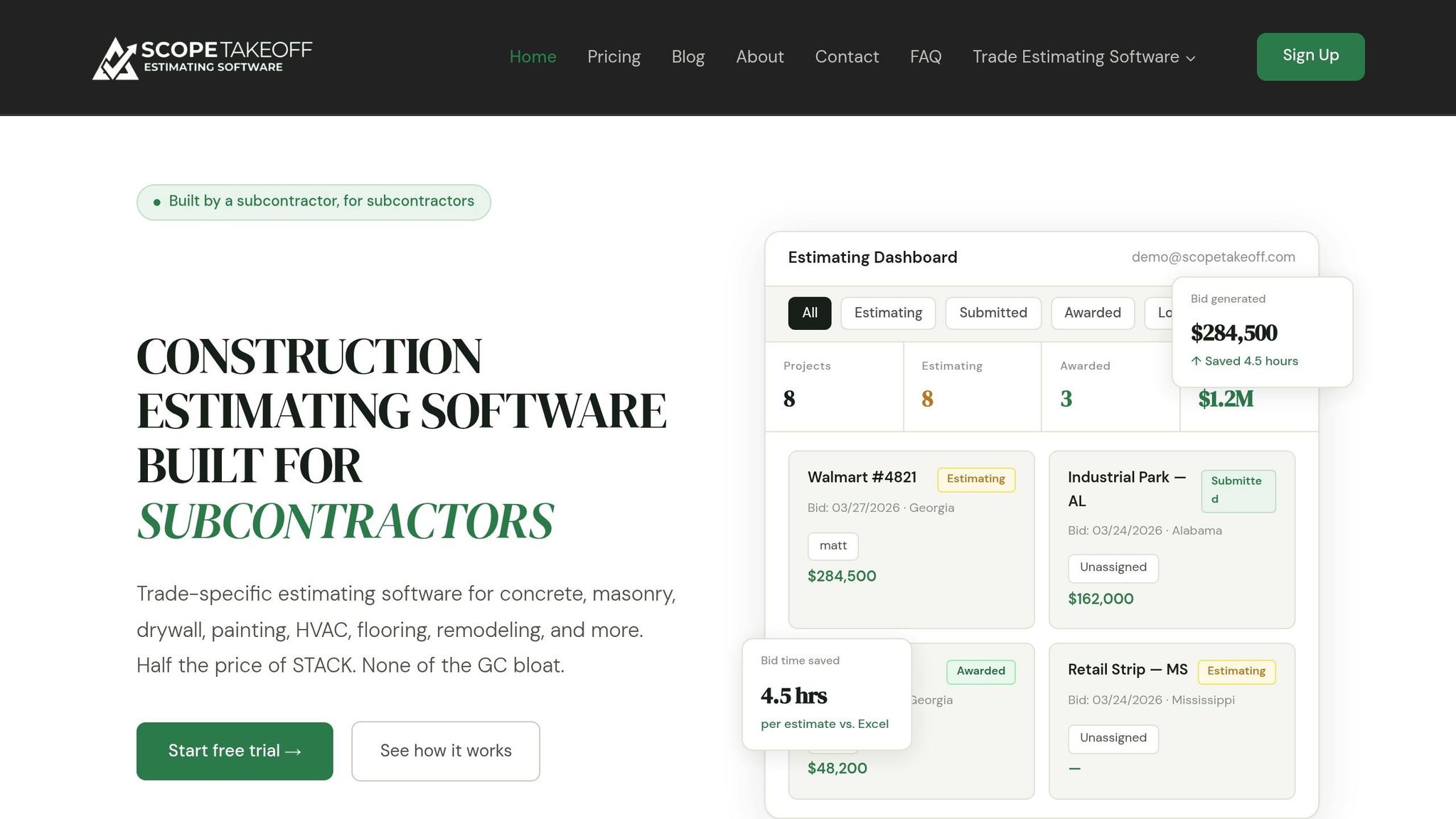
Relying on manual processes for bidding can lead to costly mistakes. Modern software, like ScopeTakeoff, helps eliminate errors by identifying missing items or zero-priced entries, which can lead to financial trouble. With its AI-powered analysis, ScopeTakeoff connects trade-specific assembly libraries directly to your project plans, reducing the measurement inaccuracies that often occur with spreadsheets.
At just $100 per person per month, ScopeTakeoff provides unlimited projects and estimates, offering a cost-efficient way to streamline collaboration between estimators, project managers, and field teams. Features like automated approval trails and a centralized risk register ensure every decision is well-documented – an essential safeguard when one bad project could jeopardize an entire year’s profits.
How to Know If a Construction Job Is Worth Bidding (Before You Waste Time)
FAQs
What risks should make me pass on a bid?
When reviewing bids, it’s wise to steer clear of those with vague plans or incomplete details – these often result in underestimated costs and unforeseen challenges. Be cautious about projects with slim profit margins, significant budget risks, or clients with a reputation for late payments or frequent scope changes. Red flags like difficult site conditions or a track record of delays should also be taken seriously. Conducting a detailed risk assessment can safeguard your profits and help you avoid expensive surprises.
How do I set contingency without overpricing my bid?
When planning your project budget, it’s wise to set a contingency fund as a percentage of the total project cost – typically between 5% and 10%. The exact percentage should reflect the project’s scope, complexity, and potential risks. This balance is key: you want to cover unexpected expenses without overpricing your bid.
Factors like how well-defined the scope is, site conditions, and historical data from similar projects can help you decide on the right percentage. Keep in mind, contingencies are meant for unforeseen risks, while allowances are reserved for undefined items that are expected but not yet specified.
By setting a realistic and well-justified contingency, you can safeguard against surprises without unnecessarily inflating your bid. This approach keeps you competitive while ensuring you’re prepared for the unexpected.
What should I include in a bid-phase risk register?
A bid-phase risk register is a critical tool for identifying and managing potential risks that could jeopardize the success of your construction bid. It should address key areas such as scope gaps, errors in cost estimates, supply chain disruptions, subcontractor dependability, and project uncertainties. Using a scoring framework to evaluate each risk’s likelihood and impact can help you make smarter decisions, create more accurate cost estimates, and develop effective strategies to tackle potential challenges during the bid preparation process.