
This FAQ answers the estimating questions subcontractors ask before bidding: how to calculate labor, what a takeoff includes, how much markup to add, how software helps, and how to avoid underbidding. Good estimates protect profits, secure jobs, and avoid expensive mistakes. This guide answers 9 of the most common questions about construction estimating, covering methods, tools, and strategies to improve accuracy and win more bids.
Key Takeaways:
- What is construction estimating? It’s predicting total project costs, including materials, labor, equipment, overhead, and profit.
- Why accuracy matters: A 15% error on a $2M project can cost $300K, potentially wiping out a year’s profit.
- Steps for accurate estimates: Review plans, perform quantity takeoffs, calculate costs, apply markups, and submit proposals.
- Tools to minimize errors: Digital tools like ScopeTakeoff reduce manual mistakes and save time, improving accuracy throughout the preconstruction process.
- Common challenges: Errors in takeoffs, old price data, and labor errors are frequent challenges.
- Solutions: Use a historical cost database, conduct site visits, and adopt automated estimating tools, not to replace the estimator but assist.
By refining your process and use technology, you can create accurate estimates, protect profit margins, and sleep better at night.
Construction Estimating: The Complete Step-by-Step Guide
sbb-itb-4ee4ad4
Construction Estimating Basics
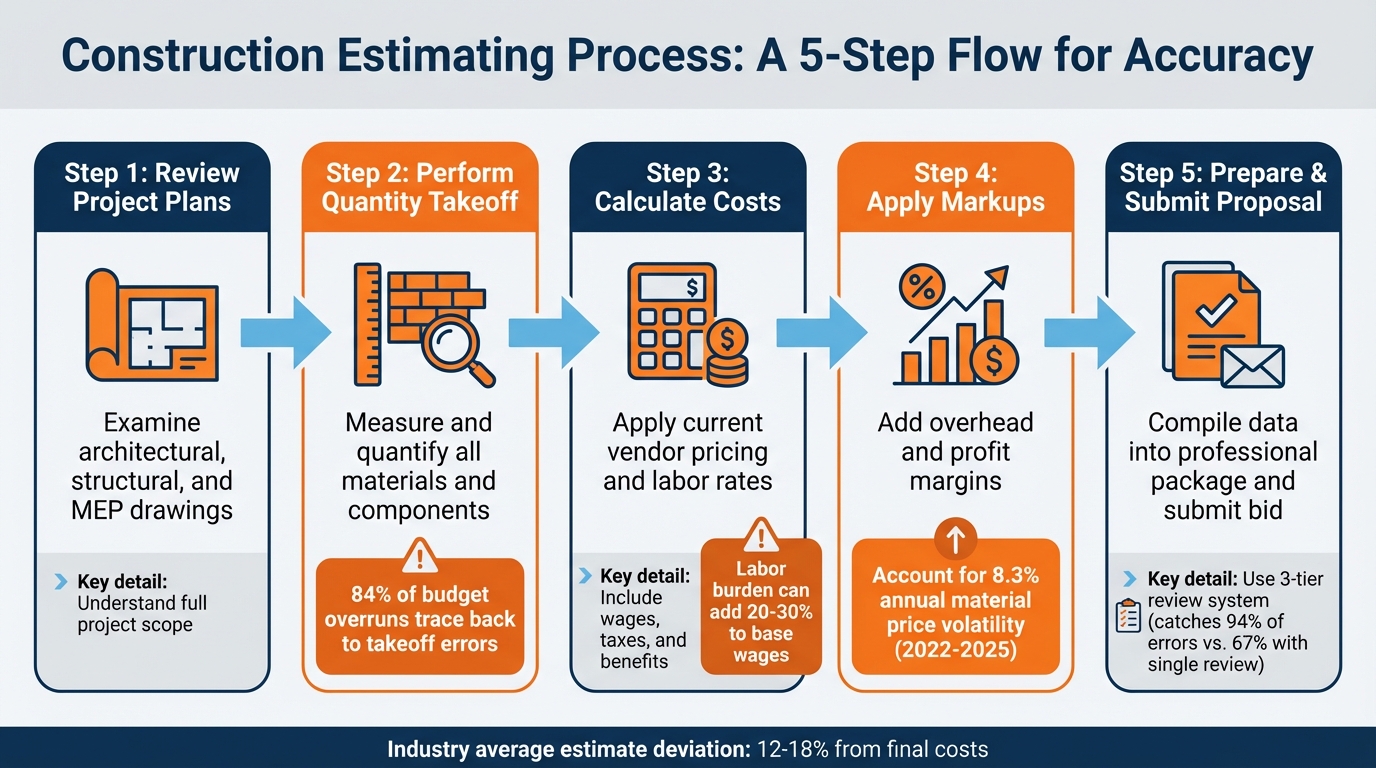
5 Key Steps in the Construction Estimating Process
1. What is construction estimating?
Construction estimating is the process of predicting the total cost of a project before any work begins, usually based on a set of plans or prints. This involves calculating expenses for materials, labor, equipment, subs, overhead and profit. For subcontractors that means turning a scope of work into a bid or proposal. Which is basically a financial plan that forms the backbone of every project.
“Cost estimating means turning a scope of work into a dollar amount you can stand behind.”
Good estimates are essential to the success of any company. They maintain and project profit margins and set the course for every other calculation that follows. Errors in estimating can have serious consequences. Bidding low can lead to financial losses and strained relationships with clients, while bidding high may cost you potential jobs.
In one estimating mistake shared with our team, a contractor underbid a commercial project after confusing U.S. tons with metric tons in the steel scope. The error created a six-figure gap in the bid and nearly put the company out of business.
2. What are the key steps in the construction estimating process?
The construction estimating process involves several key steps:
- Review project plans: Carefully examine architectural, structural, MEP (mechanical, electrical, and plumbing), civil and other drawings/specs to fully understand the project’s scope.
- Perform a quantity takeoff: Measure and calculate all material and labor needed for the job.
- Calculate costs: Use current vendor pricing or internal labor rates (including wages, taxes, and benefits) to determine expenses.
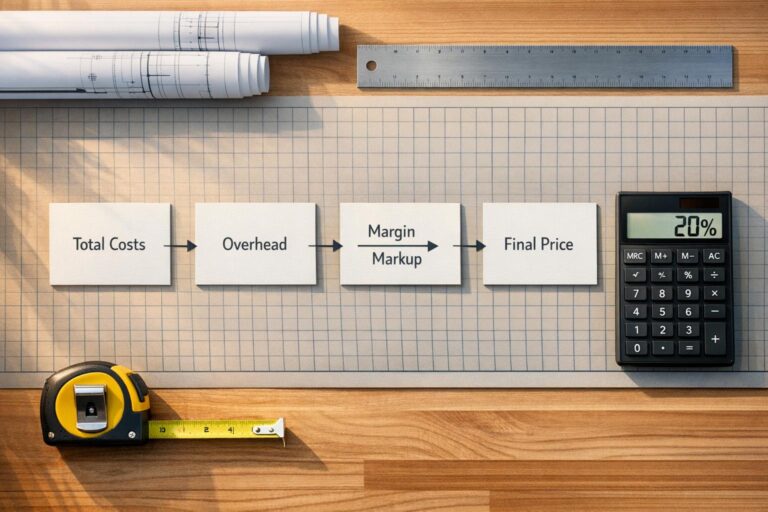
- Apply markups: Add overhead, general conditions, and profit margins to get to the final bid amount.
- Prepare and submit the proposal: Compile all the data into a professional package and submit your bid.
Accuracy is critical at every stage. For example, neglecting to include labor burden can under bid labor costs by 20–30% or more. Using old material prices can also skew estimates, especially given the high average annual volatility in material costs between 2022 and 2025. To minimize errors, many companies use a three-tier review system – self-review, peer review, and management review – which catches majority of significant mistakes compared to just with a single set of eyes of the estimator.
| Material | Typical Waste Factor |
|---|---|
| Drywall | 10% |
| Framing Lumber | 5–15% |
| Tile (Straight) | 10% |
| Tile (Diagonal) | 15% |
| Concrete | 5–10% |
Always account for waste factors when ordering materials. For example, plan for 10% extra drywall and tile, and 5–10% extra concrete to cover cuts and breakage. Ordering exact quantities can lead to costly change orders if adjustments are needed.
With the basics of estimating in mind, let’s take a closer look at the role of quantity takeoffs in creating accurate estimates.
3. What is quantity takeoff in construction estimating?
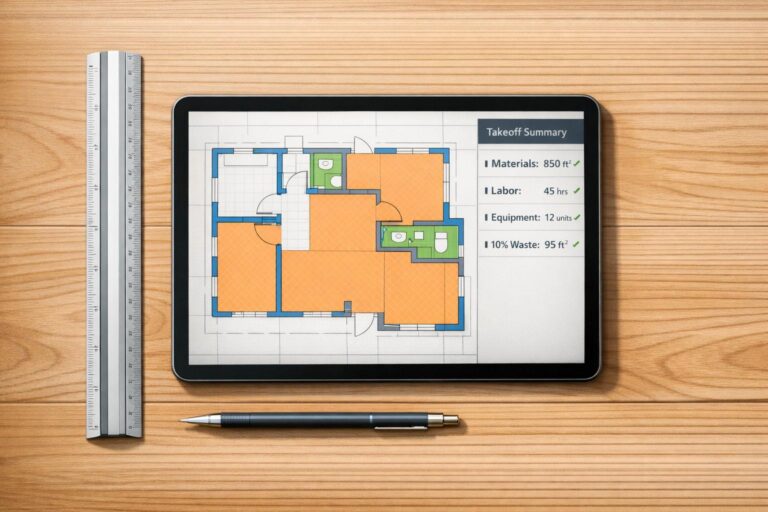
Quantity takeoff (QTO) is the measurement phase of construction estimating. During this step, 2D blueprints more commonly just called plans are converted into a detailed list of materials, labor, and equipment. This step lays the foundation for confident cost calculations. Without precise quantities, the entire estimate becomes unreliable. While the takeoff focuses on the quantities (e.g., 50 sheets of drywall), the estimate adds costs, labor rates, and other factors like overhead and profit.
Research shows that the majority of projects that go over their budgets can trace the issue back to errors in the takeoff stage. Manual takeoffs are time-consuming and are prone to mistakes like scale errors or double counting. Digital tools, such as ScopeTakeoff, can cut that time down and improve accuracy.
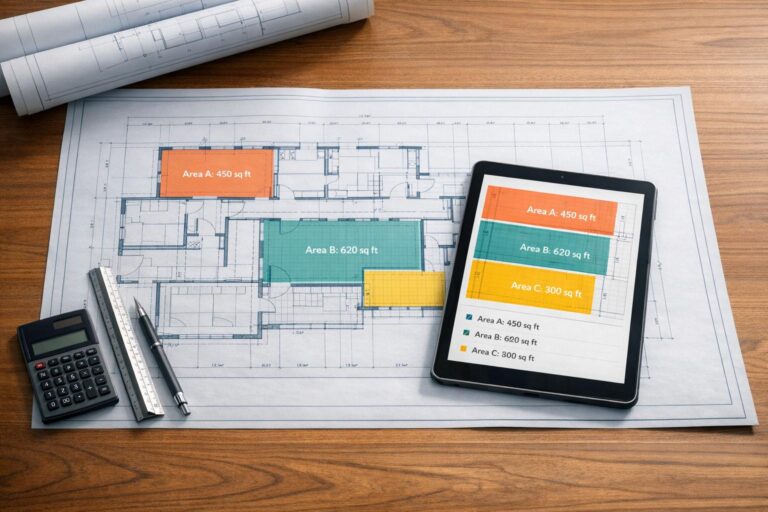
Before starting a takeoff, always verify the drawing scale against a known dimension to avoid costly mistakes. Use color-coding to clearly mark measured areas and prevent double-counting. Begin with the largest and most expensive items – like structural steel, concrete, and major mechanical systems – to identify any potential scope issues early on.
Methods and Techniques for Accurate Estimating
4. What are the main types of estimating methods used in construction?
Subcontractors rely on different estimating methods depending on the project stage, the data available, and the level of accuracy required. One of the most detailed approaches is detailed estimating (also known as bottom up estimating). This method breaks down every task, material, and resource into individual pieces. It’s especially useful for final budgets and bid preparation, offering a high level of accuracy when a full set of project drawings are available.
Another common approach is unit cost estimating which calculates costs based on standard measurements like square feet or linear feet. For example, installing tile at $4.00 per square foot for a 500-square-foot area would result in $2,000 in labor costs. This method is ideal for repetitive tasks such as drywall, flooring, or painting and allows for quick cost comparisons between similar projects.
Assembly estimating (or system estimating) takes a broader view by grouping components into larger systems. Instead of pricing individual items like studs, insulation, and drywall, it calculates the cost of an entire wall system. This method is quicker than detailed estimating and is particularly effective for trade-specific jobs. Tools like ScopeTakeoff’s pre-built assembly libraries simplify this process by offering customizable templates for common systems like wall framing, electrical rough-ins, and HVAC installations.
Parametric estimating uses statistical models and historical data to predict costs based on variables such as project size, location, and complexity. Similarly, analogous estimating relies on cost data from previous, comparable projects.
Choosing the right method depends on the information available. For early-stage feasibility studies, square-foot estimating may be sufficient.
However, competitive bids typically demand detailed line-item breakdowns. The American Society of Professional Estimators outlines a 5-level classification system, where Level 1 represents the least accurate Order of Magnitude estimates and Level 5 represents the most accurate Bid Estimates. Selecting the appropriate method is critical for preparing competitive bids while safeguarding profit margins.
Once the estimating method is determined, the next challenge is accurately calculating labor costs.
5. How do subcontractors calculate labor costs in estimates?
After measuring material and system costs, subcontractors must calculate labor costs with precision. Labor costs are one of the hardest and most variable parts of estimating because even small errors can lead to significant financial consequences. To avoid this, subcontractors use fully burdened labor rates, which include not just base wages but also payroll taxes, workers comp, unemployment insurance, benefits, and paid time off. Overlooking the labor burden can understate labor costs by 20% to 30% or more.
“Calculating labor costs presents the toughest obstacle for newbies… High-quality work is obviously based on expertise; hence, never undervalue it.”
- Mike Falahee, President, Marygrove Awning Co.
For residential contractors, burdened labor rates typically range from $35 to $65 per hour, depending on the trade and region. On projects governed by the Davis-Bacon Act, such as prevailing wage jobs, the U.S. Department of Labor sets strict wage requirements that must be included in labor estimates. Beyond hourly rates, subcontractors also need to consider productivity factors. How much work a crew can realistically complete in a day. For instance, a two-person drywall crew might hang 25 to 40 sheets per day, depending on site conditions.
Tracking actual labor hours on completed jobs and comparing them to estimates is a valuable practice. This historical data helps refine future bids and highlights areas where crews may be working faster or slower than expected. Collaboration with foremen or site managers is also essential to adjust production rates for site-specific challenges like limited access, occupied spaces, or adverse weather conditions.
Using Technology for Construction Estimating
6. How does software improve estimating accuracy for subcontractors?
Estimating software tackles issues by automating calculations and consolidating data. For instance, you can upload PDF blueprints and measure quantities directly on-screen, avoiding the need to retype data or switch tools. Trade-specific automation takes this further – inputting a single measurement, like the linear footage of a wall, automatically generates a detailed breakdown of required materials and labor. This could include studs, plates, insulation, drywall, screws, and even labor hours. These features not only save time but also help subcontractors submit more competitive bids.
Specialized estimating software saves significant amount of time per estimate compared to Excel or paper. AI-powered takeoff tools go even further, completing processes in a fraction of the time. With this increased efficiency, subcontractors can potentially boost their bid volume and win more work in less time.
By automating repetitive tasks and centralizing pricing and cost data, software allows subcontractors to focus on fine-tuning their bids. Teams can review historical pricing, collaborate on estimates in real time, and avoid starting from scratch for every project. Additionally, tools like one-click generation of polished Schedule of Values (SOV) documents and branded proposals save hours of administrative work while ensuring a professional presentation.
7. How does ScopeTakeoff streamline subcontractor estimating workflows?
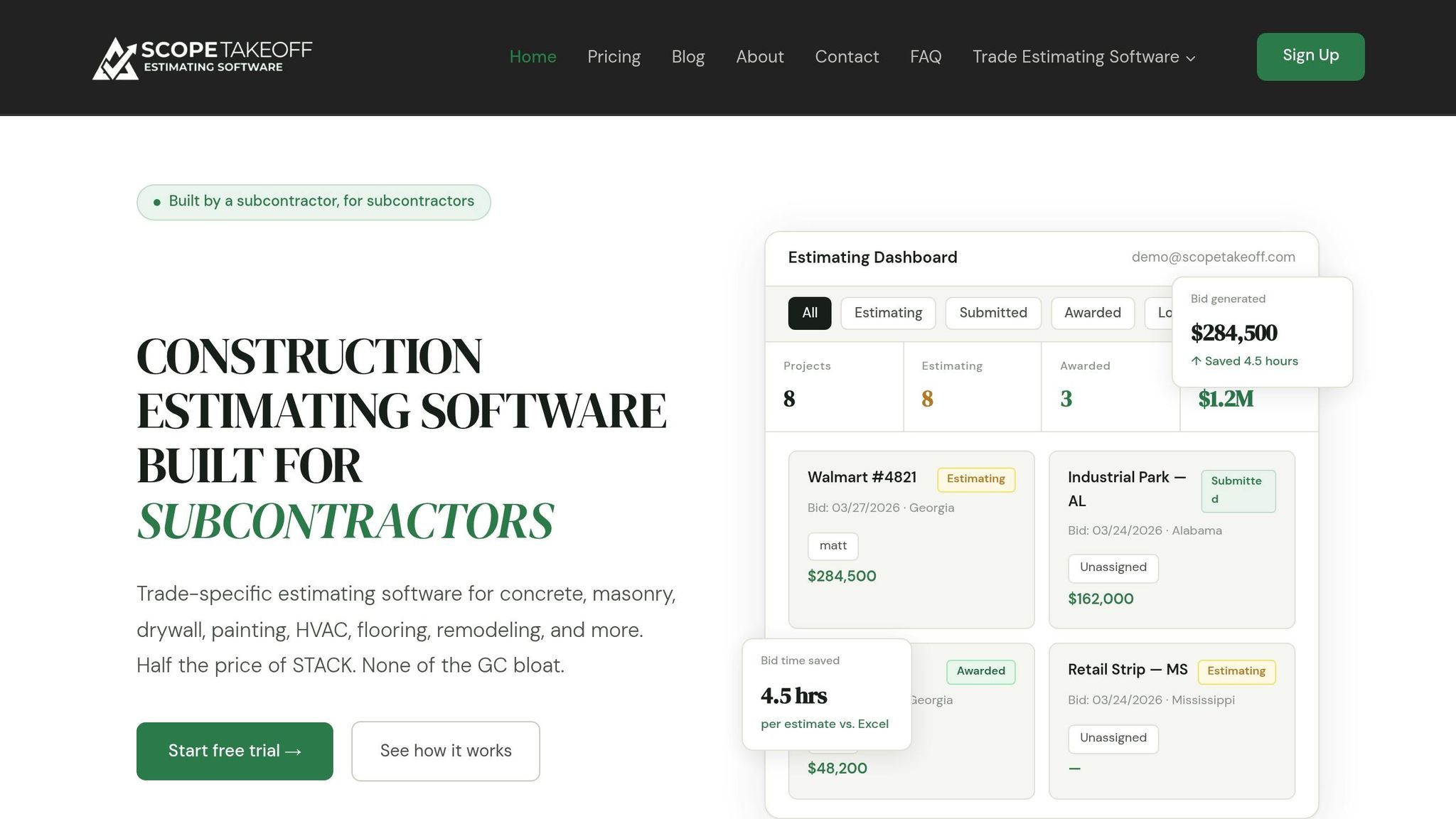
ScopeTakeoff builds on the advantages of digital estimating tools to further simplify workflows for subcontractors. Designed specifically for businesses with annual revenues between $500,000 and $10 million, ScopeTakeoff offers a cost-effective solution at $100 per user per month. It includes pre-built assembly libraries for over 10 trades, such as concrete, masonry, drywall, painting, HVAC, and roofing, as well as integrated PDF takeoff, unlimited projects, and SOV export capabilities.
The platform eliminates manual calculations by automating trade-specific formulas. For example, concrete subcontractors can calculate cubic yards, drywall crews can determine board counts, asphalt contractors can compute tonnage, and roofers can factor in slopes – all with built-in accuracy. This automation minimizes errors and reduces the time spent on spreadsheet calculations.
For masonry work, the assembly library calculates all necessary quantities – blocks, mortar, reinforcement, and accessories – based on wall dimensions input by the estimator. One roofing subcontractor noted that using ScopeTakeoff helped their team deliver bids three times faster, with SOV exports formatted and ready for direct submission to general contractors.
The platform also supports businesses managing multiple licensed entities by automatically populating the correct license numbers and signatories on proposals. A team dashboard tracks bid statuses (submitted, awarded, or lost) and provides real-time insights into estimator progress. With no annual contracts, no setup fees, and a 14-day free trial, ScopeTakeoff is designed for quick adoption without the complications of larger enterprise tools.
Common Challenges in Construction Estimating
8. What are common challenges in construction estimating and how to solve them?
Construction estimating is fraught with challenges that can derail even the most carefully prepared bids. For instance, quantity takeoff mistakes are a major culprit. These errors often arise from incorrect scale settings on multi-page drawings or overlooking waste factors. A practical fix? Always verify at least one horizontal and one vertical dimension on every drawing to catch scale discrepancies.
Another frequent issue is outdated pricing. With material and labor prices fluctuating relying on stale data can be disastrous. To counter this, request supplier quotes that include 30–60 day validity periods, and consider using escalation clauses in contracts to account for sudden price swings during the bidding phase.
Labor miscalculations are another significant hurdle. One common mistake is using generic productivity rates instead of your own historical data. Tracking production rates – like how much drywall is installed per day – can help refine future estimates and prevent such errors.
Misunderstandings in scope interpretation is another major issue. Vague specs like “paint all exposed surfaces” can lead to costly assumptions. To avoid this, use a formal Request for Information (RFI) process to clarify ambiguities during the bid phase and clearly document exclusions to avoid scope creep.
“Accuracy is everything in construction estimating as any mistake can hit either the top line or bottom line directly.” – Advance Estimating
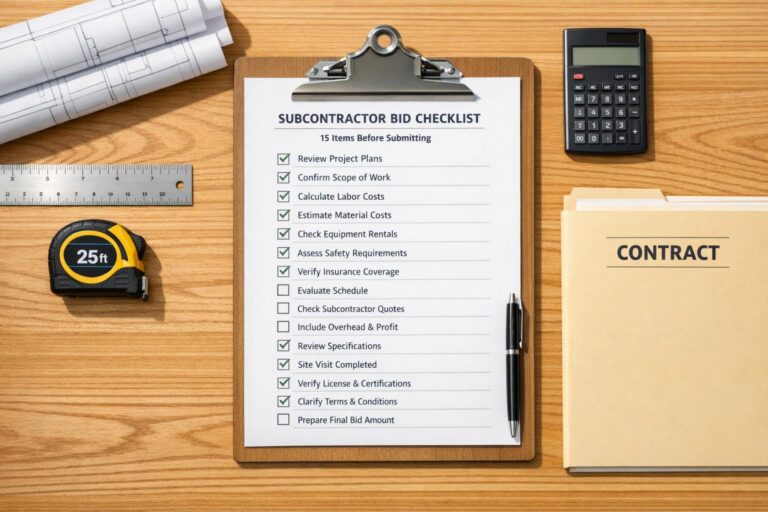
Finally, a robust review process is critical. A three-tiered approach – starting with a self-check using a standardized checklist, followed by a peer review of high-value items, and concluding with a management review – can catch the majority of mistakes.
By addressing these common challenges, subcontractors can significantly improve the accuracy of their bids.
9. How can subcontractors improve estimate accuracy and win more bids?
Now that we’ve identified the common pitfalls, here are some effective strategies to sharpen your estimates and secure more projects.
Start by building a historical cost database that tracks actual versus estimated costs for each project. Break this data down by CSI division to pinpoint recurring biases. For example, if your concrete work consistently runs over budget, apply a multiplier to future estimates for concrete.
Mandatory site visits are another must. Relying solely on photos or drawings can lead to costly surprises, with most estimates impacted by unforeseen site conditions. These surprises can drive up labor costs when crews encounter access issues, unexpected ground conditions, or other challenges. Use a standardized checklist during site visits to document critical details like staging areas, delivery constraints, and potential hazards.
Incorporate risk-based contingencies into your estimates. For well-defined projects, set aside 2–3% of the budget; for standard scopes, use 5–8%; and for renovations or riskier jobs, allocate 15–25%. This strategy helps you remain competitive while preserving your margins on more complex jobs.
Finally, leverage digital takeoff tools to minimize manual errors. Spreadsheet-based estimates are prone to mistakes like misreading scales or entering incorrect decimals, which can lead to significant cost overruns. Tools like ScopeTakeoff automate trade-specific calculations – whether it’s cubic yards for concrete, board counts for drywall, or tonnage for asphalt – reducing human error and providing a clear audit trail.
“A bid that misses actual costs a $2 million project means huge unexpected losses – enough to eliminate annual profit and threaten bonding capacity.” – ConstructionBids.ai
Conclusion
We’ve covered the essentials – from quantity takeoffs to fully burdened labor rates and addressing outdated pricing. The bottom line? Accuracy is the foundation of profitability. Even small errors can quickly eat into profits and put bonding capacity at risk. This need for precision is driving contractors to move away from traditional methods and embrace digital solutions.
It’s time to leave behind manual Excel spreadsheets and generic software. Digital tools eliminate common issues like scale errors, broken formulas, and the repetitive “starting from scratch” process that drags down your bidding efficiency. For example, ScopeTakeoff offers features like trade-specific assemblies, integrated PDF plan takeoffs, and automatic calculations for tasks such as measuring cubic yards, board counts, or tonnage. At $100 per person per month with no annual contract, it’s designed specifically for subcontractors who demand both speed and precision without dealing with overly complex enterprise software.
To stay competitive, implement these strategies now: adopt a three-tier review process, build a historical cost database, and leverage technology to handle more bids each week. Contractors who use structured processes and modern tools consistently report better results. In an industry where margins are tight and competition is fierce, these steps are essential to staying ahead.