
Checklist for Client-Focused Construction Proposals
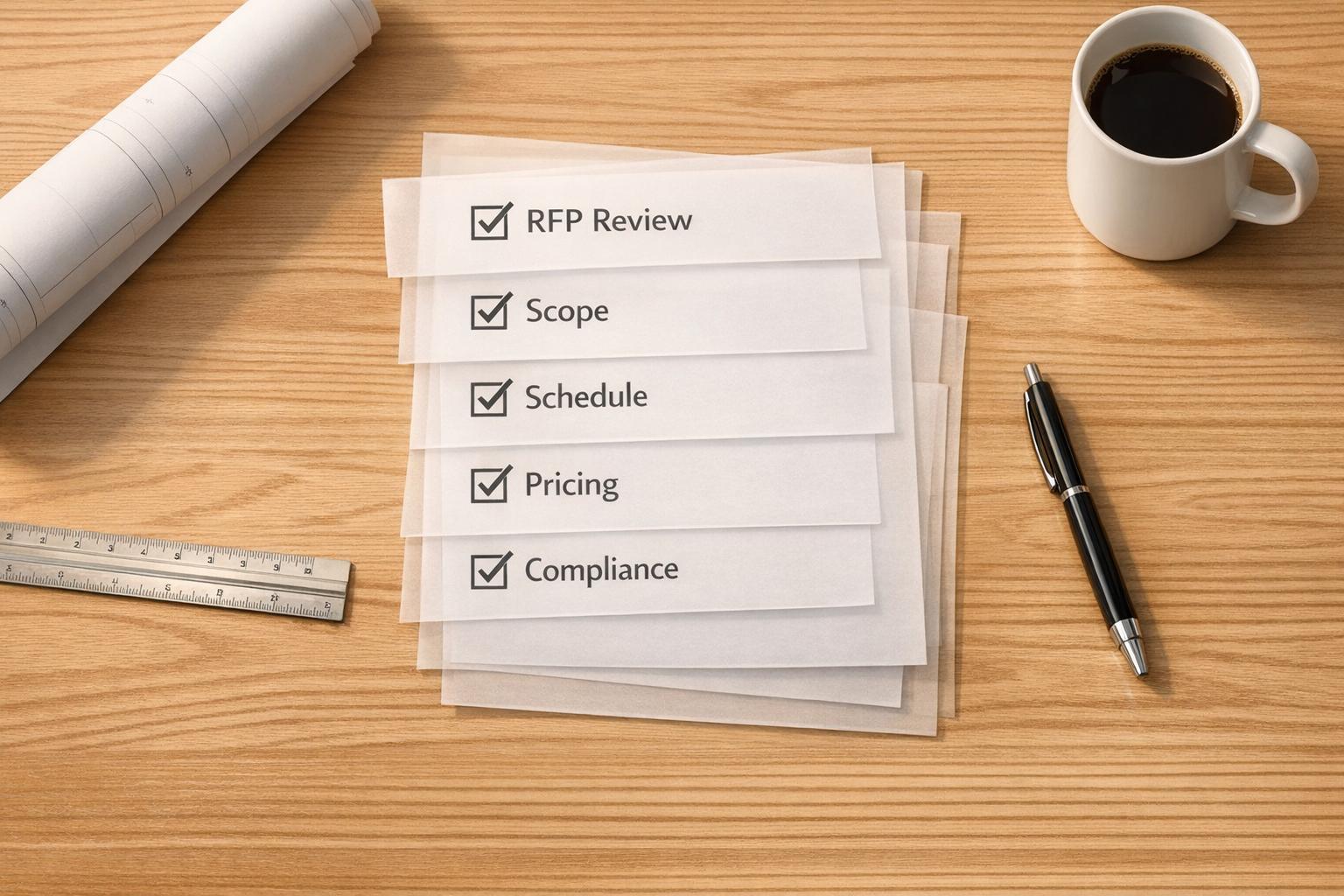
A successful construction proposal isn’t just about pricing – it’s about showing you understand the client’s needs and can deliver on them. Here’s what matters most:
- Preparation is key: Review the RFP, understand client priorities, and visit the site to identify challenges.
- Clarity wins: Use the client’s language, address their goals, and organize your proposal to match the RFP.
- Details matter: Include a clear scope of work, realistic schedules, and a transparent cost breakdown.
- Compliance counts: Ensure all required documents and certifications are included to avoid disqualification.
- First impressions last: Decision-makers often spend just 30 seconds scanning your proposal, so make every detail count.
Following a structured checklist ensures nothing is overlooked, increases your chances of winning contracts, and saves time for future bids. Now, let’s break it down step by step. You can also explore our construction estimating guides for more trade-specific advice.
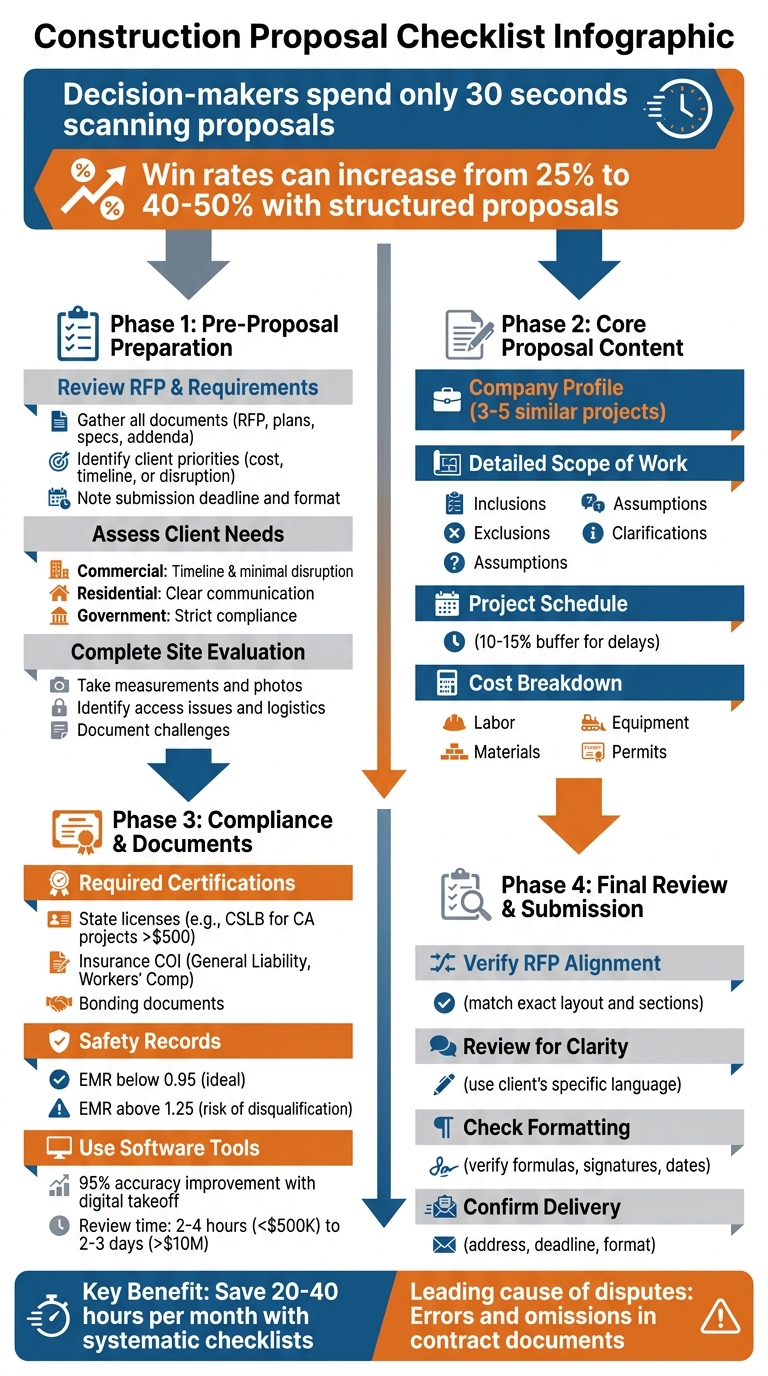
Construction Proposal Checklist: Pre-Proposal to Submission Process
What Should A Construction Proposal Include?
sbb-itb-4ee4ad4
Pre-Proposal Preparation Checklist
Getting the pre-proposal phase right is crucial. This step lays the groundwork for a proposal that speaks directly to the client’s needs and meets all project requirements. Skipping this preparation can lead to oversights like missed details, inaccurate pricing, or a proposal that doesn’t address the client’s priorities.
Review the Client’s RFP and Requirements
Start by gathering all the relevant documents: the RFP itself, project plans, specifications, standard form contracts, building codes, and insurance requirements. Be sure to check for any addenda or templates that may have been issued – missing these can disqualify your bid.
Dive into the technical and compliance details. Look for specifics like required materials, installation methods, quality standards, and certifications. This is also the time to identify what matters most to the client. Are they focused on cost, tight deadlines, or minimizing operational disruptions? Pay attention to how proposals will be scored; for instance, some clients may prioritize technical expertise and safety records over pricing.
Don’t leave submission logistics to the last minute. Note the exact deadline, the required format (hard copy, digital, or both), and whether signatures or bonding documents are needed. If anything is unclear, submit RFIs (Requests for Information) as soon as possible. To make your proposal easier to evaluate, consider organizing it in the same order as the RFP checklist.
| RFP Detail to Review | Purpose of Review |
|---|---|
| Addenda | Ensures your proposal reflects the most up-to-date project information |
| Insurance/Bonding | Confirms you meet the client’s financial and liability requirements |
| Exclusions | Clearly defines what you’re not responsible for, preventing scope disputes |
| Evaluation Criteria | Helps you understand whether the client values technical expertise, safety, or price most |
| Site Access/Logistics | Identifies constraints like delivery routes, crane placement, or night work requirements |
Once you’ve reviewed the RFP, shift your focus to understanding the client’s underlying goals.
Assess Client Needs
Take time to connect directly with the client to uncover their priorities. Ask questions like, “What’s your biggest concern about this project?” or “Have you worked with contractors on similar projects before? How did that go?” These conversations can reveal issues that aren’t obvious in the RFP.
Different types of clients have different priorities. For instance:
- Commercial clients often value timelines and minimal disruption to their operations.
- Residential clients typically appreciate clear communication and respect for their property.
- Government projects usually require strict compliance, certified processes, and financial stability.
Also, consider whether the client has goals tied to sustainability, social responsibility, or diversity. These elements are becoming increasingly common in RFPs and could influence how you tailor your proposal.
Once you’ve clarified the client’s needs, it’s time to verify the on-site conditions.
Complete Site Evaluation
An on-site visit is essential for creating an accurate proposal. These visits can uncover challenges that aren’t apparent in the project plans, such as underground obstacles, poor soil conditions, or access issues. They also help you plan for logistics like crane placement, material delivery routes, and laydown areas.
During your visit, take detailed measurements and photos. This documentation not only helps you prepare a precise cost estimate using trade-specific estimating software but also provides evidence to back up your pricing. It’s also a good opportunity to connect with on-site decision-makers and build relationships. A thorough evaluation helps you identify tasks like demolition or remediation, ensuring you account for all costs and avoid disputes over scope later on.
Core Proposal Content Checklist
Once you’ve wrapped up your pre-proposal preparation, it’s time to craft the actual proposal. This is where all your research and site evaluations come together to make a strong case for why your firm is the best choice. The proposal should be thorough, transparent, and directly tied to the client’s RFP requirements.
A well-organized proposal can push your win rate from the industry average of 25% to as high as 40–50%. To achieve this, ensure the following key components are addressed clearly.
Company Profile and Past Projects
Your company profile is your chance to establish trust and show why you’re the safest and most qualified option. Start with a concise overview of your firm’s history, project-specific expertise, and ability to handle the project’s scope.
Introduce key team members – such as the Project Manager, Superintendent, Safety Lead, and Estimator – by highlighting their relevant experience and certifications.
"Evaluators buy your people as much as your company" – Maila Kim, ConstructConnect
Highlight 3–5 projects similar in scale and type to the one you’re bidding on. Include details like contract values, delivery methods, completion dates, and measurable results. Use specific data to back up your claims – such as "completed 15 healthcare renovations exceeding $5M in value".
Additionally, include your state or local licenses, certifications, professional memberships, and any awards. Provide safety and quality records, such as your Experience Modification Rate (EMR), a summary of your safety protocols, and quality control measures. Back up your credibility with proof of financial stability (e.g., insurance certificates and bonding capacity) and include client testimonials or references.
Detailed Scope of Work
The scope of work is where you directly address the client’s needs, as identified during your pre-proposal research. This section should be crystal clear, as it outlines exactly what you will deliver.
Start by rephrasing the client’s objectives in your own words to show you understand their goals. Organize the scope logically, either by project phases (e.g., Demolition, Rough-In, Installation, Finishing) or by specific trades (e.g., Electrical, Plumbing, HVAC). Break it into four distinct categories:
- Inclusions: What your team will handle.
- Exclusions: What falls outside your responsibilities.
- Assumptions: Conditions or factors you’re basing your proposal on.
- Clarifications: Any gray areas that need explanation.
Be specific when describing materials and methods. For example, instead of saying "install HVAC system", specify "Install Carrier Infinity 5-ton variable-speed heat pump including new ductwork." Identify responsibilities, reference drawings and specs, and describe site logistics like access routes and storage areas. Address the change order process upfront to avoid disputes later.
Project Schedule and Milestones
A realistic and detailed schedule is key to meeting client expectations. Provide a baseline timeline that includes major milestones such as Notice to Proceed (NTP), mobilization, structural completion, substantial completion, and final completion. Clearly differentiate between "Substantial Completion" (when the space is usable) and "Final Completion" (when all punch list items are resolved).
Highlight critical path activities that could impact the overall timeline. Account for factors like permitting, long-lead materials, and seasonal/weather-related delays. To ensure credibility, build in a 10–15% buffer for unforeseen issues.
Explain how you’ll monitor progress – such as through look-ahead planning, production tracking, and regular updates – and outline strategies for recovering from delays, like resequencing tasks or adding shifts. Include details on construction hours, noise restrictions, and present the schedule using easy-to-read formats like phase-based timelines or milestone tables.
Cost Breakdown and Pricing
Break down your pricing in US dollars, detailing labor, materials, equipment, permits, and subcontractor costs. Organize costs by phase or trade to give the client a clear picture of where their money is going.
If your pricing is on the higher side, justify it by emphasizing benefits like faster completion times, premium materials, or superior safety standards. Tools such as ScopeTakeoff can help ensure precise estimates by automating calculations and generating professional outputs, making your bid preparation more efficient.
Include clear payment terms, such as the schedule for progress payments and retention percentages. Specify how long the pricing is valid and outline any conditions (e.g., material cost increases or scope changes) that could lead to price adjustments. This level of detail helps avoid misunderstandings and ensures both parties are on the same page.
Compliance and Supporting Documents Checklist
Submitting a proposal without all the required documents? That’s an instant ticket to disqualification. Procurement teams are strict about compliance, and even the best pricing won’t save a bid that’s missing key paperwork. This section will help you double-check that you’ve met all regulatory and contractual requirements before hitting "submit."
Include Required Certifications and Documents
Start by organizing all your compliance documents in the exact order and format specified in the RFP. This includes essential items like valid state licenses (e.g., California requires a CSLB license for projects over $500), specialty trade certifications, and your federal ID number. Also, don’t forget current Certificates of Insurance (COI) for General Liability and Workers’ Compensation, as well as bonding verification documents like bid bonds or performance bonds. Pro tip: Don’t just rely on the COI – call the insurance provider to confirm its authenticity and active coverage.
Many RFPs also require affidavits and compliance forms. These might include non-collusion affidavits, drug-free workplace certifications, equal opportunity statements, and minority-business participation plans. Additionally, include your Experience Modification Rate (EMR) and safety records. For most commercial projects, an EMR below 0.95 is ideal, while anything above 1.25 could lead to premium surcharges or even disqualification from high-risk jobs.
Once you’ve gathered everything, use digital tools to double-check for errors and ensure nothing gets overlooked.
Use Software Tools for Accuracy
Compliance is just one piece of the puzzle – accuracy in your calculations is equally critical. Modern estimating tools can help you avoid costly mistakes. For example, platforms like ScopeTakeoff make it easier to create accurate SOV exports and handle trade-specific calculations for areas like concrete, drywall, and HVAC. By automating calculations, these tools help reduce common errors, like broken spreadsheet formulas or missed data entries, especially under tight deadlines.
Before submitting, carefully inspect your spreadsheets for hidden rows or formula issues. Allocate enough review time based on your bid size: set aside 2–4 hours for bids under $500,000 and up to 2–3 days for bids exceeding $10 million. Digital takeoff tools can boost the accuracy of your quantity counts by as much as 95%.
Final Review and Submission Checklist
After completing your preparatory and core content reviews, this final step ensures your proposal is polished and meets every client requirement. It’s worth noting that decision-makers often spend only about 30 seconds scanning a proposal before deciding whether to dive deeper or move on to the next option.
Verify Alignment with RFP Requirements
Begin by structuring your proposal to match the RFP’s layout exactly – use the same order, section titles, and naming conventions. This approach allows evaluators to quickly confirm that you’ve addressed each requirement. Go over the RFP line by line, ensuring every question, requested document, and formatting rule has been addressed.
If the RFP outlines specific evaluation criteria (e.g., 40% qualifications, 30% approach, 30% cost), adjust your proposal’s emphasis accordingly. Have a project executive or principal-in-charge conduct a high-level review to ensure that contract language, fees, and strategies align with both your firm’s policies and the client’s objectives. This leadership review helps catch strategic issues that might slip past individual contributors.
| Review Category | Key Validation Steps |
|---|---|
| Compliance | Confirm all RFP questions are answered and required forms (e.g., bid forms, affidavits) are included. |
| Cohesion | Ensure tone and voice are consistent, technical terminology is standardized, and branding (logos, colors) is uniform. |
| Strategy | Verify the executive summary addresses the client’s priorities and the "Why Us" section highlights your unique strengths. |
| Logistics | Account for delivery method (electronic or hard copy), confirm pricing validity period, and check for correct units and currency. |
Once the structure is locked in, shift your attention to ensuring the language speaks directly to the client.
Review for Clarity and Client-Focused Language
Test your proposal by removing the client’s name and project details. If it could apply to another client, it needs to be reworked. Your proposal should reflect the client’s language and priorities – use their specific terminology, concerns, and goals as outlined in the RFP or during earlier discussions.
Replace generic phrases with precise descriptions. For example, instead of saying "install new HVAC system", specify "install Carrier Infinity 5-ton variable-speed heat pump with digital programmable thermostats in six zones." Instead of "improved efficiency", use something like "reduced month-end close from 15 days to 6 days." This level of detail demonstrates your understanding and builds trust.
Have someone outside the proposal team do a final read-through. A fresh perspective can catch jargon, placeholder text, or formatting issues that others might overlook. Use a document search to locate any remaining brackets ("[ ]"), placeholders like "TBD" or "DRAFT", and other incomplete sections. Keep your executive summary concise – under 300 words – to convey confidence and respect the client’s time.
Once the language is refined, move on to a final check of formatting and completeness.
Check Formatting and Completeness
To ensure accuracy, verify that all blanks on the bid form are filled, all addenda are acknowledged, and required signatures are included. Make sure you’ve attached original bid bonds, insurance certificates, non-collusion affidavits, and any project-specific certifications.
Double-check spreadsheet formulas for errors, and confirm that all extensions (quantity × unit price) and totals are correct. Use imperial units, US currency formatting ($), and MM/DD/YYYY date format consistently throughout the document. Include a pricing expiration date (typically 30 days) to protect against material cost changes.
Allocate review time based on the size of the bid: 2–4 hours for smaller proposals, 4–8 hours for mid-sized ones, and up to 2 days for large projects. If submitting a hard copy, plan extra time for printing, binding, and any custom elements like tabs or covers.
Finally, confirm the delivery address and submission deadline. Late submissions are usually disqualified, no matter how competitive the bid. If you’re using estimating tools like ScopeTakeoff, run a final check to ensure all trade-specific calculations and formatting are accurate before exporting. Overlooking even minor details could cost you the project.
Conclusion
A detailed checklist serves as your roadmap for crafting client-centered proposals. It turns a standard bid into a tailored presentation that can double your chances of winning contracts, boosting win rates from 25% to as high as 50%.
Clients value confidence over cost alone. By using a checklist to address every requirement, define exclusions, and ensure accuracy, you remove the uncertainties that often lead to disputes. It’s worth noting that errors and omissions in contract documents are the leading cause of construction disputes in North America. A methodical approach helps you sidestep these expensive pitfalls before they arise.
"Winning proposals aren’t just about having the lowest price. They’re about communicating value, demonstrating expertise, and building trust." – Takeoff Convert
From outlining a clear scope to precise pricing, each checklist item enhances the professionalism of your proposal. Not only do checklists help secure more projects, but they also save you 20–40 hours per month, freeing up time to refine future submissions. When deadlines are tight and teamwork is essential, a consistent checklist ensures no detail is overlooked.
Here’s the bottom line: decision-makers spend just 30 seconds scanning your proposal before deciding whether to dive deeper. That means every detail counts in making a strong first impression. A complete and verified proposal shows why you’re the contractor they can trust.
FAQs
What makes a construction proposal client-focused?
A construction proposal centered on the client places their needs, goals, and expectations at the forefront. It highlights the contractor’s capability to complete the project safely, on schedule, and within the agreed budget. Essential components include a comprehensive project scope, clear and transparent pricing, relevant qualifications, and customized technical plans. By emphasizing expertise, addressing potential risks, and aligning with the client’s priorities, such a proposal fosters trust and improves the chances of securing the project.
What should I include in a scope of work to avoid disputes?
When creating a scope of work, clarity is key to avoiding disputes. Be specific about the tasks involved, the materials required, and what is not included. Clearly outline inclusions and exclusions, refer to relevant project standards, and make sure any changes are documented with signed change orders. A detailed breakdown of responsibilities and deliverables helps everyone stay on the same page and reduces the chances of miscommunication.
How can I catch compliance issues before submitting a bid?
To spot compliance issues before submitting a bid, it’s essential to set up a thorough review process. A checklist can be a lifesaver here – double-check math accuracy, ensure the scope is complete, confirm specifications are met, verify pricing is correct, and make sure all required documentation is included. By making this review a regular part of your workflow, you can catch mistakes early and avoid the headaches of non-compliance or expensive errors.