
Ultimate Guide to Quantity Takeoff Basics
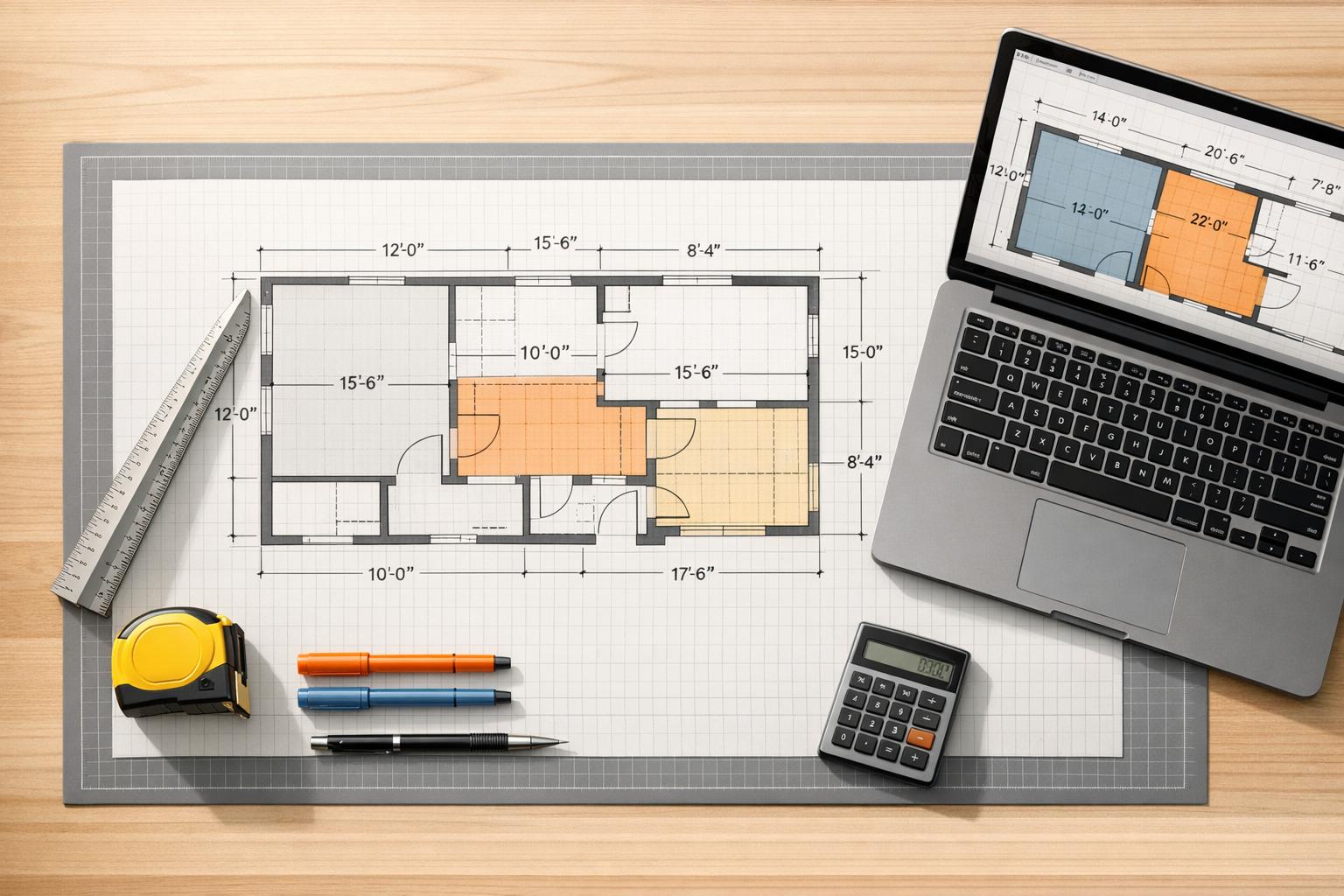
Quantity takeoff (QTO) is the process of breaking down project plans into detailed measurements of materials, labor, and equipment. A precise QTO ensures accurate cost estimates, competitive bids, and reduced waste. Errors in takeoff can lead to mispricing, rework, and profit loss.
Key Takeaways:
- What it is: QTO transforms blueprints into measurable quantities for materials, labor, and tools.
- Why it matters: Incorrect estimates can lead to cost overruns or uncompetitive bids.
- How it’s done: Measurements include area (e.g., flooring), volume (e.g., concrete), linear (e.g., piping), and count (e.g., fixtures).
- Tools: Digital tools like ScopeTakeoff improve speed and accuracy, reducing errors by up to 98%.
Accurate QTO is the foundation of successful construction projects. Let’s explore how to get it right.
What is a Quantity Takeoff in Construction? (Explained for Beginners)
sbb-itb-4ee4ad4
Types of Quantity Takeoff Measurements
When it comes to Quantity Takeoff (QTO), choosing the right measurement method is everything. Each material requires a specific approach, and this choice directly impacts the accuracy of your estimates and the competitiveness of your bids.
Area takeoffs focus on surface measurements, calculated as length × width. This method works for materials like drywall, flooring, roofing, paint, and carpet. For instance, if a room measures 12 feet by 15 feet, you’ll need 180 square feet of flooring. Always double-check your scale against a known dimension on the drawing to avoid errors.
Volume takeoffs add height (or depth) to the equation, using the formula: length × width × height. This is essential for materials that occupy three-dimensional spaces, like concrete, earthwork, asphalt, and gravel. In the U.S., these are typically measured in cubic yards. For example, a concrete slab measuring 20 feet by 30 feet by 0.5 feet (6 inches) would require approximately 11.1 cubic yards of concrete.
Linear takeoffs are all about length, expressed in linear feet. This method is perfect for materials like pipes, electrical wiring, baseboards, gutters, and steel beams. For example, if a plumbing line runs from one end of a building to the other, it’s measured in linear feet rather than area or volume.
Count takeoffs involve tallying individual items – things like doors, windows, light fixtures, and plumbing fixtures. If your plan shows 15 light fixtures, you simply count 15 units.
| Measurement Type | Calculation Method | Common Applications | Unit of Measure |
|---|---|---|---|
| Area | Length × Width | Drywall, flooring, roofing, paint | Square Feet (SF) |
| Volume | Length × Width × Height | Concrete, earthwork, asphalt | Cubic Yards (CY) |
| Linear | Length | Pipes, wiring, trim, baseboards | Linear Feet (LF) |
| Count | Individual Tally | Doors, windows, fixtures | Each (EA) |
Some materials require alternative measurements. For example, sand or rebar might be measured by weight (tons or pounds). To keep your estimates aligned with procurement practices, match your takeoff method to how the supplier sells the material. For instance, while drywall is measured in square feet during takeoff, it’s often ordered by the sheet. This attention to detail ensures your estimates reflect actual purchasing conditions.
How to Perform Quantity Takeoff: Step-by-Step
Review Drawings and Specifications
Begin by gathering the entire set of project plans – this includes floor plans, elevations, sections, and specifications. Narrow your focus to pages relevant to your trade to save time. For instance, a drywall contractor doesn’t need to analyze HVAC ductwork layouts, and an electrician can skip over concrete foundation details.
Before diving into measurements, check for revision clouds and addenda to ensure you’re working with the latest updates. Using outdated plans can seriously impact your bid. Take a close look at the legend and abbreviation list – misinterpreting terms like "TYP" (typical) as a one-off or overlooking "NIC" (not in contract) can lead to errors that cost you both time and money.
Once you’re confident in the accuracy of your drawings, organize your data by trade or project phase. This will help streamline the takeoff process and keep things manageable.
Organize Work by Trade or Phase
Start by creating a master list of everything you’ll need – materials, fixtures, and other products. Then, break the takeoff into sections based on trade or project phase. For larger projects, consider dividing the work into smaller, more manageable pieces, such as individual floors, buildings, or construction phases. This approach minimizes mistakes and helps maintain focus.
Consider using assembly-based takeoffs to simplify your process. Instead of counting each component – like studs, plates, and nails – individually, measure "linear feet of exterior wall" and let the assembly account for all related items. This ensures you don’t overlook smaller but essential components like anchors, fasteners, or brackets. Grouping related items in this way also sets the stage for more accurate measurements in the next step.
Measure and Verify Quantities
With your data organized, move on to measuring and verifying quantities with precision.
Calibrate the scale every time you start. Use a known dimension, such as a standard door width (typically 3 feet), to set the scale correctly. Never rely on the accuracy of a PDF file without verification – dimensions can sometimes be off, so always double-check with a reliable reference.
As you work through the drawings, use a systematic approach – such as reviewing from left to right or top to bottom – and color-code items as you count them. This helps avoid double-counting or missing anything. Measure similar items in sequence before moving on to different types of measurements to stay organized.
Don’t forget to factor in waste. While plans show "net in place" quantities, real-world construction involves overages for cutting, waste, and potential errors. Clearly document any assumptions you make about inclusions or exclusions – this can protect your profit margins and back up your final bid if questions arise.
Manual vs. Digital Quantity Takeoff Methods
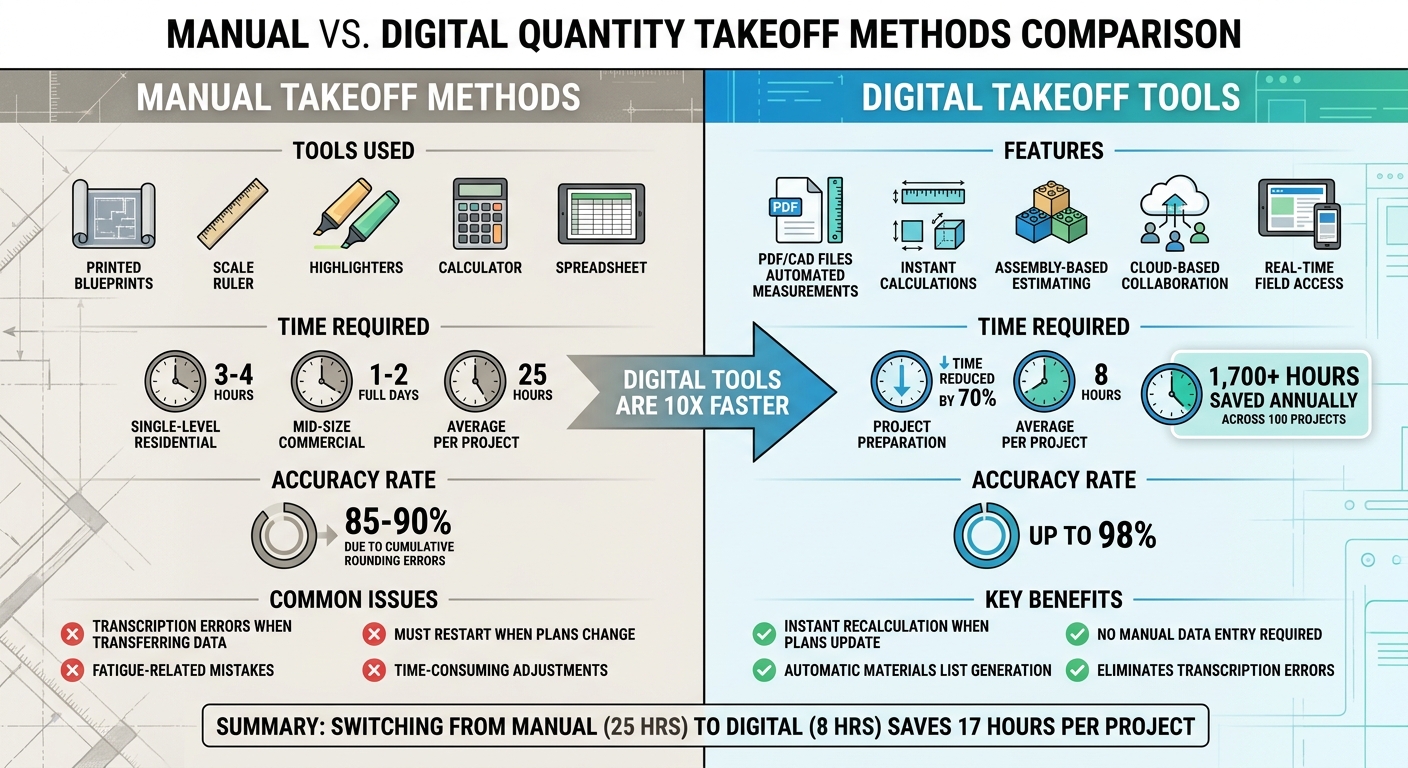
Manual vs Digital Quantity Takeoff: Time, Accuracy and Cost Comparison
Manual Takeoff Methods
Manual takeoff relies on traditional tools like printed blueprints, scale rulers, highlighters, and calculators to transfer measurements from paper plans into spreadsheets. While this method has been a go-to approach in the industry for decades, it comes with several challenges. For instance, completing a takeoff for a single-level residential project can take 3–4 hours, while a mid-size commercial project might demand 1–2 full days.
One major drawback of manual methods is the potential for cumulative rounding errors, which can lower accuracy to around 85–90%. Additionally, when project plans change, manual takeoffs often require starting from scratch or making time-consuming adjustments, which slows down the bidding process. There’s also the risk of transcription errors when transferring data from paper to spreadsheets, not to mention the mistakes caused by fatigue, such as miscounting fixtures on complex drawings.
Benefits of Digital Takeoff Tools
Digital takeoff tools simplify the process by automating measurements directly from PDF or CAD files. These tools can instantly calculate dimensions like linear feet, square footage, or cubic volume, increasing accuracy to as much as 98% while cutting project preparation time by up to 70%.
One standout feature of digital tools is assembly-based estimating. For example, measuring the length of a wall can automatically generate a materials list, including studs, drywall sheets, fasteners, and even labor hours. When plans are updated, digital tools recalculate instantly, eliminating the need to redo the entire takeoff. A switch from manual methods (25 hours per project) to digital tools (8 hours per project) has saved companies over 1,700 hours annually across 100 projects. On top of that, these tools enable cloud-based collaboration and real-time access for teams in the field.
These advantages make digital tools like ScopeTakeoff a game-changer for quantity takeoff.
How ScopeTakeoff Improves QTO
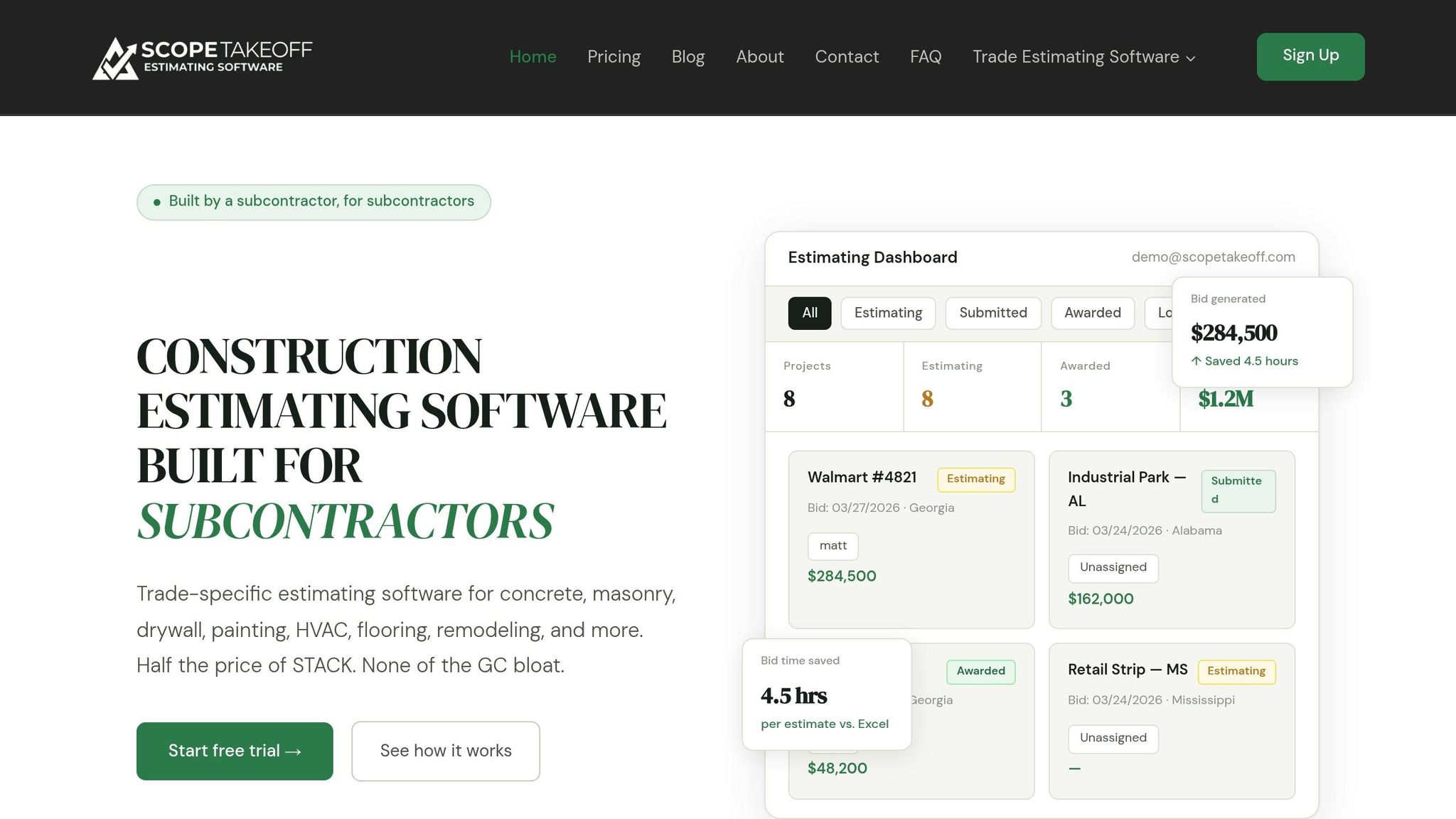
ScopeTakeoff takes digital quantity takeoff to the next level with trade-specific assembly libraries designed for over 10 trades, including concrete, masonry, drywall, painting, HVAC, flooring, remodeling, landscaping, roofing, and asphalt. These libraries come with pre-built configurations that account for all necessary materials and labor.
The platform’s PDF plan takeoff feature allows users to work directly from digital plans, performing automatic trade calculations and eliminating the need for manual data entry. Multi-entity profiles make it easy to manage estimates across various business divisions within one account, while team estimating tools enable real-time collaboration on bids. Features like unlimited projects, client-facing proposal exports, and bid review workflows streamline every step of the process – from initial measurements to final proposals – all for $100 per person per month.
Best Practices and Common Mistakes
Best Practices for Accurate Takeoffs
To ensure precision during takeoffs, these strategies can refine your process and minimize errors.
Verify scale calibration by using a known measurement, like a 3-foot door, to confirm accuracy. This simple step, as highlighted in the "Measure and Verify Quantities" section, can prevent significant errors that might otherwise snowball throughout your estimate.
Work systematically by sticking to a consistent approach – whether it’s left-to-right, top-to-bottom, or another logical sequence. Using color-coding while counting items can help you avoid double-counting or missing anything. Cross-checking floor plans with elevations, sections, and specifications is also critical. Overlooking details in the specs could lead to costly mistakes, like pricing PVC when copper is required.
Organize by assemblies rather than counting individual components. For example, group items like studs, plates, and fasteners together for a wall. This method reduces the chances of missing smaller items, such as anchors or brackets. Don’t forget to apply waste factors to account for real-world needs like cutting, breakage, or lap lengths, as plans typically show "net in place" quantities that don’t reflect actual usage.
Document your assumptions to clarify what’s included and excluded in your takeoff. Pay close attention to the drawing legend for abbreviations like "TYP" (typical, requiring multiplication) or "NIC" (not in contract), as these can significantly impact your calculations if misinterpreted.
Common Mistakes to Avoid
Even with careful planning, certain missteps can throw off your estimates. Here are some of the most frequent errors to watch out for.
Rushing through measurements is a common problem, especially when deadlines are tight. This can result in misread dimensions or skipped items. Always double-check that you’re working with the latest set of drawings, including any addenda or revisions. Overlooking updates can lead to quantities that don’t align with the final project scope.
Ignoring site conditions can be a costly oversight. Relying solely on 2D plans without considering factors like site slope, drainage, or soil quality can result in unexpected costs, such as the need for additional fill material or retaining walls. Be sure to account for these physical variables, even if they’re not immediately apparent on the plans.
Focusing only on primary items often leads to missing essential accessories. Neglecting to account for waste, cutting, or errors can also mean that the quantities derived from the plans fall short of actual field requirements. Interestingly, about 85% of construction professionals still use Excel for estimating, which increases the likelihood of calculation errors and makes revisions more cumbersome.
"A single scope or spec error can ripple into shortages, rework, and delays. Catching it early in takeoff keeps the budget and schedule on track." – Beam AI
Conclusion
Quantity takeoff serves as the backbone of every estimate, and mistakes here can have a domino effect on material costs, labor hours, and overall profitability. Dustin Elliott, Director of Product Operations at Buildxact, sums it up perfectly:
"If the quantities are wrong, everything downstream is wrong too: material costs are off, labor hours don’t match reality, and the price you bid either erodes margin or prices you out of the job".
This highlights why modern tools are no longer optional – they’re essential. Digital takeoff methods have revolutionized subcontractor estimating, offering speeds up to 10 times faster than manual methods. Even more impressive, AI-powered tools can handle tasks in just 20 to 30 minutes that would traditionally take 6 to 8 hours. And this isn’t just about speed – automation also slashes the chances of human error, a common issue with manual processes.
ScopeTakeoff is one solution leading this shift, offering trade-specific assembly libraries, automated calculations, PDF plan takeoff, unlimited project capacity, and team collaboration tools – all for $100 per person per month.
But tools alone aren’t enough. Accurate takeoffs depend on pairing the right technology with disciplined workflows. For instance, calibrate your scale using a known dimension (like a door width), measure drawings systematically, factor in waste, and always cross-check specifications with floor plans. These habits ensure you’re getting the most out of your digital tools.
Considering that planning errors can drain up to 20% of a project’s value, mastering the basics of takeoff and embracing digital solutions is key to reducing risks and safeguarding profits.
FAQs
How do I choose the right QTO measurement type?
Choosing the right QTO (Quantity Takeoff) measurement type hinges on the materials you’re working with and the project’s scope. Typical measurement types include linear feet, square feet, cubic yards, or piece counts, depending on the material. For instance, concrete is often measured in cubic yards, while framing materials might be calculated in linear feet. Always factor in the specific needs of your trade and leverage digital tools to streamline the process and maintain precision.
What waste factor should I add to my takeoff?
For roofing projects, it’s common to plan for 10-15% extra material to account for waste. In general construction, adding an additional 5-10% to your material estimates is a standard practice. These allowances help ensure you have enough materials on hand to avoid shortages during installation.
What should I verify before starting a takeoff?
Before beginning a takeoff, it’s crucial to double-check several details to maintain both accuracy and efficiency. Start by carefully reviewing the project plans and specifications to fully grasp the scope of work. Make sure all drawings are current and complete, and verify that the correct measurement units and scale are configured.
Don’t forget to factor in waste percentages and overage allowances to avoid shortfalls later. Lastly, ensure that all required tools and software are prepared and functioning properly. This preparation helps streamline the process and minimizes the risk of mistakes.